
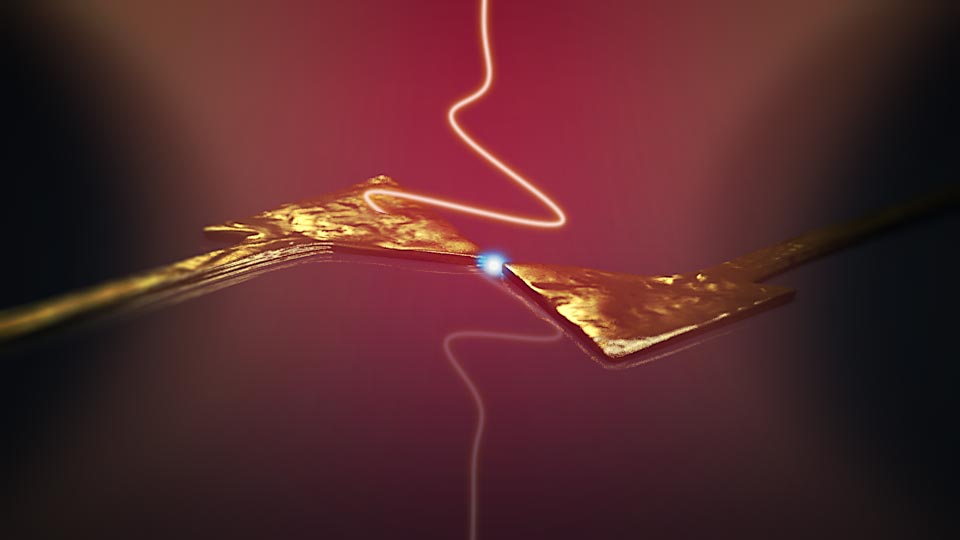
A European team of researchers including physicists from the University of Konstanz has found a way of transporting electrons at times below the femtosecond range by manipulating them with light. This could have major implications for the future of data processing and computing.
Contemporary electronic components, which are traditionally based on silicon semiconductor technology, can be switched on or off within picoseconds (i.e. 10-12 seconds). Standard mobile phones and computers work at maximum frequencies of several gigahertz (1 GHz = 109 Hz) while individual transistors can approach one terahertz (1 THz = 1012 Hz). Further increasing the speed at which electronic switching devices can be opened or closed using the standard technology has since proven a challenge. A recent series of experiments – conducted at the University of Konstanz and reported in a recent publication in Nature Physics – demonstrates that electrons can be induced to move at sub-femtosecond speeds, i.e. faster than 10-15 seconds, by manipulating them with tailored light waves.
“This may well be the distant future of electronics,” says Alfred Leitenstorfer, Professor of Ultrafast Phenomena and Photonics at the University of Konstanz (Germany) and co-author of the study. “Our experiments with single-cycle light pulses have taken us well into the attosecond range of electron transport”. Light oscillates at frequencies at least a thousand times higher than those achieved by purely electronic circuits: One femtosecond corresponds to 10-15 seconds, which is the millionth part of a billionth of a second. Leitenstorfer and his team from the Department of Physics and the Center for Applied Photonics (CAP) at the University of Konstanz believe that the future of electronics lies in integrated plasmonic and optoelectronic devices that operate in the single-electron regime at optical – rather than microwave – frequencies. “However, this is very basic research we are talking about here and may take decades to implement,” he cautions.
A question of controlling light and matter
The challenge for the international team of theoretical and experimental physicists from the University of Konstanz, the University of Luxembourg, CNRS-Université Paris Sud (France) and the Center for Materials Physics (CFM-CSIC) and Donostia International Physics Center (DIPC) in San Sebastián (Spain) who collaborated on this project was to develop an experimental set-up for manipulating ultrashort light pulses at femtosecond scales below a single oscillation cycle on the one hand, and to create nanostructures suited for high-precision measurements and manipulation of electronic charges on the other. “Fortunately for us, we have first-class facilities at our disposal right here in Konstanz,” says Leitenstorfer, whose team conducted the experiments. “The Center for Applied Photonics is a world-leading facility for the development of ultrafast laser technology. And thanks to our Collaborative Research Center 767 ‘Controlled Nanosystems: Interaction and Interfacing to the Macroscale’, we have access to extremely well-defined nanostructures that can be created and controlled at the nanometer scale.”
Superfast electron switch
The experimental set-up developed by Leitenstorfer’s team and coordinating author Daniele Brida (formerly leader of an Emmy Noether research group at the University of Konstanz, now professor at the University of Luxembourg) involved nanoscale gold antennae as well as an ultrafast laser capable of emitting one hundred million single-cycle light pulses per second in order to generate a measurable current. The bowtie design of the optical antenna allowed for a sub-wavelength and sub-cycle spatio-temporal concentration of the electric field of the laser pulse into the gap of a width of six nm (1 nm = 10-9 meters).
As a result of the highly nonlinear character of electron tunneling out of the metal and acceleration over the gap in the optical field, the researchers were able to switch electronic currents at speeds of approximately 600 attoseconds (i.e. less than one femtosecond, 1 as = 10-18 seconds). “This process only occurs at time scales of less than half an oscillation period of the electric field of the light pulse,” explains Leitenstorfer – an observation that the project partners in Paris and San Sebastián were able to confirm and map out in detail by means of a time-dependent treatment of the electronic quantum structure coupled to the light field.
The study opens up entirely new opportunities for understanding how light interacts with condensed matter, enabling observation of quantum phenomena at unprecedented temporal and spatial scales. Building on the new approach to electron dynamics driven at the nanoscale by optical fields that this study affords, the researchers will move on to investigate electron transport at atomic time and length scales in even more sophisticated solid-state devices with picometre dimensions.
Facts:
- International team of researchers including scientists from the University of Konstanz manages to control the ultrafast motion of electrons in a metallic nanocircuit by manipulating them with light.
- New method for speeding up the way electronic devices may be switched in the future.
Reference: “Sub-femtosecond electron transport in a nanoscale gap” by Markus Ludwig, Garikoitz Aguirregabiria, Felix Ritzkowsky, Tobias Rybka, Dana Codruta Marinica, Javier Aizpurua, Andrei G. Borisov, Alfred Leitenstorfer and Daniele Brida, 23 December 2019, Nature Physics.
DOI: 10.1038/s41567-019-0745-8
Funded by the Spanish Ministry of Science, Innovation and Universities (MICINN), Eusko Jaurlaritza (Basque Government), the German Research Foundation (DFG), the EC | EU Framework Programme for Research and Innovation H2020 | H2020 Priority Excellent Science | H2020 European Research Council (H2020 Excellent Science – European Research Council).
Never miss a breakthrough: Join the SciTechDaily newsletter.
Follow us on Google and Google News.
6 Comments
This research result may be great. However it is not clear from this article if-and-how the thermal energy is being dissipated or accumulated. Is this charge displacement adiabatic? Is it superconductive? As you ‘move’ an electric charge you are producing an electric current. In electrically resistive mediums an electric current produces heat. The faster the current (electron in this case) moves the more intense the heat. What size of heat-sink would be required in a practical application? What coolant would be required in a practical application, i.e. liquid nitrogen? liquid helium?
Imagine it looks like control crystal from stargate universe
It’s clumsy science-reporting to refer to translational speeds in terms of temporal units.
And what use will all this be? I.e. what practical applications might this technology have?
I can’t wait for the future of gaming with entire devices running this speed!
Light isn’t a wave