
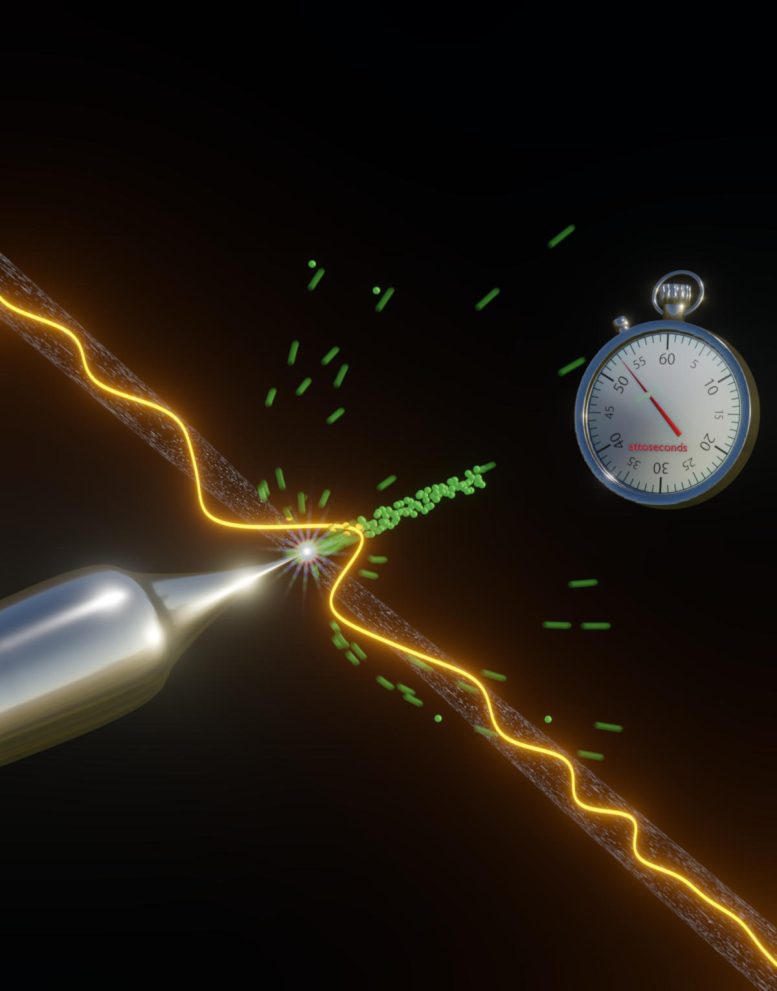
Researchers produced ultrafast electron bursts using light field synthesis. It could revolutionize electronics and material sciences by enabling faster circuits and precise atomic studies.
Have you ever wondered why your computer and other electronic devices sometimes perform quickly and other times slowly? It all boils down to the speed at which electrons, the smallest particles in our microcosm, flow out from the tiny leads within the transistors of electronic microchips and create pulses. Developing methods to increase this speed is crucial for pushing electronics and their applications to their maximum performance potential.
But what is the shortest time possible for electrons to stream from a tiny metal lead in an electronic circuit?
By using extreme short laser flashes, a team of researchers led by Professor Eleftherios Goulielmakis, head of the group Extreme Photonics of the institute for Physics at the University of Rostock, and collaborators at the Max Planck Institute of Solid State Research in Stuttgart used state-of-the-art laser pulses to eject electrons from a tungsten nanotip and to generate the shortest electron burst to date. The findings were recently published in the journal Nature.
Whereas it has long been known that light can release electrons from metals—Einstein was the first to explain how—the process is extremely hard to manipulate. The electric field of light changes its direction about a million billion times per second making it challenging to control the way it rips off electrons from the surface of metals.
Light Field Synthesis
To overcome this challenge, the Rostock scientists and their co-workers used a modern technology that was earlier developed in their group—light field synthesis—which allowed them to shorten a light flash to less than a full swing of its own field. In turn, they used these flashes to illuminate the tip of a tungsten needle to knock electrons free into a vacuum.
“Using light pulses that comprise merely a single cycle of its field, it is now possible to give electrons a precisely controlled kick to set them free from the tungsten tip within a very short time interval,” explains Eleftherios Goulielmakis, head of the research group.
But the challenge could not be overcome unless the scientists also found a way to measure the brevity of these electron bursts. To deal with this hurdle, the team developed a new type of camera that can take snapshots of the electrons during the short time the laser is pushing them out from the nanotip and into the vacuum.
”The trick was to use a second, very weak, light flash,” said Dr. Hee-Yong Kim, the leading author of the new study. “This second laser flash can gently perturb the energy of the electron burst to find out how it looks like in time,” he adds. “It is like the game ‘What’s in the box?’ where players try to identify an object without looking at it. but just by turning it around to feel its shape with their hands,” he continues.
Future Electronics
But how could this technology be used in electronics? “As technology advances rapidly, it is reasonable to expect the development of microscopic electronic circuits in which electrons travel in a vacuum space among closely packed leads to prevent obstacles that slow them down”, says Goulielmakis. “Using light to eject electrons and drive them among these leads could speed up future electronics by several thousand times today’s performance”, he further explains.
But the researchers believe that their newly developed methodology will be used directly for scientific purposes. “Ejecting electrons from a metal within a fraction of a light’s field cycle dramatically simplifies the experiments and allows us to use advanced theoretical methods to understand the emission of electrons in ways that were not previously possible,” says Professor Thomas Fennel, a coauthor in the new publication.
“Since our electron bursts provide excellent resolution for taking snapshots of electronic and atomic motions in materials, we plan to use them to acquire a deep understanding of complex materials to facilitate their applications in technology,” Goulielmakis concludes.
Reference: “Attosecond field emission” by H. Y. Kim, M. Garg, S. Mandal, L. Seiffert, T. Fennel, and E. Goulielmakis, 25 January 2023, Nature.
DOI: 10.1038/s41586-022-05577-1
Never miss a breakthrough: Join the SciTechDaily newsletter.
Follow us on Google and Google News.