
Close Menu
    Facebook X (Twitter) Instagram
    SciTechDaily
    • Biology
    • Chemistry
    • Earth
    • Health
    • Physics
    • Science
    • Space
    • Technology
    Facebook X (Twitter) Pinterest YouTube RSS
    SciTechDaily
    Home»Physics»Engineers Show Tiny Liquid Drops Can Make Solids Stiffer
    Physics

    Engineers Show Tiny Liquid Drops Can Make Solids Stiffer

    By Rase McCray, Yale UniversityDecember 16, 2014No Comments3 Mins Read
    Facebook Twitter Pinterest Telegram LinkedIn WhatsApp Email Reddit
    Share
    Facebook Twitter LinkedIn Pinterest Telegram Email Reddit
    Engineers Stiffen Solids with Liquid Inclusions
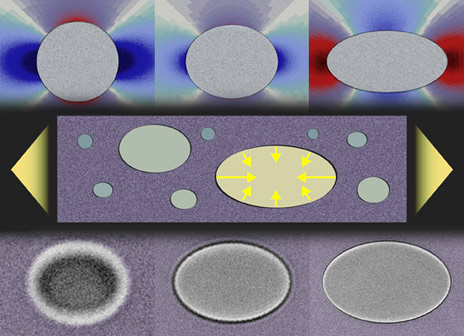
    Tiny liquid droplets embedded in a solid can make it stronger due to surface tension. Credit: Yale University

    Engineers from Yale University have strengthened solid materials by using very small embedded liquid droplets.

    Engineers at Yale University have discovered that the stiffness of liquid drops embedded in solids has something in common with Goldilocks: While large drops of liquids are softer than the solid that surrounds them, extremely tiny drops of liquid can actually be stiffer than certain solids. But when they’re “just right,” the liquid drops have the exact same stiffness as the surrounding solid.

    The key is a liquid’s tendency to have as small a surface as possible — a contractile force known as “surface tension” that, for example, allows a cup of water to be filled slightly above the brim without spilling.

    “Usually, replacing parts of a solid with liquid only makes a material weaker,” said associate professor of mechanical engineering and materials science Eric Dufresne, principal investigator of the research that was published on December 15 in Nature Physics. “But when the embedded liquid droplets are very small, surface tension makes them so stiff that they can actually make a solid stronger.”

    Dufresne’s team demonstrated this counterintuitive effect by embedding liquid drops as small as a micron in diameter into silicone. The researchers then stretched the silicone, causing the liquid to stretch as well.

    When the liquid drops in the silicone were large enough, they deformed easily and weakened the material. However, very small droplets resisted deformation and strengthened the surrounding material. When many tiny liquid drops were embedded in the silicone, the resulting material was as much as 30% stronger than the pure silicone, according to the researchers.

    “It turns out that the importance of surface tension is inversely proportional to the size,” said Dufresne, who is also the director of Yale’s Center for Engineering Innovation & Design. “So what’s just a negligible force for big things becomes a strong force for very small things — which in turn can strongly affect the material as a whole.”

    Dufresne suggested that these results provide engineers with “a new knob to turn” to control the properties of composite materials. For example, droplets of just the right size can mimic the mechanical properties of the surrounding solid; these “cloaked” droplets could provide additional optical or electrical functionality, without sacrificing mechanical performance.

    Reference: “Stiffening solids with liquid inclusions” by Robert W. Style, Rostislav Boltyanskiy, Benjamin Allen, Katharine E. Jensen, Henry P. Foote, John S. Wettlaufer and Eric R. Dufresne, 15 December 2014, Nature Physics.
    DOI: 10.1038/nphys3181

    Additional authors of the research include Robert W. Style, Rostislav Boltyanskiy, Benjamin Allen, Katharine E. Jensen, and John S. Wettlaufer of Yale, as well as Henry P. Foote of the University of North Carolina-Chapel Hill.

    Never miss a breakthrough: Join the SciTechDaily newsletter.
    Follow us on Google and Google News.

    Materials Science Yale University
    Share. Facebook Twitter Pinterest LinkedIn Email Reddit

    Related Articles

    Scientists Replicate Surface Structures at the Atomic Scale

    The Amazing Properties of Cornstarch and Water

    Researchers Find a Way to Tap into Long-Lived Sound Waves in Glass

    Orbital Engineering, Yale Engineers Change Electron Trajectories

    A New Understanding of How to Trap Light

    SLAC Scientists Complete Terahertz Experiment

    LCLS Low-Energy Test Just Shy of the 284-Electronvolt Carbon Edge

    High-Energy Radiation is Refracted Setting the Stage for Gamma Optics

    Yale Physicists Take Significant Step in the Development of Quantum Computing

    Leave A Reply Cancel Reply

    • Facebook
    • Twitter
    • Pinterest
    • YouTube

    Don't Miss a Discovery

    Subscribe for the Latest in Science & Tech!

    Trending News

    Bone-Strengthening Discovery Could Reverse Osteoporosis

    Scientists Uncover Hidden Trigger Behind Stem Cell Aging

    Scientists Find Way to Reverse Fatty Liver Disease Without Changing Diet

    Could Humans Regrow Limbs? New Study Reveals Promising Genetic Pathway

    Scientists Reveal Eating Fruits and Vegetables May Increase Your Risk of Lung Cancer

    Scientists Reverse Brain Aging With Simple Nasal Spray

    Scientists Uncover Potential Brain Risks of Popular Fish Oil Supplements

    Scientists Discover a Surprising Way To Make Bread Healthier and More Nutritious

    Follow SciTechDaily
    • Facebook
    • Twitter
    • YouTube
    • Pinterest
    • Newsletter
    • RSS
    SciTech News
    • Biology News
    • Chemistry News
    • Earth News
    • Health News
    • Physics News
    • Science News
    • Space News
    • Technology News
    Recent Posts
    • Europe’s Most Active Volcano Just Got Stranger – Here’s Why Scientists Are Rethinking It
    • Why Are Giant Ants Letting Tiny Ants Crawl All Over Them?
    • Revolutionary Technique Sends Healthy Mitochondria Exactly Where They’re Needed
    • This Student Recreated the Universe in a Bottle. What She Discovered Could Help Reveal How Life Started on Earth
    • Alzheimer’s Symptoms May Start Outside the Brain, Study Finds
    Copyright © 1998 - 2026 SciTechDaily. All Rights Reserved.
    • Science News
    • About
    • Contact
    • Editorial Board
    • Privacy Policy
    • Terms of Use

    Type above and press Enter to search. Press Esc to cancel.