
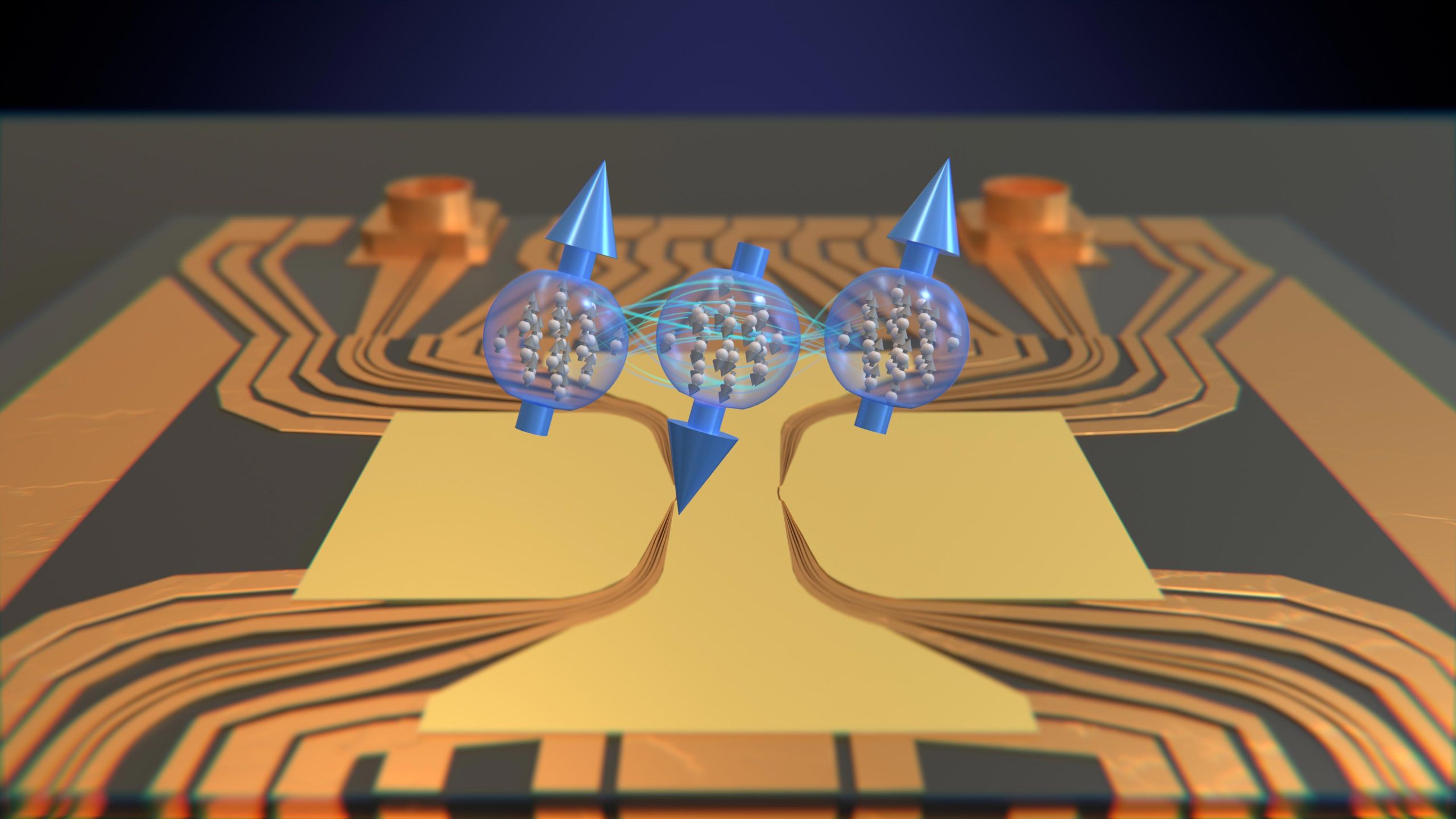
Entangled atoms, separated in space, are giving scientists a powerful new way to measure the world with stunning precision.
Researchers from the University of Basel and the Laboratoire Kastler Brossel have shown that quantum entanglement can be used to measure multiple physical quantities at the same time with greater accuracy than previously possible.
What Makes Quantum Entanglement So Unusual
Entanglement is widely considered one of the strangest effects in quantum physics. When two quantum objects are entangled, measurements made on them can be linked even if the objects are far apart. These connections appear as statistical correlations that classical physics cannot explain. It can seem almost as if measuring one object influences the other one at a distance. This phenomenon, known as the Einstein-Podolsky-Rosen paradox, was experimentally confirmed and later recognized with the 2022 Nobel Prize in physics.
Turning a Quantum Mystery Into a Measurement Tool
Building on this foundation, a team led by Prof. Dr. Philipp Treutlein at the University of Basel and Prof. Dr. Alice Sinatra at the Laboratoire Kastler Brossel (LKB) in Paris demonstrated that entanglement between physically separated quantum systems can be harnessed for practical measurements. Their work shows that entangled particles spread across space can be used to extract several physical parameters at once with improved precision. The findings were recently published in the journal Science.
Improved Measurements Through Entanglement
“Quantum metrology, which exploits quantum effects to improve measurements of physical quantities, is by now an established field of research,” says Treutlein. About fifteen years ago, he and his collaborators were among the first to entangle the spins of extremely cold atoms. These spins can be thought of as tiny compass needles. When entangled, they allowed the researchers to determine their orientation more precisely than would be possible if each atom were measured independently.
“However, those atoms were all in the same location,” Treutlein explains: “We have now extended this concept by distributing the atoms into up to three spatially separated clouds. As a result, the effects of entanglement act at a distance, just as in the EPR paradox.”
Measuring Fields Across Space
This approach opens new possibilities for measuring how physical quantities vary from place to place. For example, to map the spatial distribution of an electromagnetic field, researchers can use entangled atomic spins that are separated in space. As with measurements made at a single location, entanglement reduces uncertainty that arises from quantum effects. It can also help cancel out external disturbances that affect all the atoms in the same way.
“So far, no one has performed such a quantum measurement with spatially separated entangled atomic clouds, and the theoretical framework for such measurements was also still unclear,” says Yifan Li, who worked on the experiment as a postdoc in Treutlein’s group. Along with colleagues at the LKB, the team explored how to minimize measurement uncertainty when using entangled clouds to study the spatial structure of an electromagnetic field.
To carry out the experiment, the researchers first entangled the atomic spins within a single cloud. They then divided that cloud into three parts that remained entangled with each other. Using only a small number of measurements, they were able to determine the field distribution with much higher precision than would be expected without entanglement between distant clouds.
Applications in Atomic Clocks and Gravity Sensors
“Our measurement protocols can be directly applied to existing precision instruments such as optical lattice clocks,” says Lex Joosten, a PhD student in the Basel group. In these clocks, atoms are held in place by laser light arranged in a lattice pattern and serve as extremely stable timekeepers. The new methods could reduce certain errors caused by how atoms are distributed across the lattice, leading to even more accurate time measurements.
The same principles could also improve atom interferometers, which are instruments used to measure the Earth’s gravitational acceleration. In some applications, known as gravimeters, scientists are especially interested in how gravity changes across space. By using entangled atoms, these variations could be measured more precisely than before, offering sharper tools for studying gravity and the environment.
Reference: “Multiparameter estimation with an array of entangled atomic sensors” by Yifan Li, Lex Joosten, Youcef Baamara, Paolo Colciaghi, Alice Sinatra, Philipp Treutlein and Tilman Zibold, 22 January 2026, Science.
DOI: 10.1126/science.adt2442
Never miss a breakthrough: Join the SciTechDaily newsletter.
Follow us on Google and Google News.
10 Comments
Entangled Atoms Are Transforming How We Measure the World!
Very very good!
Please ask researchers to think deeply:
1. What is your benchmark for measuring the world?
2. How do you view the way you measure the world?
Any so-called evidence tainted by human intervention risks distorting our understanding and cognition of the intrinsic dynamics of natural laws.
—— Excerpted from https://zhuanlan.zhihu.com/p/1996561896279667777.
Example 1: Two sets of cobalt-60 are manually rotated in opposite directions, and even without detection, people around the world know that they will not be symmetrical because these two objects are not mirror images of each other at all. However, a group of so-called physicists and so-called academic publications do not believe it. They conducted experiments and the results were indeed asymmetric, but they still firmly believed that these two objects were mirror images of each other, and the asymmetry was due to a violation of the previous natural laws (CP violation). In the history of science, there can never be a dirtier and uglier operation and explanation than this. These people and the so-called academic publications they manipulate no longer know what shame is.
—— Excerpted from https://scitechdaily.com/what-happens-when-light-gains-extra-dimensions/#comment-947619.
Example 2: Please see how the so-called “mystery of θ – τ” is explained: θ and τ are completely identical in all measurable physical properties such as mass, lifetime, charge, spin, etc. However, experimental observations have shown that the θ meson decays into two π mesons, while the τ meson decays into three π mesons, making it difficult for physicists to explain why they are so similar. Physicist Martin Block proposed a highly challenging idea: θ and τ are the same particle, but in weak interactions, parity is not conserved. An easy to understand explanation is the following analogy:: There are two boxes of apples with identical weight, color, and taste. However, when one box is opened, there are two apples, while when the other box is opened, there are three apples. This confuses the old farmer who buys apples. He circled around the orchard and came up with a highly challenging idea: these two boxes of apples are not from the same tree, so they are the same.
—— Excerpted from https://scitechdaily.com/what-happens-when-light-gains-extra-dimensions/#comment-947686.
This approach opens new possibilities for measuring how physical quantities vary from place to place. For example, to map the spatial distribution of an electromagnetic field, researchers can use entangled atomic spins that are separated in space. As with measurements made at a single location, entanglement reduces uncertainty that arises from quantum effects. It can also help cancel out external disturbances that affect all the atoms in the same way. So far, no one has performed such a quantum measurement with spatially separated entangled atomic clouds, and the theoretical framework for such measurements was also still unclear.
WHY? WHY? WHY?
Please ask researchers to think deeply:
1. Why is quantum entanglement and spin?
2. Why do atoms entangle and spin?
3. Are the spin and entanglement of particles related to topological spin and entanglement?
When we pursue the ultimate truth of all things, the space in which our bodies and all things exist may itself be the final and deepest puzzle we need to explore. This is not only the pursuit of physics, but also the most magnificent exploration of the origin of the universe by human reason.
Based on the Topological Vortex Theory (TVT), space is an uniformly incompressible physical entity. Space-time vortices are the products of topological phase transitions of the tipping points in space, are the point defects in spacetime. Point defects do not only impact the thermodynamic properties, but are also central to kinetic processes. They create all things and shape the world through spin and self-organization.
In today’s physics, some so-called peer-reviewed journals—including the Proceedings of the National Academy of Sciences, Physical Review Letters, Science, Nature, and others—stubbornly insist on and promote the following:
1. Even though θ and τ particles exhibit differences in experiments, physics can claim they are the same particle. This is science.
2. Even though topological vortices and antivortices have identical structures and opposite rotational directions, physics can define their structures and directions as entirely different. This is science.
3. Even though two sets of cobalt-60 rotate in opposite directions and experiments reveal asymmetry, physics can still define them as mirror images of each other. This is science.
4. Even though vortex structures are ubiquitous—from cosmic accretion disks to particle spins—physics must insist that vortex structures do not exist and require verification. Only the particles that like God, Demonic, or Angelic are the most fundamental structures of the universe. This is science.
5. Even though everything occupies space and maintains its existence in time, physics must still debate and insist on whether space exists and whether time is a figment of the human mind. This is science.
6. Even though space, with its non-stick, incompressible, and isotropic characteristics, provides a solid foundation for the development of physics, physics must still insist that the ideal fluid properties of space do not exist. This is science.
and go on.
Is this the counterintuitive science they widely promote? Compromising with pseudo academic publications and peer review by pseudo scholars is an insult to science and public intelligence. Some so-called scholars no longer understand what shame is. The study of Topological Vortex Theory (TVT) reminds us that the most profound problems in physics often lie at the intersection of different theories. By exploring these border regions, we can not only resolve contradictions in existing theories but also discover new physical phenomena and application possibilities.
Under the topological vortex architecture, it is highly challenging for even two hydrogen atoms or two quarks to be perfectly symmetrical, let alone counter-rotating two sets of cobalt-60. Contemporary physics and so-called peer-reviewed publications (including the Proceedings of the National Academy of Sciences, Physical Review Letters, Science, Nature, Science Bulletin, etc.) stubbornly believe that two sets of counter rotating cobalt-60 are two mirror images of each other, constructing a more shocking pseudoscientific theoretical framework in the history of science than the “geocentric model”. This pseudo scientific framework and system have seriously hindered scientific progress and social development.
For nearly a century, physics has been manipulated by this pseudo scientific theoretical system and the interest groups behind it, wasting a lot of manpower, funds, and time. A large amount of pseudo scientific research has been conducted, and countless pseudo scientific papers have been published, causing serious negative impacts on scientific and social progress, as well as humanistic development.
Complexity does not necessarily mean that there is no logical and architectural framework to follow. Mathematics is the language and tool that reveals the motion of spacetime, rather than the motion itself. Although the physical form of spacetime vortices is extremely simple, their interaction patterns are highly complex, and we must develop more and richer mathematical languages to describe and understand them.
The development of the Topological Vortex Theory (TVT) reflects a progression from concrete physical phenomena to abstract mathematical modeling and, ultimately, to interdisciplinary unification. Its core innovation lies in forging the continuous spacetime geometry of general relativity with the discrete interactions of quantum field theory within the same topological dynamical system. The core idea of TVT — space is physical, and matter is its topological excitation—already provides a solid and elegant scientific path for understanding the origin of all things.
——Excerpted from https://scitechdaily.com/microscope-spacecrafts-most-precise-test-of-key-component-of-the-theory-of-general-relativity/#comment-909171 and https://t.pineal.cn/blogs/6255/A-Mathematical-and-Physical-Analysis-On-the-Origin-of-Objects.
This phenomenon, known as the Einstein-Podolsky-Rosen paradox, was experimentally confirmed and later recognized with the 2022 Nobel Prize in physics.
Why is physics so obsessed with paradoxes today?
SHAME! SHAME! SHAME!
The value of scientific theory lies in revealing truth rather than maintaining dogma. Only by adhering to the universality of symmetry and deepening our understanding of the nature of spacetime through theories like Topological Vortex Theory (TVT) can physics avoid the trap of pseudoscience and truly move toward the ultimate unification of physics theory.
——Excerpted from https://t.pineal.cn/blogs/5248/Bao-hua-ZHANG-Profile-A-Innovator-in-Theoretical-Physics-1 and https://zhuanlan.zhihu.com/p/1952302320672043229.
Under the manipulation of vested interest groups, at a certain stage of scientific development, the Nobel Prize ceremony can be as grand as it is ridiculous.
Please ask researchers to think deeply:
1. What people observe from Earth is that the moon is larger than the stars. Is this just an appearance or a nature essence?
2. All experimental observations are parity non conservative, is this a appearance or nature essence? Why?
3. Is it the nature essence or the appearance that can be observed in scientific experiments?
4. Can the nature essence of things be directly observed?
5. What is the significance of summarization and induction?
thanks for this
Thank you for browsing and commenting.
The development and progress of physics require more people who care about physics.