
Close Menu
    Facebook X (Twitter) Instagram
    SciTechDaily
    • Biology
    • Chemistry
    • Earth
    • Health
    • Physics
    • Science
    • Space
    • Technology
    Facebook X (Twitter) Pinterest YouTube RSS
    SciTechDaily
    Home»Space»ESO Image of the Week – Worlds With Many Suns
    Space

    ESO Image of the Week – Worlds With Many Suns

    By European Southern ObservatoryFebruary 13, 2019No Comments2 Mins Read
    Facebook Twitter Pinterest Telegram LinkedIn WhatsApp Email Reddit
    Share
    Facebook Twitter LinkedIn Pinterest Telegram Email Reddit
    Worlds With Many Suns
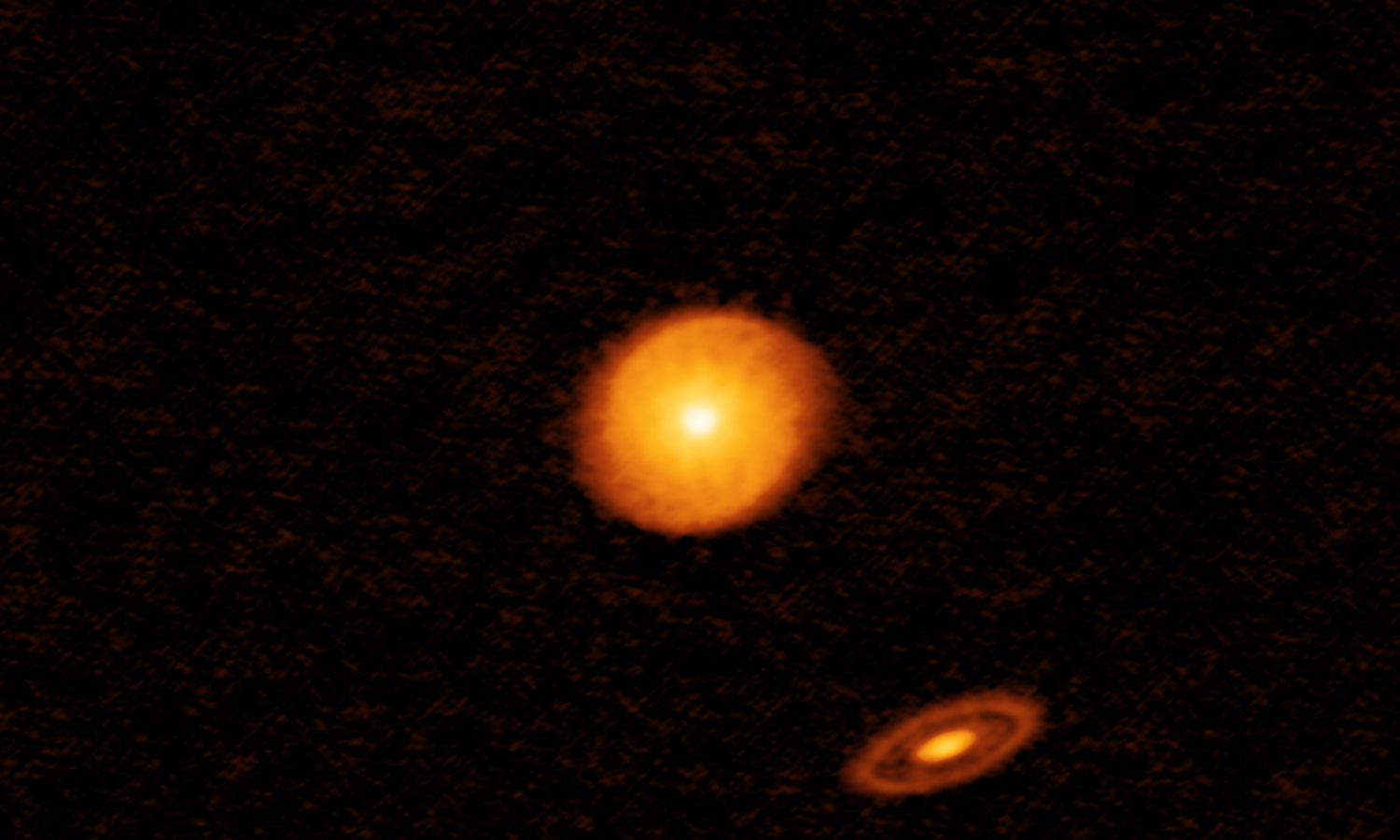
    This object, called AS 205, is notable for being a multiple star system, one of two such systems imaged by DSHARP (the other being HT Lup). While two discs are discernible here, the lower right disc is in fact shared by two stars in a binary system, so we are actually looking at a system of three fledgling stars. Credit: ALMA (ESO/NAOJ/NRAO), S. Andrews et al.; NRAO/AUI/NSF, S. Dagnello

    This week’s Picture of the Week highlights another of the 20 images to come out of ALMA’s first Large Program, the Disk Substructures at High Angular Resolution Project (DSHARP). DSHARP explored a number of nearby protoplanetary discs to learn more about the earliest stages of planet formation, and a staggering quantity of data from the project has just been released.

    This object, called AS 205, is notable for being a multiple star system, one of two such systems imaged by DSHARP (the other being HT Lup). While two discs are discernible here, the lower right disc is in fact shared by two stars in a binary system, so we are actually looking at a system of three fledgling stars.

    Although most high-resolution studies have so far focused on single stars, multiple systems are far from uncommon in the Universe. It is thought that over half of all stars may exist in multiple systems, an estimate that may be even higher for young stars. The presence of companion stars is likely to have complex implications for a disc and its substructures. This is due to as the gravitational influence of a stellar neighbour, which may distort and redistribute the material within the disc. Data from AS 205 and HT Lup indicate that stars and their neighbouring discs interact strongly.

    Despite their unsettled birth environments, planets have been detected in multiple stellar systems — some orbiting just one of the stars, others orbiting the entire system. The latter are more likely to have stable orbits than the former, which get caught up in volatile interstellar dynamics.

    Never miss a breakthrough: Join the SciTechDaily newsletter.
    Follow us on Google and Google News.

    ALMA Astronomy
    Share. Facebook Twitter Pinterest LinkedIn Email Reddit

    Related Articles

    First Clear Detection of a Moon-Forming Disc Around a Planet Outside Our Solar System

    Surprising Insights Into Star Formation From Unprecedented Survey of the “Nurseries” Where Stars Are Born

    Mind the Gap: Direct Link Uncovered Between Protoplanetary Disk Structures and Giant Exoplanets

    Young Chaotic Star System Reveals Secrets of Planet Formation

    Earliest Gigantic Black Hole Storm Ever Discovered – Supermassive Black Hole a Telltale Sign About Very Early History of the Universe

    Map of the Nearby Universe Created by Cosmic Cartographers Reveals the Diversity of Star-Forming Galaxies

    Massive Stars Are Formed Not From Dust Disk but From Debris – “A Chaotic Mess”

    Spinning Disks, Oddball Stars, and Strange Planets Help Astronomers Test Theories About Planetary System Formation

    ALMA Peers Back 12.4 Billion Years and Discovers the Most Ancient Galaxy of Its Kind Ever Observed

    Leave A Reply Cancel Reply

    • Facebook
    • Twitter
    • Pinterest
    • YouTube

    Don't Miss a Discovery

    Subscribe for the Latest in Science & Tech!

    Trending News

    The Universe Is Expanding Too Fast and Scientists Can’t Explain Why

    “Like Liquid Metal”: Scientists Create Strange Shape-Shifting Material

    Early Warning Signals of Esophageal Cancer May Be Hiding in Plain Sight

    Common Blood Pressure Drug Shows Surprising Power Against Deadly Antibiotic-Resistant Superbug

    Scientists Uncover Dangerous Connection Between Serotonin and Heart Valve Disease

    Scientists Discover a “Protector” Protein That Could Help Reverse Hair Loss

    Bone-Strengthening Discovery Could Reverse Osteoporosis

    Scientists Uncover Hidden Trigger Behind Stem Cell Aging

    Follow SciTechDaily
    • Facebook
    • Twitter
    • YouTube
    • Pinterest
    • Newsletter
    • RSS
    SciTech News
    • Biology News
    • Chemistry News
    • Earth News
    • Health News
    • Physics News
    • Science News
    • Space News
    • Technology News
    Recent Posts
    • A Common Diabetes Drug May Hold the Key to Stopping HIV From Coming Back
    • Ancient “Syphilis-Like” Disease in Vietnam Challenges Key Scientific Assumptions
    • Drinking Alcohol To Cope in Your 20s Could Damage Your Brain for Life
    • Scientists Crack Alfalfa’s Chromosome Mystery After Decades of Debate
    • Ancient Ant-Plant Alliance Collapses As Predatory Wasps Move In
    Copyright © 1998 - 2026 SciTechDaily. All Rights Reserved.
    • Science News
    • About
    • Contact
    • Editorial Board
    • Privacy Policy
    • Terms of Use

    Type above and press Enter to search. Press Esc to cancel.