
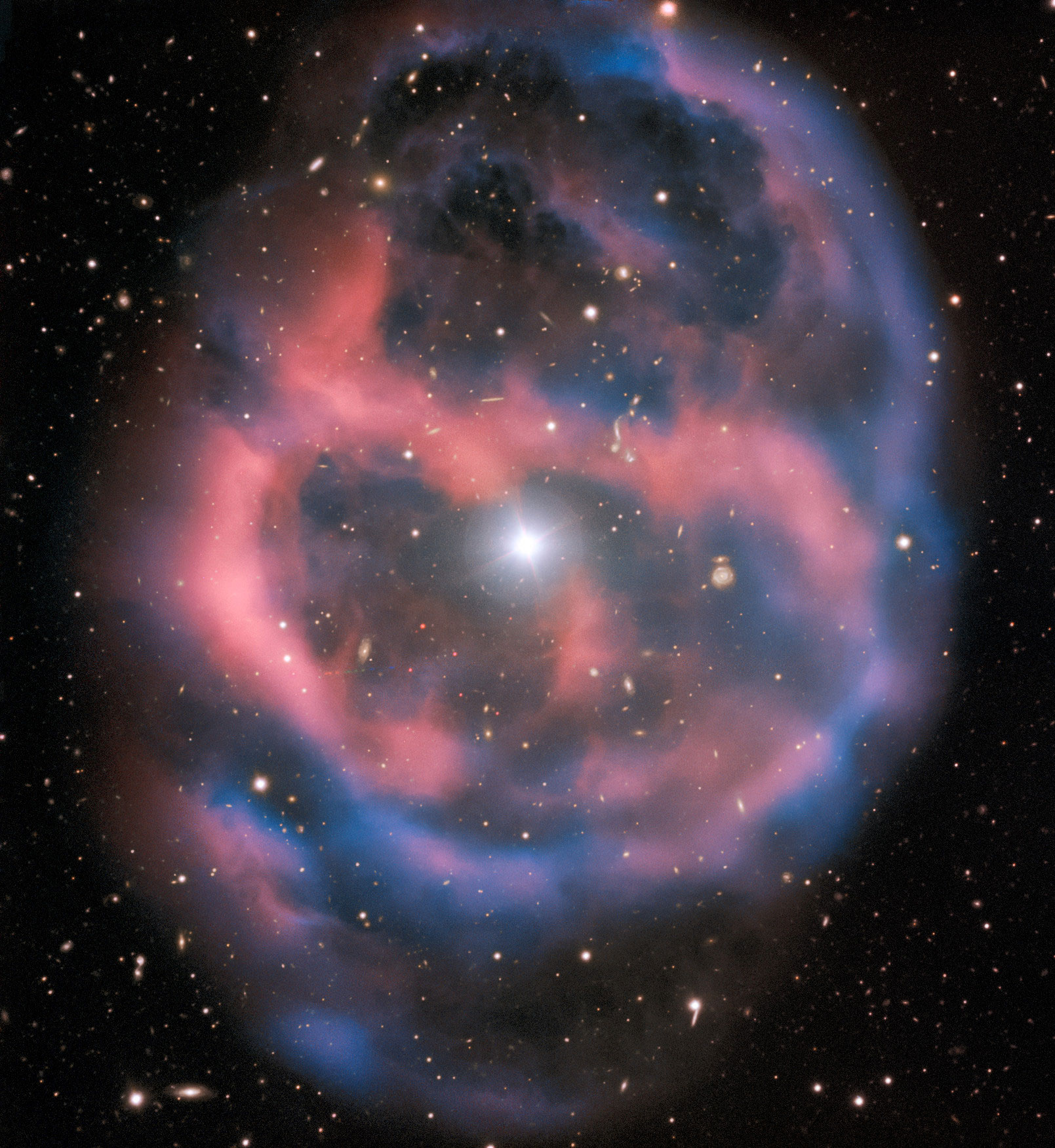
The faint, ephemeral glow emanating from the planetary nebula ESO 577-24 persists for only a short time — around 10,000 years, a blink of an eye in astronomical terms. ESO’s Very Large Telescope captured this shell of glowing ionized gas — the last breath of the dying star whose simmering remains are visible at the heart of this image. As the gaseous shell of this planetary nebula expands and grows dimmer, it will slowly disappear from sight.
An evanescent shell of glowing gas spreading into space — the planetary nebula ESO 577-24 — dominates this image[1]. This planetary nebula is the remains of a dead giant star that has thrown off its outer layers, leaving behind a small, intensely hot dwarf star. This diminished remnant will gradually cool and fade, living out its days as the mere ghost of a once-vast red giant star.
Red giants are stars at the end of their lives that have exhausted the hydrogen fuel in their cores and begun to contract under the crushing grip of gravity. As a red giant shrinks, the immense pressure reignites the core of the star, causing it to throw its outer layers into the void as a powerful stellar wind. The dying star’s incandescent core emits ultraviolet radiation intense enough to ionize these ejected layers and cause them to shine. The result is what we see as a planetary nebula — a final, fleeting testament to an ancient star at the end of its life[2].
This dazzling planetary nebula was discovered as part of the National Geographic Society — Palomar Observatory Sky Survey in the 1950s, and was recorded in the Abell Catalogue of Planetary Nebulae in 1966[3]. At around 1400 light-years from Earth, the ghostly glow of ESO 577-24 is only visible through a powerful telescope. As the dwarf star cools, the nebula will continue to expand into space, slowly fading from view.
This pan video explores the planetary nebula ESO 577-24. ESO’s Very Large Telescope captured this shell of glowing ionized gas — the last breath of the dying star whose simmering remains are visible at the heart of this image. As the gaseous shell of this planetary nebula expands and grows dimmer, it will slowly disappear from sight.
This image of ESO 577-24 was created as part of the ESO Cosmic Gems Programme, an initiative that produces images of interesting, intriguing, or visually attractive objects using ESO telescopes for the purposes of education and public outreach. The program makes use of telescope time that cannot be used for scientific observations; nevertheless, the data collected are made available to astronomers through the ESO Science Archive.
This video zooms in from a view of the Milky Way to the planetary nebula ESO 577-24. ESO’s Very Large Telescope captured this shell of glowing ionized gas — the last breath of the dying star whose simmering remains are visible at the heart of this image. As the gaseous shell of this planetary nebula expands and grows dimmer, it will slowly disappear from the sight of even ESO’s powerful telescopes.
Notes
[1] Planetary nebulae were first observed by astronomers in the 18th century — to them, their dim glow and crisp outlines resembled planets of the Solar System.
[2] By the time our Sun evolves into a red giant, it will have reached the venerable age of 10 billion years. There is no immediate need to panic, however — the Sun is currently only 5 billion years old.
[3] Astronomical objects often have a variety of official names, with different catalogs providing different designations. The formal name of this object in the Abell Catalogue of Planetary Nebulae is PN A66 36.
Never miss a breakthrough: Join the SciTechDaily newsletter.
Follow us on Google and Google News.
2 Comments
Recall that 97% of all stars end up as this, first a planetary nebula, then a secondary glow, then belches as the old star fades into white dwarf life that seems to be endless.
What an amazing prospect to grow old along with our star!! First snowball Earth, then the Great Oxygenation Event, then Extinction Events, and here we still are, just like our white dwarf star!!
The sphere is diametrically geometric opposition to itself because of its own imperfection, a false statement due to conscious awareness, which augments time-conciliation by polarities, and Hamiltonian conjugate quantities podcast…(nothing is experienced without change.)
Indeed, the preponderance for the multi-verse is a direct correlation with the neutral polarity of photons (podcast) in equipollence with causality from quantum of action.
How do Neutral Photons Carry the Sign & Value of Charge?
Niels Bohr – The Quantum of Action and the Description of Nature
SEE THE EPISTEMOLOGICAL PROBLEM
Nima Arkani Hamed Why is Quantum Gravity So Significant Closer to Truth
The Looped Light of the Triple-Slit Real Experiment as a Confirmation for
the Extra Dimensions of Quantum Spacetime and the Reality of Dark Energy
Spin-Mediated Consciousness: Theory, Experimental
Studies, Further Development & Related Topics
The Trascension Hypothesis – John Smart
The Cruise 2018/19 Show — CHANEL -*Low volume
Vangelis – Beautiful Planet Earth [HD]