
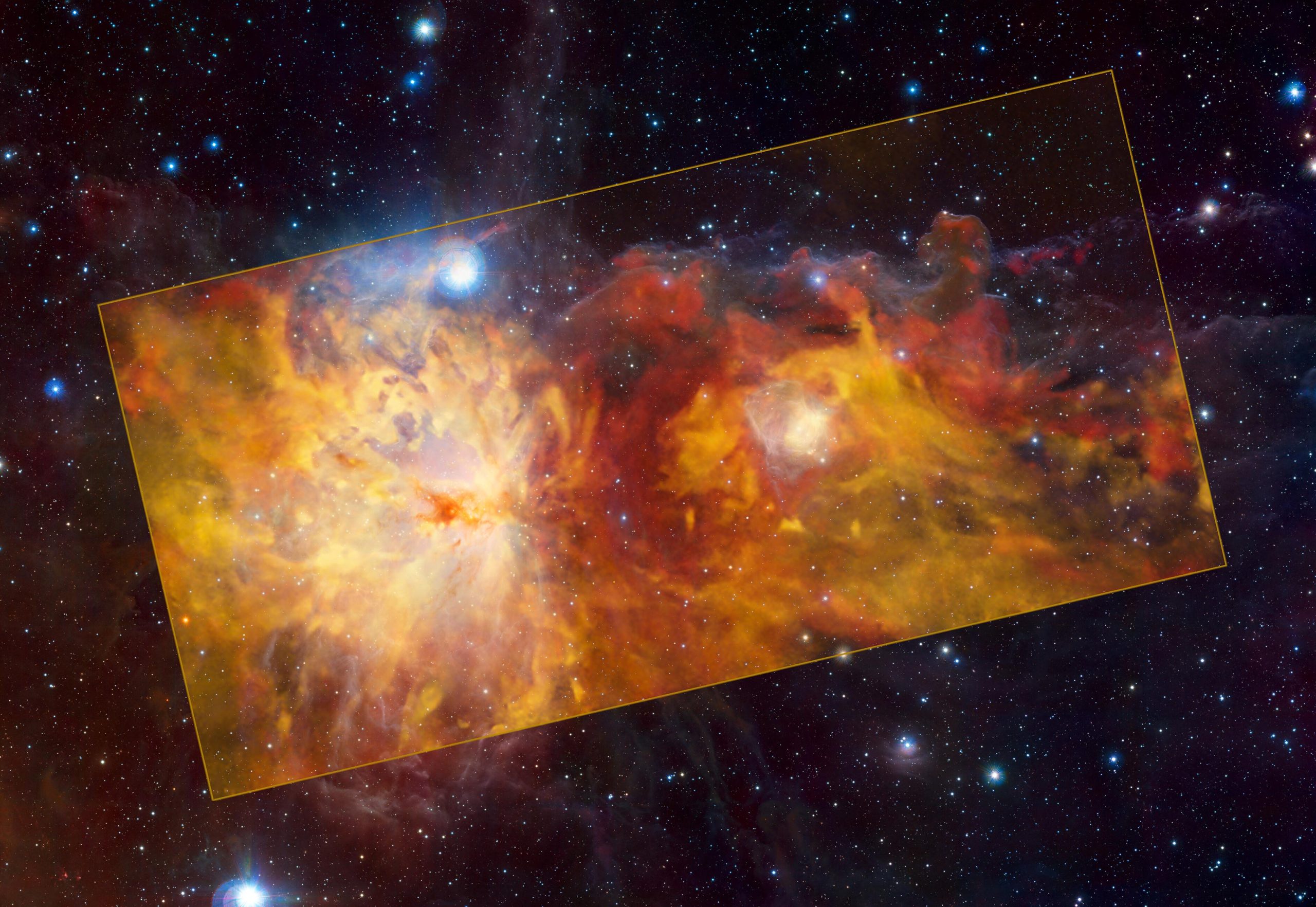
The European Southern Observatory presents a spectacular view of the Flame Nebula in Orion, captured in radio waves, showcasing stellar nurseries and newly discovered nebulae like the Cow Nebula. These observations are part of a larger effort to map the molecular clouds essential for star formation.
Orion offers you a spectacular firework display to celebrate the holiday season and the new year in this new image from the European Southern Observatory (ESO). But no need to worry, this iconic constellation is neither exploding nor burning. The “fire” you see in this holiday postcard is Orion’s Flame Nebula and its surroundings captured in radio waves — an image that undoubtedly does justice to the nebula’s name! It was taken with the ESO-operated Atacama Pathfinder Experiment (APEX), located on the cold Chajnantor Plateau in Chile’s Atacama Desert.
The newly processed image of the Flame Nebula, in which smaller nebulae like the Horsehead Nebula also make an appearance, is based on observations conducted by former ESO astronomer Thomas Stanke and his team a few years ago. Excited to try out the then recently installed SuperCam instrument at APEX, they pointed it towards the constellation Orion. “As astronomers like to say, whenever there is a new telescope or instrument around, observe Orion: there will always be something new and interesting to discover!” says Stanke. A few years and many observations later, Stanke and his team have now had their results accepted for publication in the journal Astronomy & Astrophysics.
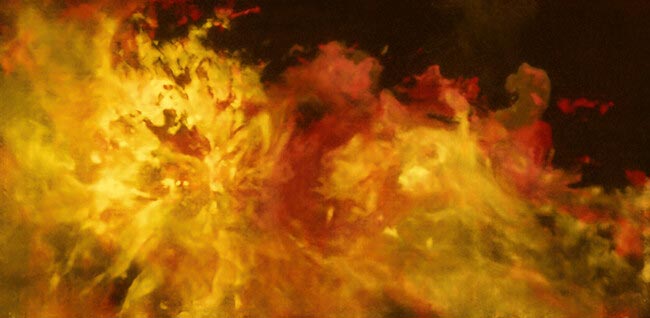
One of the most well-known constellations, Orion contains the largest, close to our Sun molecular clouds, which are massive cosmic objects mostly composed of hydrogen and the birthplace of new stars and planets. These clouds are situated between 1300 and 1600 light-years apart and include the most active stellar nursery in the Solar System’s neighborhood, as well as the Flame Nebula shown in this image. The newborn stars in the core of this “emission” nebula produce high-energy radiation, which illuminates the surrounding gases.
With such an exciting target, the team was unlikely to be disappointed. In addition to the Flame Nebula and its surroundings, Stanke and his collaborators were able to admire a wide range of other spectacular objects. Some examples include the reflection nebulae Messier 78 and NGC 2071 — clouds of interstellar gas and dust believed to reflect the light of nearby stars. The team even discovered one new nebula, a small object, remarkable in its almost perfectly circular appearance, which they named the Cow Nebula.
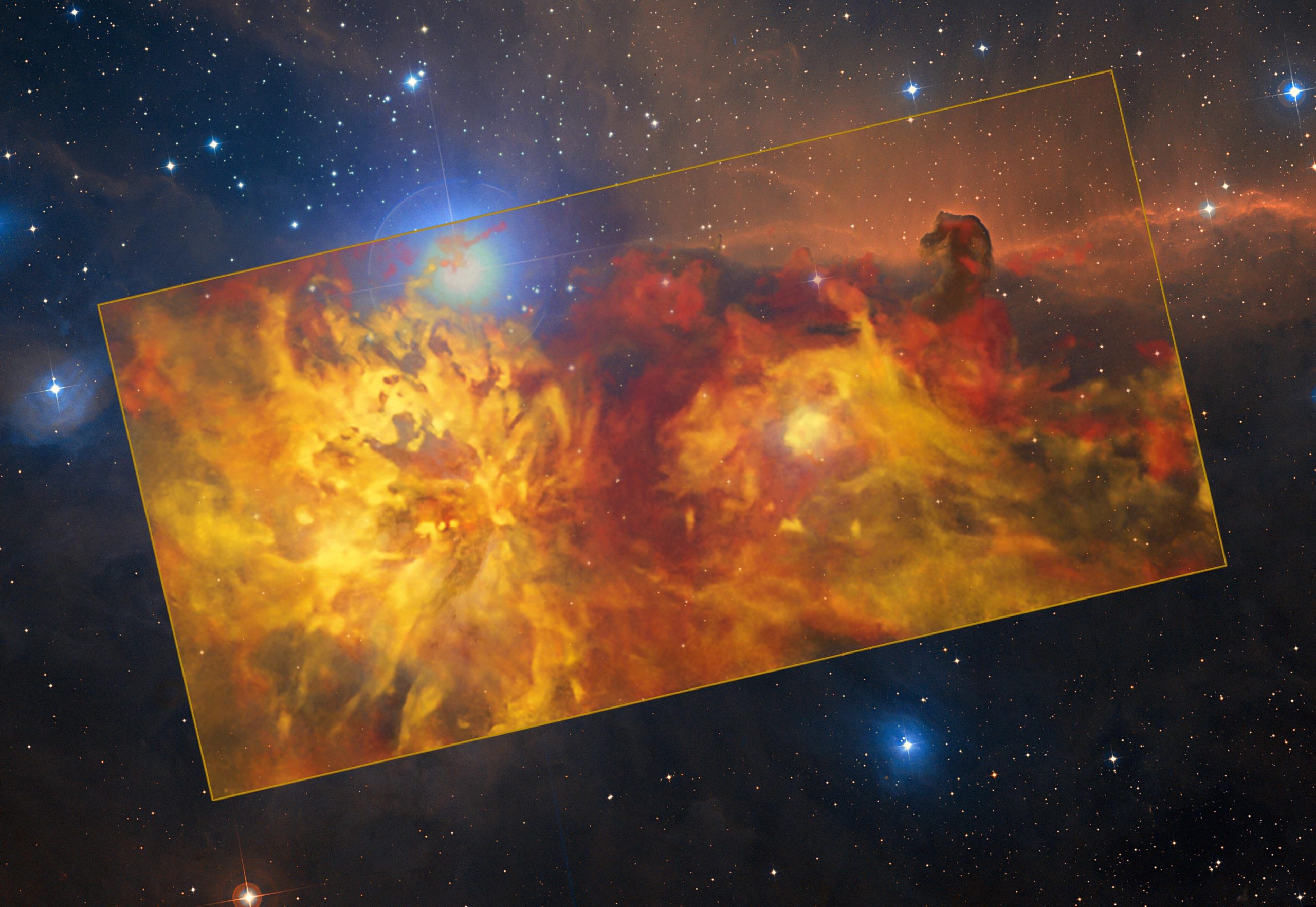
The different colors indicate the velocity of the gas. The Flame Nebula and its surroundings are moving away from us, with the red clouds in the background receding faster than the yellow ones in the foreground.
The image in the rectangle is based on observations conducted with the SuperCam instrument on the ESO-operated Atacama Pathfinder Experiment (APEX) on Chile’s Chajnantor Plateau. The background image was created from photographs in optical light forming part of the Digitized Sky Survey 2.
Credit: ESO/Th. Stanke & ESO/Digitized Sky Survey 2. Acknowledgment: Davide De Martin
The observations were conducted as part of the APEX Large CO Heterodyne Orion Legacy Survey (ALCOHOLS), a project that examined the radio waves that carbon monoxide (CO) in the Orion clouds emits. SuperCam’s main objective is to map vast gas clouds that give birth to new stars by using this molecule to scan vast regions of the sky. These clouds are really cold, with temperatures averaging only a few tens of degrees above absolute zero, in contrast to what the “fire” of this image may suggest.
Given the many secrets it can tell, this region of the sky has been scanned many times in the past at different wavelengths, each wavelength range unveiling different, unique features of Orion’s molecular clouds. One example is the infrared observations performed with ESO’s Visible and Infrared Survey Telescope for Astronomy (VISTA) at the Paranal Observatory in Chile that make up the peaceful background of this image of the Flame Nebula and its surroundings. Unlike visible light, infrared waves pass through the thick clouds of interstellar dust, allowing astronomers to spot stars and other objects that would otherwise remain hidden.
So, this holiday season, bring in the new year with this spectacular multiwavelength firework show put on by the Orion’s Flame Nebula, presented by ESO!
Reference: “The APEX Large CO Heterodyne Orion Legacy Survey (ALCOHOLS). I. Survey overview” by Thomas Stanke, H. G. Arce, J. Bally, P. Bergman, J. Carpenter, C. J. Davis, W. Dent, J. Di Francesco, J. Eislöffel, D. Froebrich, A. Ginsburg, M. Heyer, D. Johnstone, D. Mardones, M. J. McCaughrean, S. T. Megeath, F. Nakamura, M. D. Smith, A. Stutz, K. Tatematsu, C. Walker, J. P. Williams, H. Zinnecker, B. J. Swift, C. Kulesa, B. Peters, B. Duffy, J. Kloosterman, U. A. Yildiz, J. L. Pineda, C. De Breuck and Th. Klein, 18 February 2022, Astronomy & Astrophysics.
DOI: 10.1051/0004-6361/201937034
arXiv:2201.00463
The observations mentioned in this press release are presented in a paper accepted for publication in Astronomy & Astrophysics.
The team is composed of Th. Stanke (European Southern Observatory, Garching bei München, Germany [ESO]), H. G. Arce (Department of Astronomy, Yale University, New Haven, CT, USA), J. Bally (CASA, University of Colorado, Boulder, CO, USA), P. Bergman (Department of Space, Earth and Environment, Chalmers University of Technology, Onsala Space Observatory, Onsala, Sweden), J. Carpenter (Joint ALMA Observatory, Santiago, Chile [ALMA]), C. J. Davis (National Science Foundation, Alexandria, VA, USA), W. Dent (ALMA), J. Di Francesco (NRC Herzberg Astronomy and Astrophysics, Victoria, BC, Canada [HAA] and Department of Physics and Astronomy, University of Victoria, BC, Canada [UVic]), J. Eislöffel (Thu¨ringer Landessternwarte, Tautenburg, Germany), D. Froebrich (School of Physical Sciences, University of Kent, Canterbury, UK), A. Ginsburg (Department of Astronomy, University of Florida, Gainesville, FL, USA), M. Heyer (Department of Astronomy, University of Massachusetts, Amherst, MA, USA), D. Johnstone (HAA and UVic), D. Mardones (Departamento de Astronomía, Universidad de Chile, Santiago, Chile), M. J. McCaughrean (European Space Agency, ESTEC, Noordwijk, The Netherlands), S. T. Megeath (Department of Physics and Astronomy, University of Toledo, OH, USA), F. Nakamura (National Astronomical Observatory, Tokyo, Japan), M. D. Smith (Centre for Astrophysics and Planetary Science, School of Physical Sciences, University of Kent, Canterbury, UK), A. Stutz (Departmento de Astronomía, Facultad de Ciencias Físicas y Matemáticas, Universidad de Concepción, Chile), K. Tatematsu (Nobeyama Radio Observatory, National Astronomical Observatory of Japan, National Institutes of Natural Sciences, Nagano, Japan), C. Walker (Steward Observatory, University of Arizona, Tucson, AZ, US [SO]), J. P. Williams (Institute for Astronomy, University of Hawai‘i at Manoa, HI, USA), H. Zinnecker (Universidad Autonoma de Chile, Santiago, Chile), B. J. Swift (SO), C. Kulesa (SO), B. Peters (SO), B. Duffy (SO), J. Kloosterman (University of Southern Indiana, Evansville, IN, USA), U. A. Yildiz (Jet Propulsion Laboratory, California Institute of Technology, Pasadena, CA, USA [JPL]), J. L. Pineda (JPL), C. De Breuck (ESO), and Th. Klein (European Southern Observatory, Santiago, Chile).
APEX is a collaboration between the Max Planck Institute for Radio Astronomy (MPIfR), the Onsala Space Observatory (OSO) and ESO. Operation of APEX at Chajnantor is entrusted to ESO.
SuperCAM is a project by the Steward Observatory Radio Astronomy Laboratory at the University of Arizona, US.
Never miss a breakthrough: Join the SciTechDaily newsletter.
Follow us on Google and Google News.