
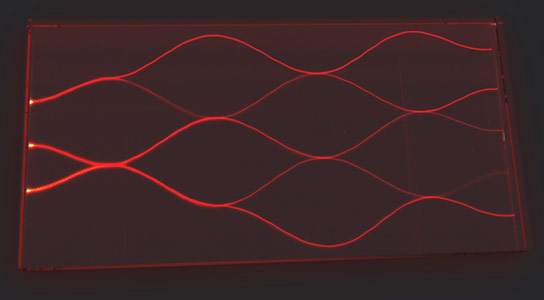
In a newly published study, researchers from the University of Vienna detail a new model of a quantum computer, the boson sampling computer.
Harnessing the unique features of the quantum world promises a dramatic speed-up in information processing as compared to the fastest classical machines. Scientists from the Group of Philip Walther from the Faculty of Physics, University of Vienna succeeded in prototyping a new and highly resource efficient model of a quantum computer – the boson sampling computer. The results are published in the upcoming issue of the renowned scientific journal Nature Photonics.
Quantum computers work by manipulating quantum objects as, for example, individual photons, electrons or atoms and by harnessing the unique quantum features. Not only do quantum computers promise a dramatic increase in speed over classical computers in a variety of computational tasks; they are designed to complete tasks that even a supercomputer would not be able to handle. Although, in recent years, there has been a rapid development in quantum technology the realization of a full-sized quantum computer is still very challenging. While it is still an exciting open question which architecture and quantum objects will finally lead to the outperformance of conventional supercomputers, current experiments show that some quantum objects are better suited than others for particular computational tasks.
The computational power of photons
The huge advantage of photons – a particular type of bosons – lies in their high mobility. The research team from the University of Vienna in collaboration with scientist from the University of Jena (Germany) has recently realized a so-called boson sampling computer that utilizes precisely this feature of photons. They inserted photons into a complex optical network where they could propagate along many different paths. “According to the laws of quantum physics, the photons seem to take all possible paths at the same time. This is known as superposition. Amazingly, one can record the outcome of the computation rather trivially: one measures how many photons exit in which output of the network,” explains Philip Walther from the Faculty of Physics.
How to beat a supercomputer
A classical computer relies on an exact description of the optical network to calculate the propagation of the photons through this circuit. For a few dozen photons and an optical network with merely a hundred inputs and outputs, even today’s fastest classical supercomputer is unable to calculate the propagation of the photons. However, for a boson sampling computer this ambitious task is within reach. The researchers met the challenge and built their prototype based on a theoretical proposal by scientists at the Massachusetts Institute of Technology (USA). “It is crucial to verify the operation of a boson-sampling computer by comparing its outcome with the predictions of quantum physics. Ironically, this test can only be performed on a classical computer. Fortunately, for small enough systems classical computers are still able to accomplish this”, as Max Tillmann, first author of the publication, points out. Thus, the researchers successfully showed that their realization of the boson-sampling computer works with high precision. These encouraging results may lead the way to the first outperformance of classical computers in the not-so-far future.
Reference: “Experimental boson sampling” by Max Tillmann, Borivoje Dakić, René Heilmann, Stefan Nolte, Alexander Szameit and Philip Walther, 12 May 2013, Nature Photonics.
DOI: 10.1038/nphoton.2013.102
Never miss a breakthrough: Join the SciTechDaily newsletter.
Follow us on Google and Google News.
3 Comments
What might “supercomputing” on this level ultimately unleash?
I’d put re-creating highly intelligent -inorganic- life for the purposes of intergalactic travel pretty high on the list. Man makes machines, machines travel, machines then bioengineer organic life forms suited for / adaptable to the conditions of the planet they arrive upon.
Eventually, perhaps humans -or our evolutionary progeny- get to other planets, other planet’s life forms will get to Earth- and out of the Darwinian Clusterf@#k likely to ensue, the winner gets the spoils and the loser enters hell. Same as its always been.
Then again, maybe Earthlings get nowhere*, but other successful beings do this -have done this / are doing this to each other…
***Perhaps we’re an evolutionary dead end and just don’t know it yet. At some point, odds / probabilities, random chance and luck play a part in things!
P.S. Separately, the entire ATGC vs. 0 or 1 binary basis for computing is itself, a wonderful file storage development too!
How long before quantum computers are scaled to a commercial application?