
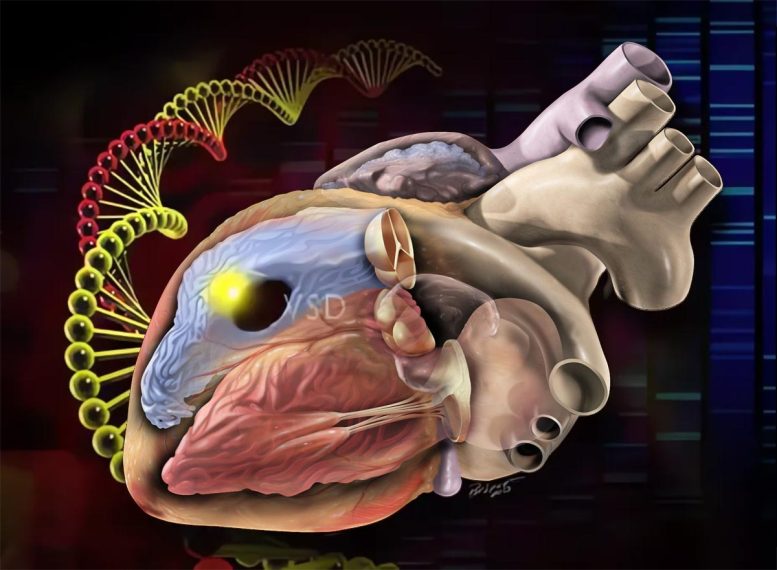
A new study found that non-inherited mutations account for many heart defects, suggesting that common pathways may underlie a wide range of common congenital diseases.
New mutations that are absent in parents but appear in their offspring account for at least 10% of severe congenital heart disease, reveals a massive genomics study led by researchers at the Yale School of Medicine.
The analysis of all the genes of more than 1800 individuals found hundreds of mutations that can cause congenital heart disease, the most common form of birth defect that afflicts nearly 1% of all newborns. In particular, the study found frequent mutations in genes that modify histones, proteins that package DNA in the nucleus and orchestrate the timing and activation of genes crucial to the development of the fetus. The results of the study, part of the Pediatric Cardiac Genomics Consortium funded by the National Heart Lung and Blood Institute, were published online on May 12 in the journal Nature.
“These findings provide new insight into the causes of this common congenital disease,” said Dr. Richard Lifton, Sterling Professor and chair of the Department of Genetics, investigator for the Howard Hughes Medical Institute, and a senior author of the paper. “Most interestingly, the set of genes mutated in congenital heart disease unexpectedly overlapped with genes and pathways mutated in autism. These findings suggest there may be common pathways that underlie a wide range of common congenital diseases.”
The mutations can occur at the same site, and both increase and decrease the modification of histone proteins, said Martina Brueckner, professor of pediatrics and genetics at Yale and another senior author of the study. The results suggest a very sensitive developmental system that might also be influenced by environmental factors in development.
“These findings point to fundamental mechanisms that play a role in a wide range of congenital diseases,” Lifton said.
Reference: “De novo mutations in histone-modifying genes in congenital heart disease” by Samir Zaidi, Murim Choi, Hiroko Wakimoto, Lijiang Ma, Jianming Jiang, John D. Overton, Angela Romano-Adesman, Robert D. Bjornson, Roger E. Breitbart, Kerry K. Brown, Nicholas J. Carriero, Yee Him Cheung, John Deanfield, Steve DePalma, Khalid A. Fakhro, Joseph Glessner, Hakon Hakonarson, Michael J. Italia, Jonathan R. Kaltman, Juan Kaski, Richard Kim, Jennie K. Kline, Teresa Lee, Jeremy Leipzig, Alexander Lopez, Shrikant M. Mane, Laura E. Mitchell, Jane W. Newburger, Michael Parfenov, Itsik Pe’er, George Porter, Amy E. Roberts, Ravi Sachidanandam, Stephan J. Sanders, Howard S. Seiden, Mathew W. State, Sailakshmi Subramanian, Irina R. Tikhonova, Wei Wang, Dorothy Warburton, Peter S. White, Ismee A. Williams, Hongyu Zhao, Jonathan G. Seidman, Martina Brueckner, Wendy K. Chung, Bruce D. Gelb, Elizabeth Goldmuntz, Christine E. Seidman and Richard P. Lifton, 12 May 2013, Nature.
DOI: 10.1038/nature12141
Samir Zaidi and Murim Choi of Yale were co-lead authors of the paper. Researchers from Harvard University, Columbia University Medical Center, the Perelman School of Medicine at University of Pennsylvania, and Icahn School of Medicine at Mt. Sinai shared senior authorship.
Never miss a breakthrough: Join the SciTechDaily newsletter.
Follow us on Google and Google News.
1 Comment
Neurofibromatosis 1 & 2 are so different yet can be found in the gene of the individual but not in the parents. Same for Noonan syndrome. Is this a skip generation condcition? We see that an experience can translate to the grandchildren, is this similar?