
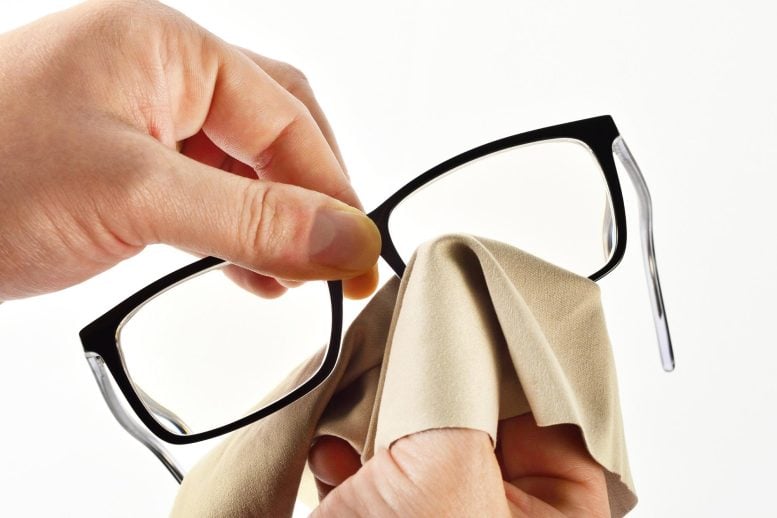
A study led by Duke University has identified high concentrations of PFAS in commonly used anti-fogging sprays and cloths, which could pose significant health risks. These substances, largely unexplored by scientists, have the potential to break down into harmful chemicals associated with severe health issues, including cancer and thyroid disorders, casting doubt on the safety claims often made about these products.
The anti-fogging sprays and cloths many people use to prevent condensation on their eyeglasses when wearing a mask or face shield may contain high levels of per- and polyfluorinated alkyl substances (PFAS), a new Duke University-led study finds.
The researchers tested four top-rated anti-fogging sprays and five top-rated anti-fogging cloths sold on Amazon. They found all nine products contained fluorotelomer alcohols (FTOHs) and fluorotelomer ethoxylates (FTEOs), two types of PFAS that largely have flown under the scientific radar until now.
Exposure to some PFAS, particularly perfluorooctanoic acid (PFOA) and perfluorooctanesulfonic acid (PFOS), is associated with impaired immune function, cancer, thyroid disease, and other health disorders. Mothers and young children may be especially vulnerable to the chemicals, which can affect reproductive and developmental health.
High Levels of PFAS Found in Anti-Fogging Sprays
“Our tests show the sprays contain up to 20.7 milligrams of PFAS per milliliter of solution, which is a pretty high concentration,” said Nicholas Herkert, a postdoctoral researcher at Duke’s Nicholas School of the Environment, who led the study.
Because FTOHs and FTEOs have received relatively little study, scientists don’t yet know what health risks they might pose, Herkert noted, but research suggests that once FTOHs have been inhaled or absorbed through the skin, they could break down in the body to PFOA or other long-lived PFAS substances that are known to be toxic. Additionally, the FTEOs used in all four spray mixtures that were analyzed in the new study exhibited significant cell-altering toxicity and conversion to fat cells in lab tests, he said.
“If we were to assume that FTOHs and FTEOs have similar toxicity to PFOA and PFOS, then one spray from these bottles would expose you to PFAS at levels that are several orders of magnitude higher than you’d receive from drinking a liter of water that contains PFAS at the current EPA health advisory limit for safe consumption, which is 70 nanograms per liter,” Herkert said.
Lack of Transparency in Product Ingredients
“It’s disturbing to think that products people have been using on a daily basis to help keep themselves safe during the COVID pandemic may be exposing them to a different risk,” said Heather Stapleton, the Ronie-Richele Garcia-Jones Distinguished Professor of environmental chemistry and health at Duke, who initiated the study after reviewing the ingredient label on a bottle of anti-fogging spray she purchased for her 9-year-old daughter.
“Ironically, it was advertised as safe and nontoxic,” Stapleton said. “It said to spray it on your glasses and use your fingers to rub it around.”
None of the other eight products tested even listed their ingredients, she added, making it next to impossible to tell if they contained potentially harmful chemicals until they were analyzed using high-resolution mass spectrometry in her research laboratory.
The researchers published their peer-reviewed study on January 5, 2022, in the journal Environmental Science & Technology.
Because their study is only the second ever to focus on FTEOs and had a small sample size, more research will be needed to flesh out these initial findings, they said. Larger studies involving tests with living organisms are the logical next step.
“FTOHs and FTEOs could be metabolic disrupters, but the only way to tell is through in vivo testing on whole organisms. We only did in vitro (lab dish) testing,” Herkert explained.
Studies with larger sample sizes might also identify other undisclosed chemicals that are being used in the sprays or cloths.
“Because of COVID, more people than ever—including many medical professionals and other first-responders—are using these sprays and cloths to keep their glasses from fogging up when they wear masks or face shields,” Stapleton said. “They deserve to know what’s in the products they’re using.”
Reference: “Characterization of Polyfluorinated Alkyl Substances (PFASs) Present in Commercial Anti-Fog Products and Their In Vitro Adipogenic Activity” by Nicholas J. Herkert, Christopher D. Kassotis, Sharon Zhang, Yuling Han, Vivek Francis Pulikkal, Mei Sun, P. Lee Ferguson and Heather M. Stapleton, 5 January 2022, Environmental Science & Technology.
DOI: 10.1021/acs.est.1c06990
Herkert and Stapleton conducted the study with Lee Ferguson and Sharon Zhang of Duke, Christopher Kassotis of Wayne State University, and Yuling Han, Vivek Pulikkal and Mei Sun of the University of North Carolina at Charlotte.
Support came from the U.S. Environmental Protection Agency; the National Institute of Environmental Health Sciences; the Michael and Annie Falk Foundation; and the North Carolina Policy Collaborative through an appropriation from the North Carolina General Assembly.
Never miss a breakthrough: Join the SciTechDaily newsletter.
Follow us on Google and Google News.
1 Comment
BlurBusterz Antifog Wipe is a reusable wipe which does not contain the FTOH and FTEO mentioned in the article. We believe BlurBusterz is the safest product on the market and can help prevent injuries especially when being used on safety glasses.