
Close Menu
    Facebook X (Twitter) Instagram
    SciTechDaily
    • Biology
    • Chemistry
    • Earth
    • Health
    • Physics
    • Science
    • Space
    • Technology
    Facebook X (Twitter) Pinterest YouTube RSS
    SciTechDaily
    Home»Technology»New Process Allows Scientists To Mold Metal At The Nanoscale
    Technology

    New Process Allows Scientists To Mold Metal At The Nanoscale

    By William Weir, Yale UniversityJanuary 23, 2019No Comments3 Mins Read
    Facebook Twitter Pinterest Telegram LinkedIn WhatsApp Email Reddit
    Share
    Facebook Twitter LinkedIn Pinterest Telegram Email Reddit
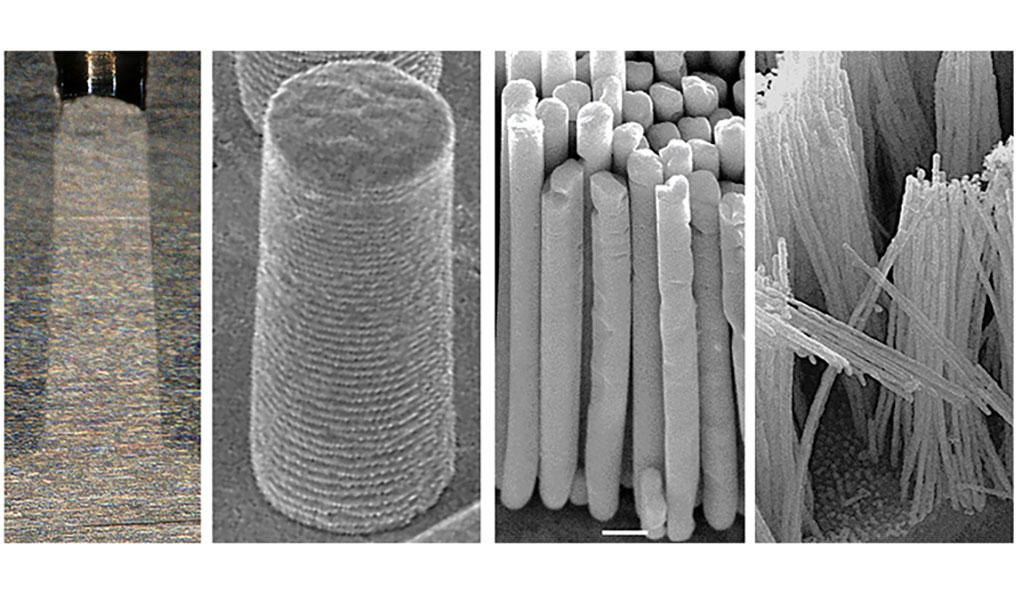
    Molding Metal at the Nanoscale
    Silver nanorods made with thermomechanical molding, ranging in size from (left to right) 0.57 millimeters, 10 micrometers, 375 nanometers, and 36 nanometers. (Jan Schroers Lab)

    Numerous metals and alloys would be ideal for specific nanoscale applications — from solar energy to microelectronics — but accurately molding metals into such minuscule shapes has proved challenging. Researchers, though, have developed a process that allows manufacturers to essentially shape any metal and alloy and replicate even the smallest details.

    The labs of Jan Schroers, professor of mechanical engineering & materials science at Yale, and professor Ze Liu of Wuhan University in China developed a method they call thermomechanical nanomolding that allows them to mold crystalline metals into shapes as small as a few nanometers in diameter. The breakthrough, said the researchers, could lead to new technologies in fields such as sensors, batteries, catalysis, biomaterials, and quantum materials. The results are published on Jan. 22 in Physical Review Letters.

    “It’s really a new way of nanomanufacturing,” Schroers said. “Today’s nanomanufacturing relies on a few materials that can be fabricated very specifically for a particular material. But our discovery suggests one technique for all metals and alloys: It allows us to fabricate essentially every metal and its combination in the periodic table in a predictable and precise manner to nano-sized features.”

    Molding crystalline metals, which include most metals in their solid state, has generally posed a challenge for manufacturers, said the researchers. How moldable a material is typically depends on its “flowability” — that is, how easily it flows under certain conditions. Flowability is high in thermoplastics, gels, and glasses, but most metals are too hard when solid and too fluid in their liquid states to mold with conventional techniques at the nanoscale.

    But by applying atomic diffusion, in which a change in pressures transports the atoms, the research team found that not only could they efficiently mold crystalline metals, but that decreasing the size of the mold actually made the process easier. As a result, they were able to create very long features at about 10 nanometers in diameter — 8,000 times smaller than a human hair — that would previously have been impossible to make.

    Because the mechanism of diffusion is present in all metals and alloys, the process could theoretically be used across the board, said the researchers. To test the wide range of applications, the researchers tried molding gold, nickel, vanadium, iron, and numerous alloys. In each case, they could readily fabricate very small nanorods.

    Reference: “Nanomolding of Crystalline Metals: The Smaller the Easier” by Ze Liu, Guoxing Han, Sungwoo Sohn, Naijia Liu and Jan Schroers, 22 January 2019, Physical Review Letters.
    DOI: 10.1103/PhysRevLett.122.036101

    Never miss a breakthrough: Join the SciTechDaily newsletter.
    Follow us on Google and Google News.

    Nanoscience Nanotechnology Yale University
    Share. Facebook Twitter Pinterest LinkedIn Email Reddit

    Related Articles

    Scientists Observe Self-Healing of a Confined Phase Change Memory Device

    Yale Engineers Create a New Kind of Metallic Glass

    Yale Engineers Develop Plant-Derived Material to Purify Water

    DMSO Treatment Could Transform Solar Cells, Boosts Efficiency

    A New Design Strategy for Better Lithium Oxygen Batteries

    Yale Engineers Turn Wasted Heat Into Power

    Yale Engineers Devise Quantum Technology On A Chip

    Nanomaterials Give Immune Cells a Cancer-Fighting Boost

    New Carbon Films Pave the Way for the Next Generation of Solar Cells

    Leave A Reply Cancel Reply

    • Facebook
    • Twitter
    • Pinterest
    • YouTube

    Don't Miss a Discovery

    Subscribe for the Latest in Science & Tech!

    Trending News

    This Copper Drug Clears Alzheimer’s Brain Toxins and Boosts Memory

    Adults Over 65 Lost Massive Amounts of Weight With Ozempic

    How Flocking Birds “Defy” One of Physics’ Most Fundamental Laws

    Physicists Create a New Kind of Schrödinger’s Cat State From Exotic Quantum Building Blocks

    Your Diet Could Be Missing the Key Ingredient for Heart Protection

    Researchers Warn Widely Prescribed Blood Pressure Drugs Could Be Harming Diabetic Kidneys

    James Webb Spots Something Strange Between Day and Night on an Alien Planet

    How Ancient People Moved a 6-Ton Stone 700 Kilometers to Stonehenge

    Follow SciTechDaily
    • Facebook
    • Twitter
    • YouTube
    • Pinterest
    • Newsletter
    • RSS
    SciTech News
    • Biology News
    • Chemistry News
    • Earth News
    • Health News
    • Physics News
    • Science News
    • Space News
    • Technology News
    Recent Posts
    • The Surprising Fix for Robot Traffic Jams
    • Near Absolute Zero, This Transistor Starts Acting Like a Brain Cell
    • Beyond DNA: Scientists Discover Inheritance That Breaks the Rules of Genetics
    • A Surprising Discovery Challenges What Scientists Thought DNA Methylation Was For
    • This New DNA Test Solves Rare Disease Mysteries That Standard Genetics Misses
    Copyright © 1998 - 2026 SciTechDaily. All Rights Reserved.
    • Science News
    • About
    • Contact
    • Editorial Board
    • Privacy Policy
    • Terms of Use

    Type above and press Enter to search. Press Esc to cancel.