
Close Menu
    Facebook X (Twitter) Instagram
    SciTechDaily
    • Biology
    • Chemistry
    • Earth
    • Health
    • Physics
    • Science
    • Space
    • Technology
    Facebook X (Twitter) Pinterest YouTube RSS
    SciTechDaily
    Home»Space»Evidence of Life on Mars? NASA’s Bold Strategy to Recover the Proof
    Space

    Evidence of Life on Mars? NASA’s Bold Strategy to Recover the Proof

    By NASAJanuary 11, 2025No Comments4 Mins Read
    Facebook Twitter Pinterest Telegram LinkedIn WhatsApp Email Reddit
    Share
    Facebook Twitter LinkedIn Pinterest Telegram Email Reddit
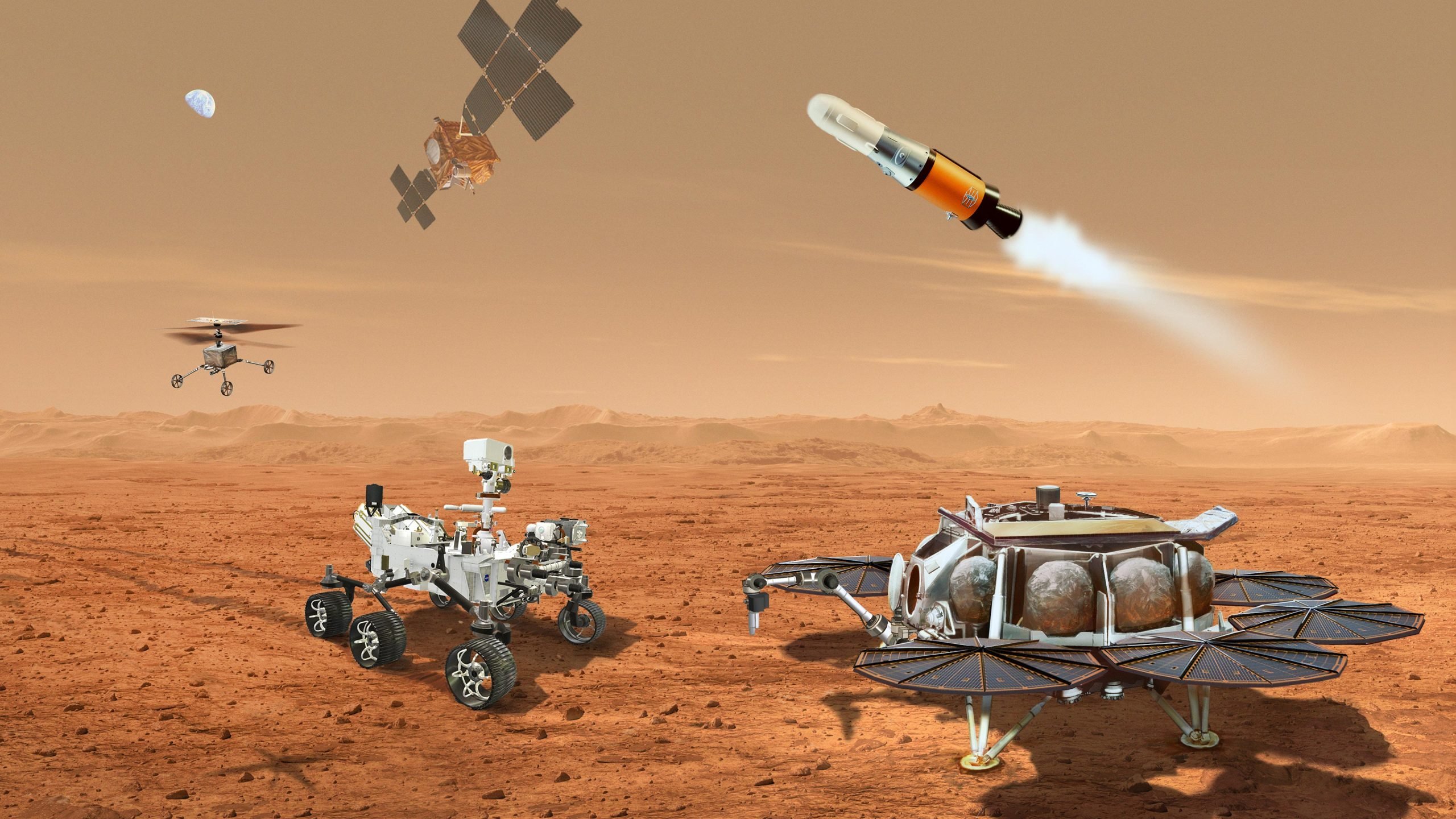
    Multiple Robots NASA Mars Sample Return Mission
    This illustration shows a concept for multiple robots that would team up to ferry to Earth samples collected from the Mars surface by NASA’s Mars Perseverance rover. Credit: NASA/JPL-Caltech

    NASA unveils a groundbreaking approach to bring Martian rock samples back to Earth by 2026, introducing competition between two strategic plans to enhance cost-efficiency and spark innovation.

    These Martian samples could revolutionize our understanding of Mars and the wider universe, potentially altering our perception of life’s origins and evolution

    NASA’s Dual Path Strategy for Mars Sample Return

    NASA has unveiled a new approach to its Mars Sample Return Program to increase the chances of successfully bringing the first Martian rock and sediment samples to Earth. The agency will explore two different landing strategies simultaneously during the program’s development phase. This dual-track approach is designed to foster competition, spark innovation, and reduce costs and timelines.

    Ultimately, NASA will choose one strategy to move forward with, as the program aims to unlock the mysteries of the universe and investigate whether Mars ever supported life. The final design and confirmation of the program are expected in the latter half of 2026.

    Mars Sample Tubes Collected by NASA Perseverance Rover
    This photomontage shows tubes containing samples from Mars, as collected by NASA’s Perseverance Mars rover. The agency’s Mars Sample Return Program plans to bring these samples back to study them in state-of-the-art facilities on Earth. Credit: NASA/JPL-Caltech/MSSS

    Enhancing Cost Efficiency and Scientific Potential

    “Pursuing two potential paths forward will ensure that NASA is able to bring these samples back from Mars with significant cost and schedule saving compared to the previous plan,” said NASA Administrator Bill Nelson. “These samples have the potential to change the way we understand Mars, our universe, and – ultimately – ourselves. I’d like to thank the team at NASA and the strategic review team, led by Dr. Maria Zuber, for their work.”

    In September 2024, the agency accepted 11 studies from the NASA community and industry on how best to return Martian samples to Earth. A Mars Sample Return Strategic Review team was charged with assessing the studies and then recommending a primary architecture for the campaign, including associated cost and schedule estimates.

    Expediting Martian Science

    “NASA’s rovers are enduring Mars’ harsh environment to collect ground-breaking science samples,” said Nicky Fox, who leads NASA’s Science Mission Directorate. “We want to bring those back as quickly as possible to study them in state-of-the-art facilities. Mars Sample Return will allow scientists to understand the planet’s geological history and the evolution of climate on this barren planet where life may have existed in the past and shed light on the early solar system before life began here on Earth. This will also prepare us to safely send the first human explorers to Mars.”

    NASA Curiosity Sky Crane Maneuver
    This artist’s concept shows how NASA’s Curiosity Mars rover was lowered to the planet’s surface using the sky crane maneuver. Credit: NASA/JPL-Caltech

    During formulation, NASA will proceed with exploring and evaluating two distinct means of landing the payload platform on Mars. The first option will leverage previously flown entry, descent, and landing system designs, namely the sky crane method, demonstrated with the Curiosity and Perseverance missions. The second option will capitalize on using new commercial capabilities to deliver the lander payload to the surface of Mars.

    Technological Innovations and Strategic Partnerships

    For both potential options, the mission’s landed platform will carry a smaller version of the Mars Ascent Vehicle. The platform’s solar panels will be replaced with a radioisotope power system that can provide power and heat through the dust storm season at Mars, allowing for reduced complexity.

    The orbiting sample container will hold 30 of the sample tubes containing samples the Perseverance lander has been collecting from the surface of Mars. A redesign of the sample loading system on the lander, which will place the samples into the orbiting sample container, simplifies the backward planetary protection implementation by eliminating the accumulation of dust on the outside of the sample container.

    Both mission options rely on a capture, containment, and return system aboard ESA’s (European Space Agency’s) Earth Return Orbiter to capture the orbiting sample container in Mars orbit. ESA is evaluating NASA’s plan.

    Never miss a breakthrough: Join the SciTechDaily newsletter.
    Follow us on Google and Google News.

    Mars Mars 2020 Perseverance Rover Mars Sample Return NASA Popular
    Share. Facebook Twitter Pinterest LinkedIn Email Reddit

    Related Articles

    Atmospheric Time Capsules: Why Scientists Are Intrigued by Air in NASA’s Mars Sample Tubes

    NASA’s Perseverance Mars Rover Shows Off Collection of Martian Samples in Stunning Panorama

    NASA’s Perseverance Rover Scouts Mars Sample Return Campaign Landing Sites

    NASA’s Ingenuity Mars Helicopter Scouts Ridgeline for Perseverance Science Team

    NASA Ingenuity Helicopter Spots Spacecraft Wreckage on Mars – Perseverance’s Cone-Shaped Backshell

    We’ve Arrived! NASA’s Mars Perseverance Rover Starts the Delta Front Campaign

    Incredible Video of Solar Eclipse on Mars – Captured by NASA’s Perseverance Rover

    NASA’s Mars Perseverance Rover Arrives at Ancient Delta for New Science Campaign

    NASA Perseverance Rover’s Self-Driving Capabilities Put to the Test in Rush to Martian Delta

    Leave A Reply Cancel Reply

    • Facebook
    • Twitter
    • Pinterest
    • YouTube

    Don't Miss a Discovery

    Subscribe for the Latest in Science & Tech!

    Trending News

    New “Nanozyme Hypothesis” Could Rewrite the Story of Life’s Origins

    Anatomy Isn’t Finished: The Human Body Still Holds Secrets

    “Pretty Close to Home”: The Hidden Earthquake Threat Beneath Seattle

    The Surprising Reason You Might Want To Sleep Without a Pillow

    Scientists Say This Natural Hormone Reverses Obesity by Targeting the Brain

    35-Million-Year-Old Mystery: Strange Arachnid Discovered Preserved in Amber

    Is AI Really Just a Tool? It Could Be Altering How You See Reality

    JWST Reveals a “Forbidden” Planet With a Baffling Composition

    Follow SciTechDaily
    • Facebook
    • Twitter
    • YouTube
    • Pinterest
    • Newsletter
    • RSS
    SciTech News
    • Biology News
    • Chemistry News
    • Earth News
    • Health News
    • Physics News
    • Science News
    • Space News
    • Technology News
    Recent Posts
    • The Ocean Current Stronger Than All Rivers Changed Earth Forever
    • NASA Artemis II Splashdown and Astronaut Recovery Operation [Image Gallery]
    • Splashdown! NASA Artemis II Returns From Record-Breaking Moon Mission
    • Scientists Freeze a Spinning Nanoparticle to Its Quantum Limit
    • A 100x Faster Breakthrough Could Fix Quantum Computers’ Biggest Problem
    Copyright © 1998 - 2026 SciTechDaily. All Rights Reserved.
    • Science News
    • About
    • Contact
    • Editorial Board
    • Privacy Policy
    • Terms of Use

    Type above and press Enter to search. Press Esc to cancel.