
Close Menu
    Facebook X (Twitter) Instagram
    SciTechDaily
    • Biology
    • Chemistry
    • Earth
    • Health
    • Physics
    • Science
    • Space
    • Technology
    Facebook X (Twitter) Pinterest YouTube RSS
    SciTechDaily
    Home»Biology»Evolution Favors New Epidemic Diseases of “Intermediate” Severity
    Biology

    Evolution Favors New Epidemic Diseases of “Intermediate” Severity

    By University of ExeterNovember 12, 2020No Comments3 Mins Read
    Facebook Twitter Pinterest Telegram LinkedIn WhatsApp Email Reddit
    Share
    Facebook Twitter LinkedIn Pinterest Telegram Email Reddit
    Pathogen Evolution
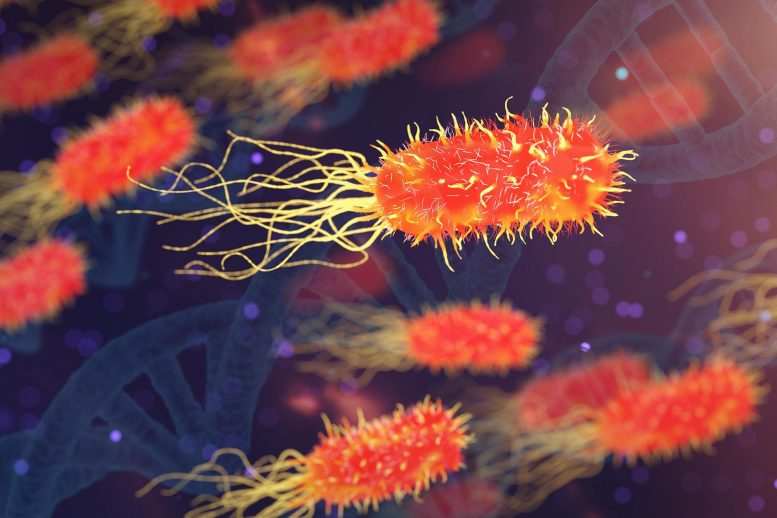
    Natural selection favors moderately virulent pathogens when they first emerge in a new host species.

    New epidemic diseases have an evolutionary advantage if they are of “intermediate” severity, research shows.

    Scientists tested the theory that pathogens (disease-causing organisms) that inflict intermediate levels of harm on their host are the most evolutionarily successful.

    The study, by the University of Exeter, Arizona State University, and Auburn University, found that natural selection favors pathogens of intermediate virulence (how much harm a pathogen causes) at the point the disease emerges in a new host species.

    This occurs because virulence and transmission are linked, with virulence arising because pathogens need to exploit hosts to persist, replicate, and transmit.

    While too-low virulence will be detrimental for pathogens if they cannot transmit, virulence that is too high will also be a disadvantage if infection kills hosts so fast that the pathogen does not have time to transmit.

    Over time, pathogens that show intermediate levels of virulence should therefore have an evolutionary advantage.

    “For a long time, conventional wisdom held that new diseases evolved to become harmless,” said Dr. Camille Bonneaud, of the Centre for Ecology and Conservation on Exeter’s Penryn Campus in Cornwall.

    “Although theoretical developments in evolutionary biology in the 1980s showed that this was not necessarily the case, such belief still holds firm, even today.

    “Our study focused on the ‘virulence-transmission trade-off’ hypothesis, which allows us to make predictions about pathogen evolution.

    “Experimental evidence for this theory is rare, but we were able to test it by using more than 50 variants of the infectious bacterial pathogen Mycoplasma gallisepticum, which infects house finches.”

    In the study, house finches from populations that had never encountered the disease were exposed to one of the different variants, simulating conditions at epidemic outbreak.

    “We found that variants that were more virulent transmitted faster, but that variants of intermediate virulence were the most evolutionarily successful,” Dr. Bonneaud said.

    “Our results therefore provide support for using the virulence-transmission trade-off hypothesis as a framework for understanding and predicting emerging pathogen evolution.”

    Counter to commonly held beliefs, however, variants of the pathogen that replicated faster during infection and achieved higher densities did not transmit better or faster than those that achieved lower densities.

    “This tells us that transmission is not always a numbers game and that we cannot use pathogen numbers as a proxy for their success.”

    The paper, published in the journal Evolution Letters, is entitled: “Experimental evidence for stabilizing selection on virulence in a bacterial pathogen.”

    Reference: “Experimental evidence for stabilizing selection on virulence in a bacterial pathogen” by Camille Bonneaud, Luc Tardy, Geoffrey E. Hill, Kevin J. McGraw, Alastair J. Wilson and Mathieu Giraudeau, 11 November 2020, Evolution Letters.
    DOI: 10.1002/evl3.203

    Never miss a breakthrough: Join the SciTechDaily newsletter.
    Follow us on Google and Google News.

    Bacteria Evolution Genetics Infectious Diseases University of Exeter Virology
    Share. Facebook Twitter Pinterest LinkedIn Email Reddit

    Related Articles

    What Are Virus Variants? Explaining Viral Mutations, COVID and Vaccines

    Researchers Shocked to Discover Bacterial Parasites Behind Rise of “Superbugs”

    A Genetic Variant You May Have Inherited From Neanderthals Reduces the Risk of Severe COVID-19

    Bats Offer Clues to Treating COVID-19 – Secrets to Longevity and Disease Tolerance

    From Jekyll to Hyde: Genetic Mutation That Makes E. Coli Deadlier Pinpointed

    Genetic Analysis Shows Life’s Earliest Evolution Was More Complicated Than Previously Suspected

    Different Groups of Bats Have Their Own Unique Strains of Coronavirus – They Have Been Evolving Together for Millions of Years

    Rapid Evolution of Deadly Pathogen: Cholera Bacterium Can Steal Up to 150 Genes in One Go

    Calcified Bacteria Sheds Light on the Health Consequences of the Evolving Diet

    Leave A Reply Cancel Reply

    • Facebook
    • Twitter
    • Pinterest
    • YouTube

    Don't Miss a Discovery

    Subscribe for the Latest in Science & Tech!

    Trending News

    Scientists Discover 132-Million-Year-Old Dinosaur Tracks on South Africa’s Coast

    Scientists Uncover the Secret Ingredient Behind the Spark That May Have Started Life on Earth

    Physicists Observe Matter in Two Places at Once in Mind-Bending Quantum Experiment

    Stanford Scientists Discover Hidden Brain Circuit That Fuels Chronic Pain

    New Study Reveals Why Ozempic Works Better for Some People Than Others

    Climate Change Is Altering a Key Greenhouse Gas in a Way Scientists Didn’t Expect

    New Study Suggests Gravitational Waves May Have Created Dark Matter

    Scientists Discover Why the Brain Gets Stuck in Schizophrenia

    Follow SciTechDaily
    • Facebook
    • Twitter
    • YouTube
    • Pinterest
    • Newsletter
    • RSS
    SciTech News
    • Biology News
    • Chemistry News
    • Earth News
    • Health News
    • Physics News
    • Science News
    • Space News
    • Technology News
    Recent Posts
    • Anatomy Isn’t Finished: The Human Body Still Holds Secrets
    • Researchers Discover Long-Lost Words of Ancient Greek Philosopher After 2,000 Years
    • New Study Warns: Asia’s Lifeline Water Source Is Rapidly Draining
    • 100 Times Worse? Thawing Permafrost May Be More Dangerous Than Previously Thought
    • “Pretty Close to Home”: The Hidden Earthquake Threat Beneath Seattle
    Copyright © 1998 - 2026 SciTechDaily. All Rights Reserved.
    • Science News
    • About
    • Contact
    • Editorial Board
    • Privacy Policy
    • Terms of Use

    Type above and press Enter to search. Press Esc to cancel.