

This image from NASA’s Spitzer Space Telescope shows the Perseus Molecular Cloud, a massive collection of gas and dust that stretches over 500 light-years across. Home to an abundance of young stars, it has drawn the attention of astronomers for decades.
Spitzer’s Multiband Imaging Photometer (MIPS) instrument took this image during Spitzer’s “cold mission,” which ran from the spacecraft’s launch in 2003 until 2009, when the space telescope exhausted its supply of liquid helium coolant. (This marked the beginning of Spitzer’s “warm mission.”) Infrared light can’t be seen by the human eye, but warm objects, from human bodies to interstellar dust clouds, emit infrared light.
Infrared radiation from warm dust generates much of the glow seen here from the Perseus Molecular Cloud. Clusters of stars, such as the bright spot near the left side of the image, generate even more infrared light and illuminate the surrounding clouds like the Sun lighting up a cloudy sky at sunset. Much of the dust seen here emits little to no visible light (in fact, the dust blocks visible light) and is therefore revealed most clearly with infrared observatories like Spitzer.
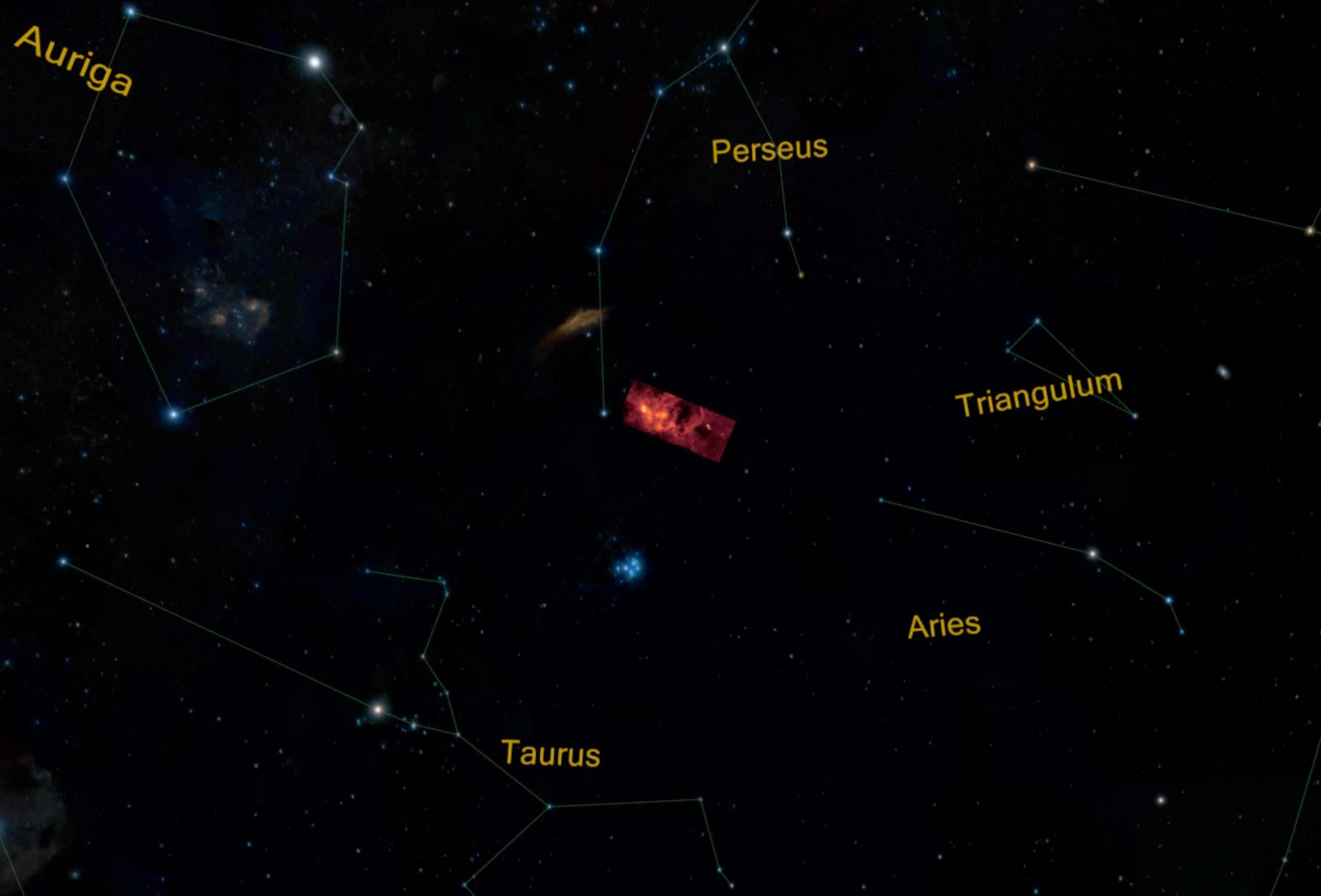
On the right side of the image is a bright clump of young stars known as NGC 1333, which Spitzer has observed multiple times. It is located about 1,000 light-years from Earth. That sounds far, but it is close compared to the size of our galaxy, which is about 100,000 light-years across. NGC 1333’s proximity and strong infrared emissions made it visible to astronomers using some of the earliest infrared instruments.
In fact, some of its stars were first observed in the mid-1980s with the Infrared Astronomical Survey (IRAS), a joint mission between NASA, the United Kingdom, and the Netherlands. The first infrared satellite telescope, it observed the sky in infrared wavelengths blocked by Earth’s atmosphere, providing the first-ever view of the universe in those wavelengths.

More than 1,200 peer-reviewed research papers have been written about NGC 1333, and it has been studied in other wavelengths of light, including by the Hubble Space Telescope, which detects mostly visible light, and the Chandra X-Ray Observatory.
Many young stars in the cluster are sending massive outflows of material — the same material that forms the star — into space. As the material is ejected, it is heated up and smashes into the surrounding interstellar medium. These factors cause the jets to radiate brightly, and they can be seen in close-up studies of the region. This has provided astronomers with a clear glimpse of how stars go from a sometimes-turbulent adolescence into calmer adulthood.
An Evolving Mystery
Other clusters of stars seen below NGC 1333 in this image have posed a fascinating mystery for astronomers: They appear to contain stellar infants, adolescents, and adults. Such a closely packed mixture of ages is extremely odd, according to Luisa Rebull, an astrophysicist at NASA’s Infrared Science Archive at Caltech-IPAC who has studied NGC 1333 and some of the clusters below it. Although many stellar siblings may form together in tight clusters, stars are always moving, and as they grow older they tend to move farther and farther apart.
Finding such a closely packed mixture of apparent ages doesn’t fit with current ideas about how stars evolve. “This region is telling astronomers that there’s something we don’t understand about star formation,” said Rebull. The puzzle presented by this region is one thing that keeps astronomers coming back to it. “It’s one of my favorite regions to study,” she added.
Since IRAS’s early observations, the region has come into clearer focus, a process that is common in astronomy, said Rebull. New instruments bring more sensitivity and new techniques, and the story becomes clearer with each new generation of observatories. On January 30, 2020, NASA will decommission the Spitzer Space Telescope, but its legacy has paved the way for upcoming observatories, including the James Webb Space Telescope, which will also observe infrared light.
The Spitzer-MIPS data used for this image is at the infrared wavelength of 24 microns. Small gaps along the edges of this image not observed by Spitzer were filled in using 22-micron data from NASA’s Wide-Field Infrared Survey Explorer (WISE).
Never miss a breakthrough: Join the SciTechDaily newsletter.
Follow us on Google and Google News.