

A newly published study from the Harvard-Smithsonian Center for Astrophysics follows up on Kepler’s discoveries, revealing that exoplanets can be divided into three groups: terrestrials, gas giants, and mid-sized gas dwarfs.
The planets of our solar system come in two basic flavors, like vanilla and chocolate ice cream. We have small, rocky terrestrials like Earth and Mars, and large gas giants like Neptune and Jupiter. We’re missing the astronomical equivalent of strawberry ice cream – planets between about one and four times the size of Earth. NASA’s Kepler mission has discovered that these types of planets are very common around other stars.
New research following up on the Kepler discoveries shows that alien worlds, or exoplanets, can be divided into three groups — terrestrials, gas giants, and mid-sized “gas dwarfs” — based on how their host stars tend to fall into three distinct groups defined by their compositions.
“We were particularly interested in probing the planetary regime smaller than four times the size of Earth, because it includes three-fourths of the planets found by Kepler. That’s where you’ll find rocky worlds, which are the only kind that we would consider potentially habitable,” says lead author Lars A. Buchhave of the Harvard-Smithsonian Center for Astrophysics (CfA).
Buchhave presented his research today in a press conference at a meeting of the American Astronomical Society.
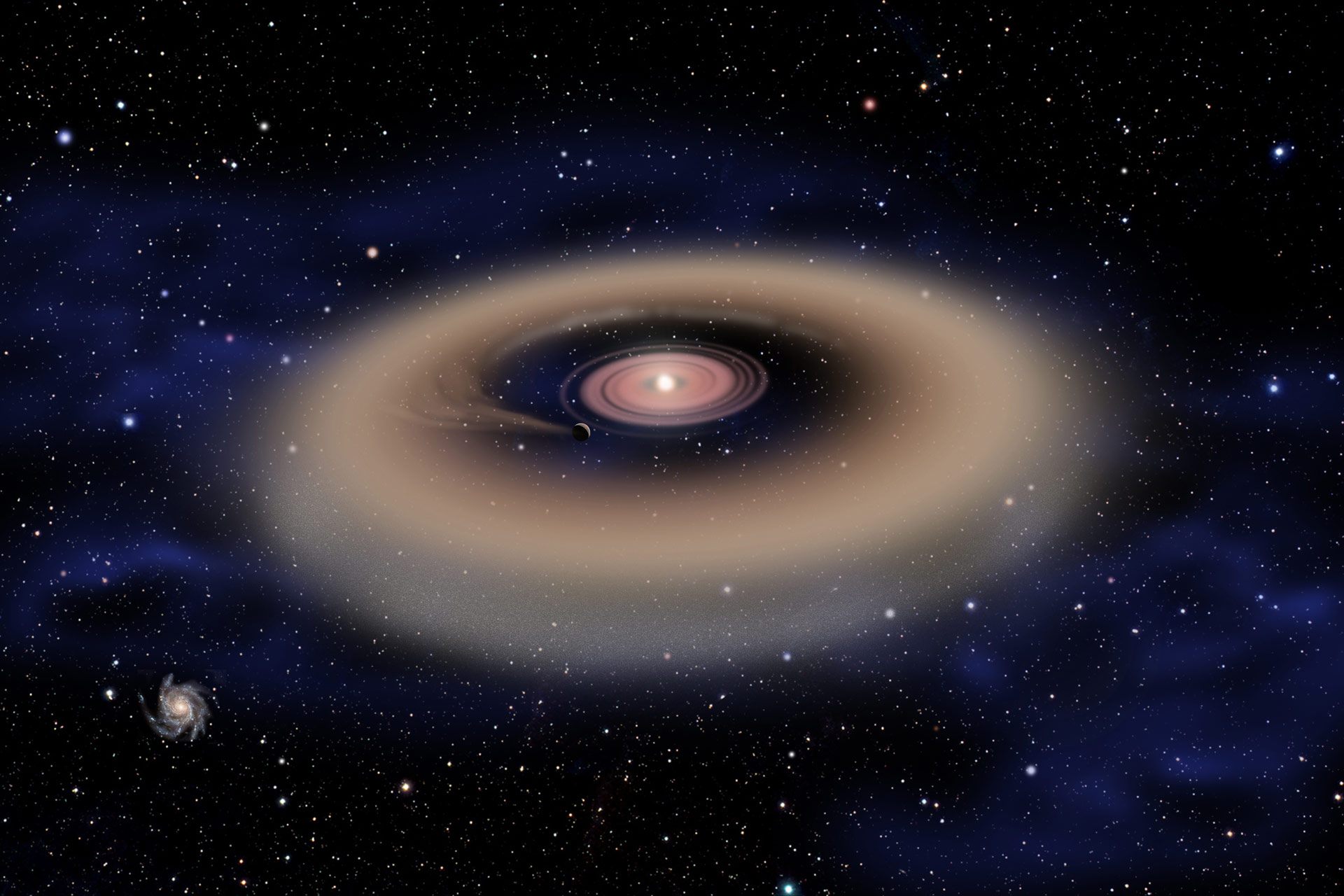
Kepler finds exoplanets using the transit method, looking for a star that dims as a planet passes in front of it from our point of view. We can learn the planet’s size from how much starlight it blocks. However, to determine the planet’s composition we need to measure its mass, so its density can be calculated. A rocky planet will be much denser than a gas giant. Unfortunately, the smaller a planet, the harder it is to measure its mass, especially for the dim and distant stars examined by Kepler.
Buchhave and his colleagues took a different approach. They measured the amount of elements heavier than hydrogen and helium, which astronomers collectively call metals, in stars with exoplanet candidates. Since a star and its planets form from the same disk of material, the metallicity of a star reflects the composition of the protoplanetary disk.
The team took follow-up spectra of more than 400 stars hosting over 600 exoplanets. Then, they conducted a statistical test to see if the sizes of the planets fell into natural groups, along with the stellar metallicities.
They found two clear dividing lines – one at a size 1.7 times as large as Earth and the other at a size 3.9 times larger than Earth. They infer that these boundaries also mark changes in composition. Planets smaller than 1.7 Earths are likely to be completely rocky, while those larger than 3.9 Earths are probably gas giants.
Planets between 1.7 and 3.9 times the size of Earth were dubbed gas dwarfs since they have thick atmospheres of hydrogen and helium. The rocky cores of gas dwarfs formed early enough to accrete some gas, although they did not grow as large as gas giants like Jupiter.
In addition, Buchhave and his collaborators discovered that the size of the largest rocky world isn’t fixed. The farther a planet is from its star, the larger it can grow before accumulating a thick atmosphere and turning into a gas dwarf. This suggests that some super-Earths can grow into true monsters.
Finally, the team found that stars with small, terrestrial worlds tended to have metallicities similar to the Sun. Stars hosting gas dwarfs tended to be slightly more metal-rich. Stars with gas giants contained the most metals – about 50 percent more than our Sun.
“It seems that there is a ‘sweet spot’ of metallicity to get Earth-size planets, and it’s about the same as the Sun. That makes sense because at lower metallicities you have fewer of the building blocks for planets, and at higher metallicities you tend to make gas giants instead,” explains Buchhave.
He emphasizes that metallicity is only one of many factors determining what kinds of planets will form around a given star. Also, their study was limited to relatively close-in planets since those were the easiest for Kepler to spot. They plan to extend their study to planets in wider orbits as that data becomes available.
Headquartered in Cambridge, Massachusetts, the Harvard-Smithsonian Center for Astrophysics (CfA) is a joint collaboration between the Smithsonian Astrophysical Observatory and the Harvard College Observatory. CfA scientists, organized into six research divisions, study the origin, evolution, and ultimate fate of the universe.
Reference: “Three regimes of extrasolar planet radius inferred from host star metallicities” by Lars A. Buchhave, Martin Bizzarro, David W. Latham, Dimitar Sasselov, William D. Cochran, Michael Endl, Howard Isaacson, Diana Juncher and Geoffrey W. Marcy, 28 May 2014, Nature.
DOI: 10.1038/nature13254
arXiv: 1405.7695
Never miss a breakthrough: Join the SciTechDaily newsletter.
Follow us on Google and Google News.