
University of Virginia School of Engineering and Northwestern University researchers create a new polymer-based electrical insulation for circuits that could help put more power in smaller spaces.
Progress in the field of integrated circuits is measured by matching, exceeding, or falling behind the rate set forth by Gordon Moore, former CEO and co-founder of Intel, who said the number of electronic components, or transistors, per integrated circuit would double every year. That was more than 50 years ago, and surprisingly his prediction, now called Moore’s Law, came true.
In recent years, it was thought that the pace had slowed; one of the biggest challenges of putting more circuits and power on a smaller chip is managing heat.
A multidisciplinary group that includes Patrick E. Hopkins, a professor in the University of Virginia’s Department of Mechanical and Aerospace Engineering with a courtesy appointment in the Department of Materials Science, and Will Dichtel, a professor in Northwestern University’s Department of Chemistry, is inventing a new class of material with the potential to keep chips cool as they keep shrinking in size — and to help Moore’s Law remain true. Their work was recently published in Nature Materials.
Low-k Dielectrics in Modern Chips
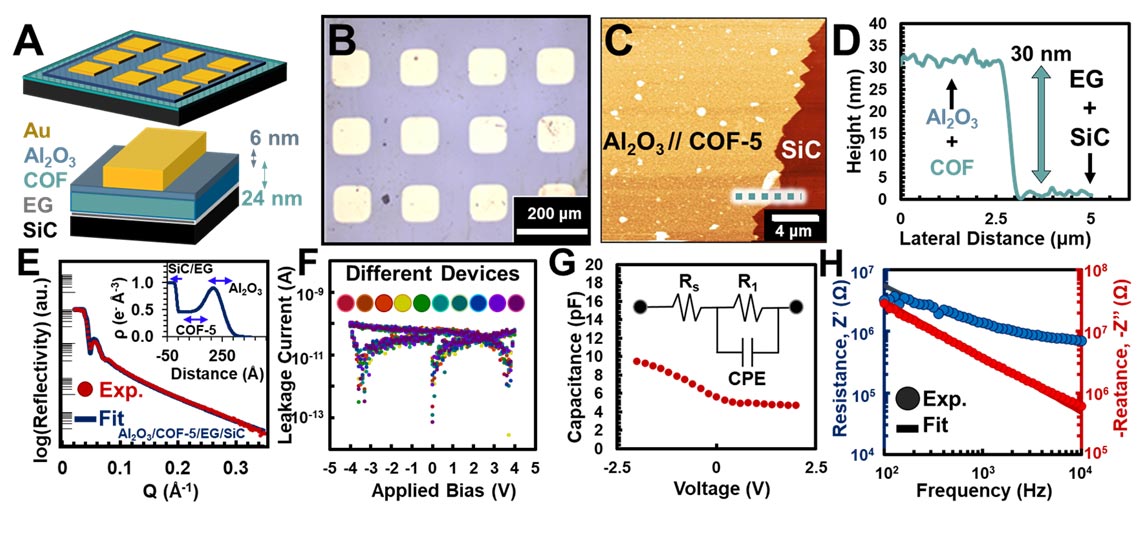
Electrical insulation materials that minimize electrical crosstalk in chips are called “low-k” dielectrics. This material type is the silent hero that makes all electronics possible by steering the current to eliminate signal erosion and interference; ideally, it can also pull damaging heat caused by electrical current away from the circuitry. The heat problem becomes exponential as the chip gets smaller because not only are there more transistors in a given area, which makes more heat in that same area, they are closer together, which makes it harder for heat to dissipate.
“Scientists have been in search of a low-k dielectric material that can handle the heat transfer and space issues inherent at much smaller scales,” Hopkins said. “Although we’ve come a long way, new breakthroughs are just not going to happen unless we combine disciplines. For this project we’ve used research and principles from several fields – mechanical engineering, chemistry, materials science, electrical engineering — to solve a really tough problem that none of us could work out on our own.”
Hopkins is one of the leaders of UVA Engineering’s Multifunctional Materials Integration initiative, which brings together researchers from multiple engineering disciplines to formulate materials with a wide array of functionalities.
“Seeing ‘my’ problem through someone else’s lens in a different field was not only fascinating, it also sparked ideas that ultimately brought advancement. I think we all had that experience,” said Ashutosh Giri, a former UVA Engineering senior scientist and Ph.D. student in Hopkins’ lab, the co-first author on the Nature Materials paper and a mechanical, industrial and systems engineering assistant professor at Rhode Island University.
“The heart of the project was when the chemical team realized the thermal functionality of their material, understanding a new dimension about their work, and when the mechanical and materials team understood the level of molecular engineering possible with chemistry,” Giri said.
2D Polymers Open New Possibilities
“We’re taking sheets of polymer that are only one atom thick – we call this 2D – and controlling their properties by layering the sheets in a specific architecture,” Dichtel said. “Our efforts on improving the methods to produce high-quality 2D polymer films enabled this collaborative work.”
The team is applying this new material class to try to meet the requirements of miniaturizing transistors on a dense chip, Dichtel said.
“This has enormous potential for use in the semiconductor industry, the industry that manufactures chips. The material has both low electrical conductivity, or ‘low-k,’ and high heat transfer capability,” he said.
This combination of properties was recently identified by the International Roadmap for Semiconductors as a prerequisite for next-generation integrated circuits.
“For this project, we are focusing on the thermal properties of this new material class, which is fantastic, but even more exciting is that we are just scratching the surface,” said Austin Evans, a Ph.D. student in Dichtel’s lab at Northwestern and first co-author on the Nature Materials paper. “Developing new classes of materials with unique combinations of properties has amazing technological potential.
“We are already exploring this new class of materials for many applications, for instance, chemical sensing. We can use these materials to determine — ‘sense’ — what chemicals and how much of those chemicals are in the air. This has broad reaching implications. For instance, by knowing about the chemicals in the air, we can optimize food storage, transport, and distribution to reduce global food waste. As we continue exploring, we are likely to find even more traits unique to these new materials,” Evans said.
Reference: “Thermally conductive ultra-low-k dielectric layers based on two-dimensional covalent organic frameworks” by Austin M. Evans, Ashutosh Giri, Vinod K. Sangwan, Sangni Xun, Matthew Bartnof, Carlos G. Torres-Castanedo, Halleh B. Balch, Matthew S. Rahn, Nathan P. Bradshaw, Edon Vitaku, David W. Burke, Hong Li, Michael J. Bedzyk, Feng Wang, Jean-Luc Brédas, Jonathan A. Malen, Alan J. H. McGaughey, Mark C. Hersam, William R. Dichtel and Patrick E. Hopkins, 18 March 2021, Nature Materials.
DOI: 10.1038/s41563-021-00934-3
Never miss a breakthrough: Join the SciTechDaily newsletter.
Follow us on Google and Google News.
3 Comments
“Gordon Moore, … said the number of electronic components, or transistors, per integrated circuit would double every year.”
That was his initial guess. It is now generally accepted to double every TWO years.
https://en.wikipedia.org/wiki/Moore's_law
Well, it’s good to see that they finally got around to actually adding the article. Previously it was just a title with two pictures…
… just add more cores and we will be fine…