
Close Menu
    Facebook X (Twitter) Instagram
    SciTechDaily
    • Biology
    • Chemistry
    • Earth
    • Health
    • Physics
    • Science
    • Space
    • Technology
    Facebook X (Twitter) Pinterest YouTube RSS
    SciTechDaily
    Home»Earth»Exploring Earth From Space: Vancouver, British Columbia, Canada
    Earth

    Exploring Earth From Space: Vancouver, British Columbia, Canada

    By European Space Agency (ESA)March 1, 2021No Comments3 Mins Read
    Facebook Twitter Pinterest Telegram LinkedIn WhatsApp Email Reddit
    Share
    Facebook Twitter LinkedIn Pinterest Telegram Email Reddit
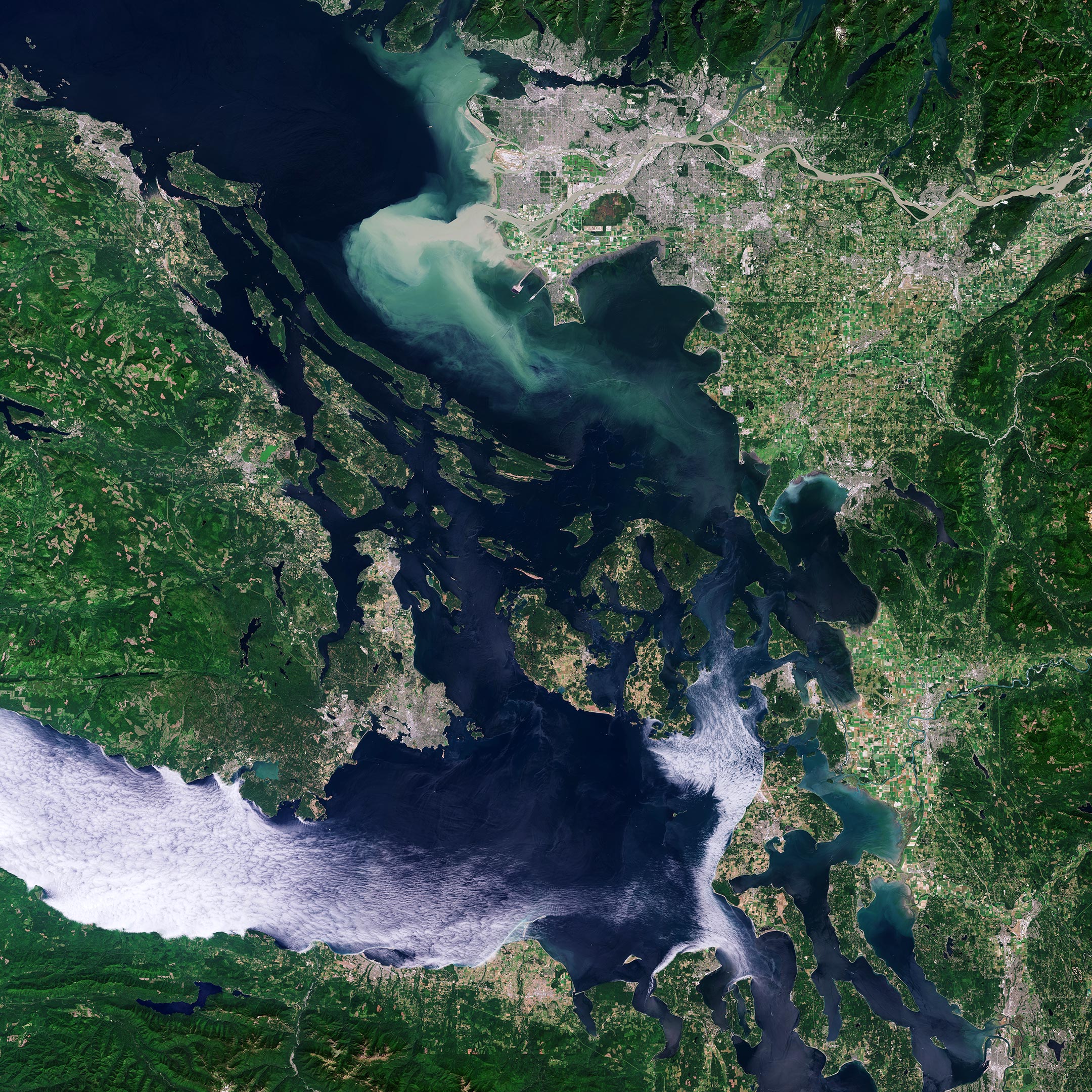
    Vancouver Canada From Space
    This image was captured by the Copernicus Sentinel-2 mission on July 29, 2019. Vancouver, visible at the top of the image, lies between Burrard Inlet, an arm of the Strait of Georgia, to the north, and the Fraser River delta to the south. Credit: Contains modified Copernicus Sentinel data (2019), processed by ESA, CC BY-SA 3.0 IGO

    Vancouver, visible at the top of the image, lies between the Burrard Inlet, an arm of the Strait of Georgia, to the north, and the Fraser River delta to the south. Vancouver has the highest population density in Canada, with over 5,400 people per square kilometer (0.39 square mile), making it the fifth-most densely populated city in North America.

    In this image, captured on July 29, 2019, an unusually large quantity of sediment can be seen gushing from the Fraser River into the Strait of Georgia. The Fraser River is the longest river within British Columbia rising at Fraser Pass in the Rocky Mountains and flows for over 1,300 km (800 mi) before emptying into the strait. The river’s annual discharge at its mouth is estimated to be around 3,550 cubic meters (925,000 gallons) per second, and is said to discharge around 20 million tonnes of sediment into the ocean.

    Several ships and vessels can be easily spotted at the top of the image, in the Burrard Inlet, which separates the city of Vancouver from the slopes of the North Shore Mountains (not visible).

    Vancouver Island dominates the left-side of the image. Covering an area of over 31,000 sq km (12,000 sq mi), it is the largest island on the Pacific coast of North America. The island is heavily wooded and mountainous with several peaks of more than 2,100 m (6,900 ft).

    At the bottom of the image, marine stratocumulus clouds can be seen over the Strait of Juan de Fuca, which also marks the international boundary between Canada and the United States. These types of cloud formations could be related to the Puget Sound Convergence Zone – a frequent weather phenomenon where northwest winds are split by the Olympic Mountains and then re-converge over Puget Sound, visible in the bottom-right of the image.

    Copernicus Sentinel-2 is a two-satellite mission. Each satellite carries a high-resolution camera that images Earth’s surface in 13 spectral bands. The mission is mostly used to track changes in the way land is being used and to monitor the health of our vegetation.

    Never miss a breakthrough: Join the SciTechDaily newsletter.
    Follow us on Google and Google News.

    European Space Agency Geography
    Share. Facebook Twitter Pinterest LinkedIn Email Reddit

    Related Articles

    Breathtaking View of Andros, Bahamas From Space [Video]

    Stunning Views of Houston Texas From Copernicus Sentinel-1 Satellite

    Earth From Space: Bolivian Highland Heart [Video]

    Flevoland, Netherlands From Space: One of the Largest Land Reclamation Projects in the World

    Earth From Space: Lake George, Uganda – A Center for Biological Diversity [Video]

    Deforestation in Bolivia Spied From Space Satellite

    Earth From Space: Japanese Archipelago [Video]

    Earth From Space: Faroe Islands [Video]

    Earth From Space: Tromsø, Norway [Video]

    Leave A Reply Cancel Reply

    • Facebook
    • Twitter
    • Pinterest
    • YouTube

    Don't Miss a Discovery

    Subscribe for the Latest in Science & Tech!

    Trending News

    Scientists May Have Found the Key to Jupiter and Saturn’s Moon Mystery

    Scientists Uncover Brain Changes That Link Pain to Depression

    Saunas May Do More Than Raise Body Temperature – They Activate Your Immune System

    Exercise in a Pill? Metformin Shows Surprising Effects in Cancer Patients

    Hidden Oceans of Magma Could Be Protecting Alien Life

    New Study Challenges Alzheimer’s Theories: It’s Not Just About Plaques

    Artificial Sweeteners May Harm Future Generations, Study Suggests

    Splashdown! NASA Artemis II Returns From Record-Breaking Moon Mission

    Follow SciTechDaily
    • Facebook
    • Twitter
    • YouTube
    • Pinterest
    • Newsletter
    • RSS
    SciTech News
    • Biology News
    • Chemistry News
    • Earth News
    • Health News
    • Physics News
    • Science News
    • Space News
    • Technology News
    Recent Posts
    • Physicists Discover a Strange New Kind of One-Dimensional Particle
    • Scientists Discover Unexpected Climate Benefit Hidden in Forest Soils
    • The Grand Canyon’s “Swiss Cheese” Rocks Hold a Critical Secret
    • Scientists Discover 430,000-Year-Old Wooden Tools, Rewriting Human History
    • Scientists Make Breakthrough on 40-Year-Old 2D Physics Puzzle
    Copyright © 1998 - 2026 SciTechDaily. All Rights Reserved.
    • Science News
    • About
    • Contact
    • Editorial Board
    • Privacy Policy
    • Terms of Use

    Type above and press Enter to search. Press Esc to cancel.