
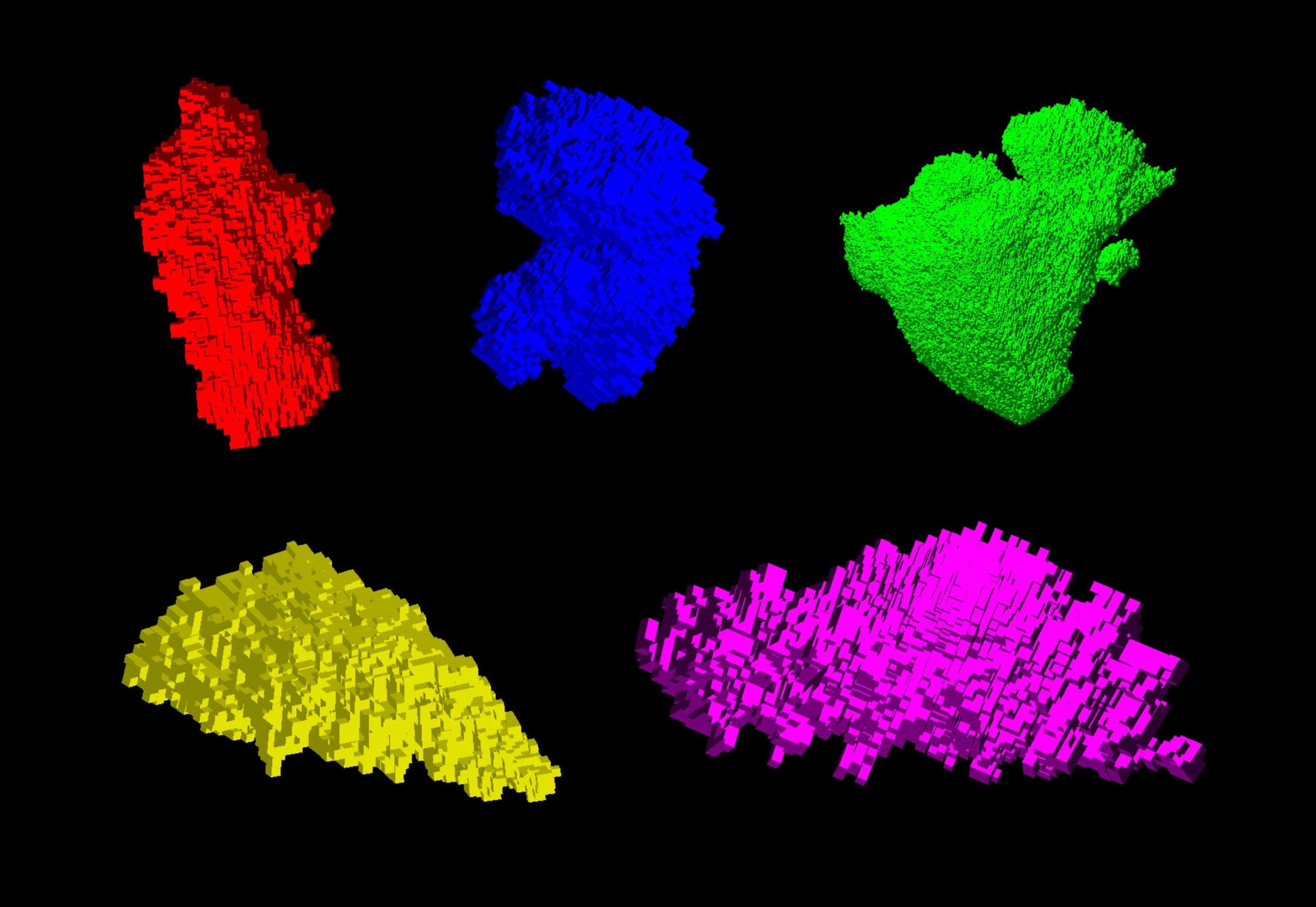
NIST researchers found that moon dust shape affects the Moon’s light reflection, potentially aiding satellite calibration and atmospheric studies.
Like a chameleon of the night sky, the Moon often changes its appearance. It might look larger, brighter, or redder, for example, due to its phases, its position in the solar system, or smoke in Earth’s atmosphere. (It is not made of green cheese, however.)
Another factor in its appearance is the size and shape of moon dust particles, the small rock grains that cover the moon’s surface. Researchers at the National Institute of Standards and Technology (NIST) are now measuring tinier moon dust particles than ever before, a step toward more precisely explaining the Moon’s apparent color and brightness. This in turn might help improve tracking of weather patterns and other phenomena by satellite cameras that use the Moon as a calibration source.
Tiny Dust, Big Tools
NIST researchers and collaborators have developed a complex method of measuring the exact three-dimensional shape of 25 particles of moon dust collected during the Apollo 11 mission in 1969. The team includes researchers from the Air Force Research Laboratory, the Space Science Institute and the University of Missouri-Kansas City.
These researchers have been studying moon dust for several years. But as described in a new journal paper, they now have X-ray nano computed tomography (XCT), which allowed them to examine the shape of particles as small as 400 nanometers (billionths of a meter) in length.
The research team developed a method for both measuring and computationally analyzing how the dust particle shapes scatter light. Follow-up studies will include many more particles, and more clearly link their shape to light scattering. Researchers are especially interested in a feature called “albedo,” moonspeak for how much light or radiation it reflects.
NIST researchers have been measuring moon dust collected during the Apollo missions for several years. Materials scientist Ann Chiaramonti Debay explains why.
The recipe for measuring the Moon’s nano dust is complicated. First you need to mix it with something, as if making an omelet, and then turn it on a stick for hours like a rotisserie chicken. Straws and dressmakers’ pins are involved too.
“The procedure is elaborate because it is hard to get a small particle by itself, but one needs to measure many particles for good statistics, since they are randomly distributed in size and shape,” NIST Fellow Ed Garboczi said.
“Since they are so tiny and because they only come in powders, a single particle needs to be separated from all the others,” Garboczi continued. “They are too small to do that by hand, at least not in any quantity, so they must be carefully dispersed in a medium. The medium must also freeze their mechanical motion, in order to be able to get good XCT images. If there is any movement of the particles during the several hours of the XCT scan, then the images will be badly blurred and generally not usable. The final form of the sample must also be compatible with getting the X-ray source and camera close to the sample while it rotates, so a narrow, straight cylinder is best.”
The procedure involved stirring the Apollo 11 material into epoxy, which was then dripped over the outside of a tiny straw to get a thin layer. Small pieces of this layer were then removed from the straw and mounted on dressmakers’ pins, which were inserted into the XCT instrument.
The XCT machine generated X-ray images of the samples that were reconstructed by software into slices. NIST software stacked the slices into a 3D image and then converted it into a format that classified units of volume, or voxels, as either inside or outside the particles. The 3D particle shapes were identified computationally from these segmented images. The voxels making up each particle were saved in separate files that were forwarded to software for solving electromagnetic scattering problems in the visible to the infrared frequency range.
Shaping the Spectrum
The results indicated that the color of light absorbed by a moon dust particle is highly sensitive to its shape and can be significantly different from that of spherical or ellipsoidal particles of the same size. That doesn’t mean too much to the researchers — yet.
“This is our first look at the influence of actual shapes of lunar particles on light scattering and focuses on some fundamental particle properties,” co-author Jay Goguen of the Space Science Institute said. “The models developed here form the basis of future calculations that could model observations of the spectrum, brightness, and polarization of the moon’s surface and how those observed quantities change during the moon’s phases.”
The authors are now studying a wider range of moon dust shapes and sizes, including particles collected during the Apollo 14 mission in 1971. The moon dust samples were loaned to NIST by NASA’s Curation and Analysis Planning Team for Extraterrestrial Materials program.
Reference: “Optical Scattering Characteristics of 3-D Lunar Regolith Particles Measured Using X-Ray Nano Computed Tomography” by Somen Baidya, Mikolas Melius, Ahmed M. Hassan, Andrew Sharits, Ann N. Chiaramonti, Thomas Lafarge, Jay D. Goguen and Edward J. Garboczi, 27 April 2021, IEEE Geoscience and Remote Sensing Letters.
DOI: 10.1109/LGRS.2021.3073344
Never miss a breakthrough: Join the SciTechDaily newsletter.
Follow us on Google and Google News.