
Close Menu
    Facebook X (Twitter) Instagram
    SciTechDaily
    • Biology
    • Chemistry
    • Earth
    • Health
    • Physics
    • Science
    • Space
    • Technology
    Facebook X (Twitter) Pinterest YouTube RSS
    SciTechDaily
    Home»Science»Fashion Gets a Charge: The Electrifying New Conductive Cotton Fiber
    Science

    Fashion Gets a Charge: The Electrifying New Conductive Cotton Fiber

    By Washington State UniversityDecember 26, 2023No Comments4 Mins Read
    Facebook Twitter Pinterest Telegram LinkedIn WhatsApp Email Reddit
    Share
    Facebook Twitter LinkedIn Pinterest Telegram Email Reddit
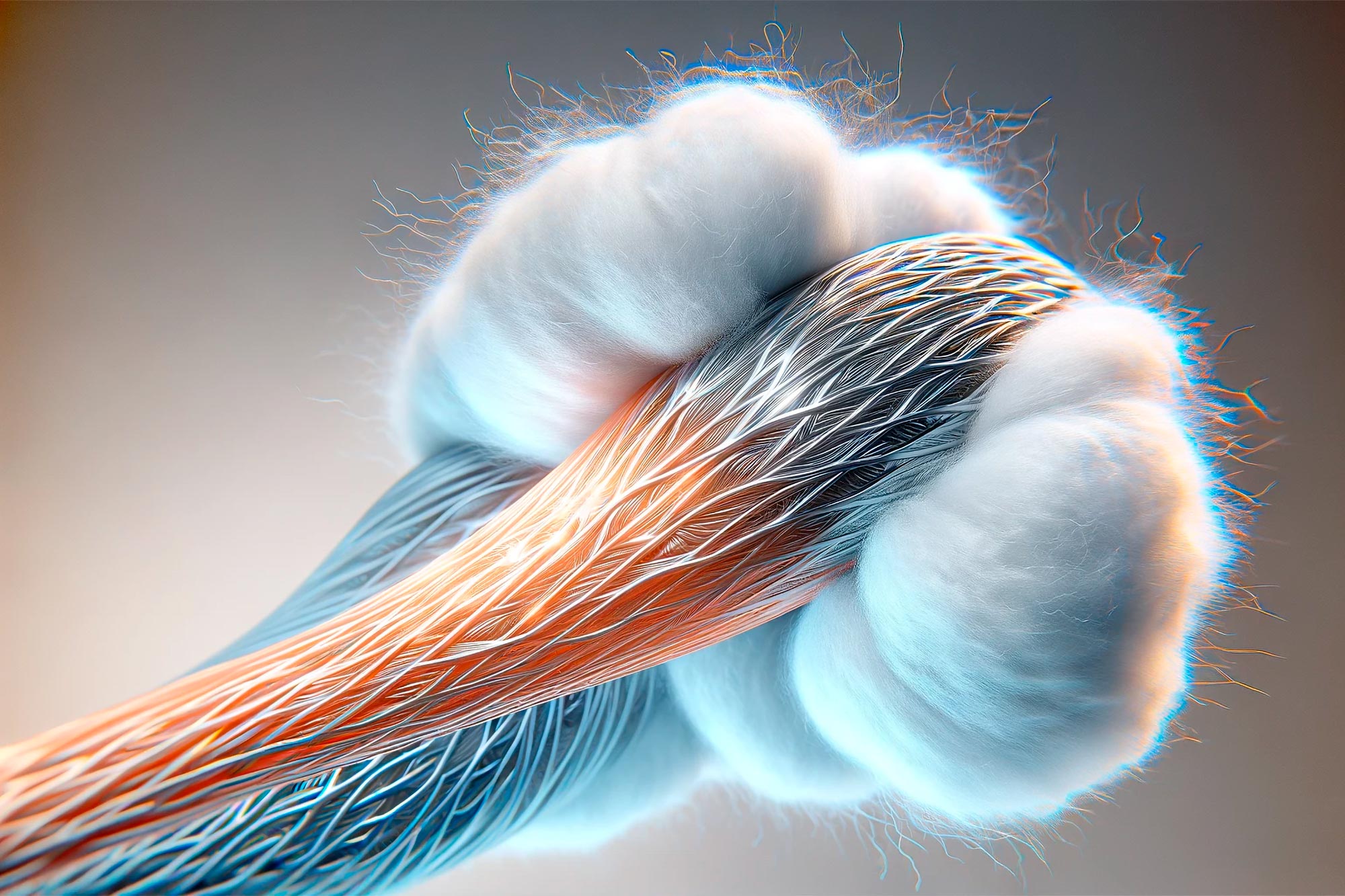
    Conductive Cotton Fiber Concept
    Researchers have developed a novel fiber blending the flexibility of cotton with the conductivity of polyaniline, a polymer. This innovative material, detailed in “Carbohydrate Polymers,” shows potential in creating wearable e-textiles for applications like health monitoring and hazardous exposure detection. (Artist’s concept.) Credit: SciTechDaily.com

    A breakthrough at Washington State University combines cotton’s flexibility with the conductivity of a polymer, paving the way for advanced wearable e-textiles.

    A single strand of fiber developed at Washington State University has the flexibility of cotton and the electric conductivity of a polymer, called polyaniline.

    The newly developed material showed good potential for wearable e-textiles. The WSU researchers tested the fibers with a system that powered an LED light and another that sensed ammonia gas, detailing their findings in the journal Carbohydrate Polymers.

    Conductive Cotton-Based Fiber
    A microscopic image of the newly developed fibers showing their side-by-side mix where one side is cotton and the other contains the polyanaline polymer that can carry an electric current. Credit: Washington State University

    “We have one fiber in two sections: one section is the conventional cotton: flexible and strong enough for everyday use, and the other side is the conductive material,” said Hang Liu, WSU textile researcher and the study’s corresponding author. “The cotton can support the conductive material which can provide the needed function.”

    Potential Applications in Wearable Technology

    While more development is needed, the idea is to integrate fibers like these into apparel as sensor patches with flexible circuits. These patches could be part of uniforms for firefighters, soldiers or workers who handle chemicals to detect for hazardous exposures. Other applications include health monitoring or exercise shirts that can do more than current fitness monitors.

    “We have some smart wearables, like smartwatches, that can track your movement and human vital signs, but we hope that in the future your everyday clothing can do these functions as well,” said Liu. “Fashion is not just color and style, as a lot of people think about it: fashion is science.”
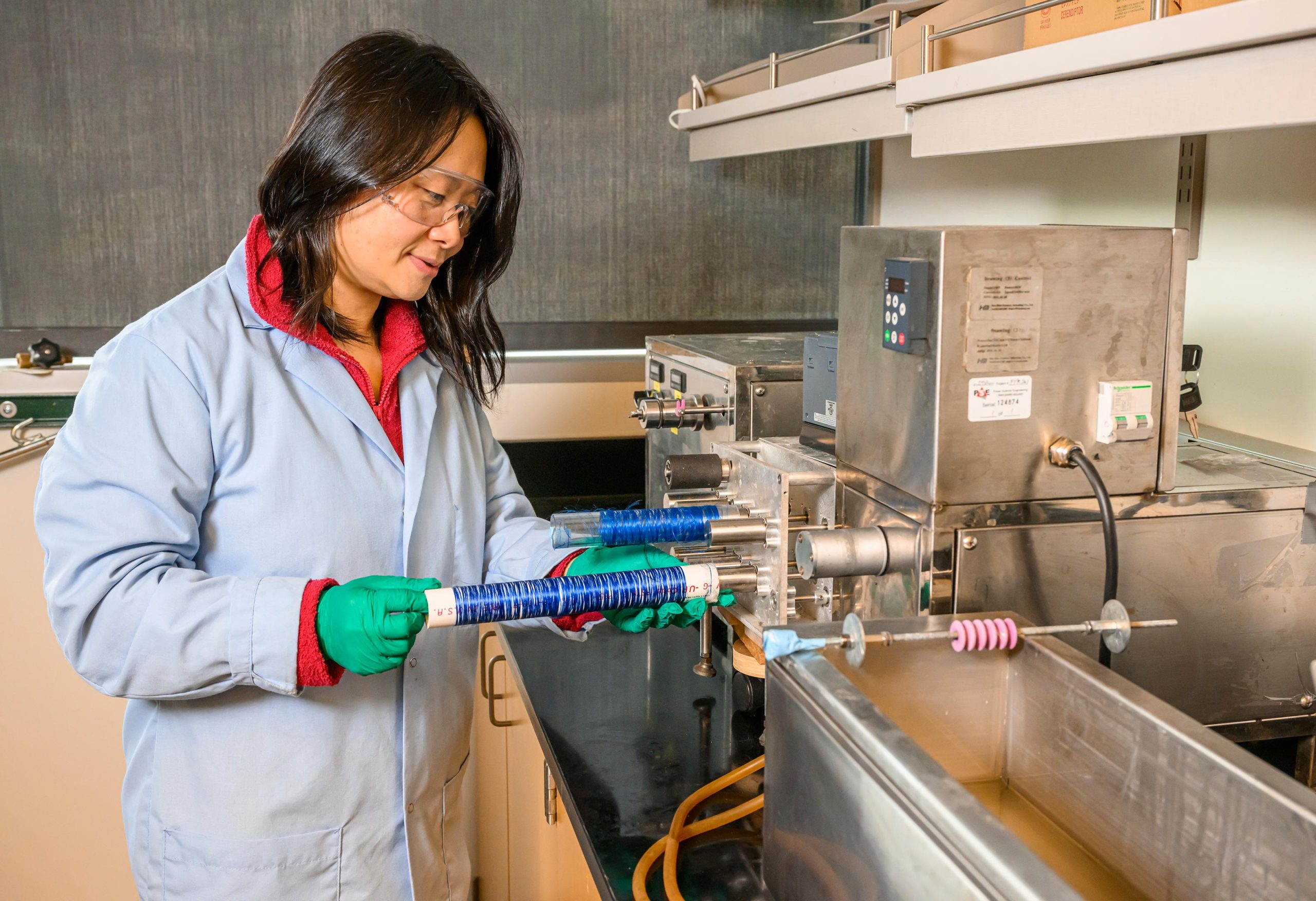
    Hang Liu Textile Researcher
    Washington State University textile researcher Hang Liu. Credit: Dean Hare, Washington State University

    Technical Challenges and Solutions

    In this study, the WSU team worked to overcome the challenges of mixing the conductive polymer with cotton cellulose. Polymers are substances with very large molecules that have repeating patterns. In this case, the researchers used polyaniline, also known as PANI, a synthetic polymer with conductive properties already used in applications such as printed circuit board manufacturing.

    While intrinsically conductive, polyaniline is brittle and by itself, cannot be made into a fiber for textiles. To solve this, the WSU researchers dissolved cotton cellulose from recycled t-shirts into a solution and the conductive polymer into another separate solution. These two solutions were then merged together side-by-side, and the material was extruded to make one fiber.

    Hang Liu Conductive Fiber
    Washington State University textile researcher Hang Liu views a a microscopic image of the newly developed fibers showing their side-by-side mix where one side is cotton and the other contains the polyanaline polymer that can carry an electric current. Credit: Dean Hare, Washington State University

    The result showed good interfacial bonding, meaning the molecules from the different materials would stay together through stretching and bending.

    Achieving the right mixture at the interface of cotton cellulose and polyaniline was a delicate balance, Liu said.

    “We wanted these two solutions to work so that when the cotton and the conductive polymer contact each other they mix to a certain degree to kind of glue together, but we didn’t want them to mix too much, otherwise the conductivity would be reduced,” she said.

    Reference: “A novel structural design of cellulose-based conductive composite fibers for wearable e-textiles” by Wangcheng Liu, Hang Liu, Zihui Zhao, Dan Liang, Wei-Hong Zhong and Jinwen Zhang, 18 August 2023, Carbohydrate Polymers.
    DOI: 10.1016/j.carbpol.2023.121308

    Additional WSU authors on this study included first author Wangcheng Liu as well as Zihui Zhao, Dan Liang, Wei-Hong Zhong and Jinwen Zhang. This research received support from the National Science Foundation and the Walmart Foundation Project.

    Never miss a breakthrough: Join the SciTechDaily newsletter.
    Follow us on Google and Google News.

    Fiber Washington State University
    Share. Facebook Twitter Pinterest LinkedIn Email Reddit

    Related Articles

    A Game-Changer in Male Contraception: Researchers Identify Key Gene

    New Study Suggests Mayas Utilized Contemporary Market-Based Economics

    Bisexuals Use Cannabis More Frequently for Coping With Mental Health Issues and “Enhancement”

    New Research Reveals the Secret to Unleashing Creativity in Conventional Thinkers

    Good Sleep Can Increase Women’s Ambitions

    Pandemic Layoffs Pushed Hospitality Workers to Leave Industry – “The Younger Generation Was Really Hit Hard”

    Scientists Identify Contents of Ancient Maya Drug Containers

    Ancient Blanket Made With 11,500 Turkey Feathers by Inhabitants of the American Southwest

    Using Machine Learning and Game Theory to Successfully Identify Bacterial Antibiotic Resistance

    Leave A Reply Cancel Reply

    • Facebook
    • Twitter
    • Pinterest
    • YouTube

    Don't Miss a Discovery

    Subscribe for the Latest in Science & Tech!

    Trending News

    New Pill Lowers Stubborn Blood Pressure and Protects the Kidneys

    Humans May Have Hidden Regenerative Powers, New Study Suggests

    Scientists Just Solved the Mystery of Why Crabs Walk Sideways

    Doctors Are Surprised by What This Vaccine Is Doing to the Heart

    This Popular Supplement May Boost Your Brain, Not Just Your Muscles

    Scientists Say This Simple Supplement May Actually Reverse Heart Disease

    Warming Oceans Could Trigger a Dangerous Methane Surge

    This Simple Movement Could Be Secretly Cleaning Your Brain

    Follow SciTechDaily
    • Facebook
    • Twitter
    • YouTube
    • Pinterest
    • Newsletter
    • RSS
    SciTech News
    • Biology News
    • Chemistry News
    • Earth News
    • Health News
    • Physics News
    • Science News
    • Space News
    • Technology News
    Recent Posts
    • New MRI Breakthrough Captures Stunningly Clear Images of the Eye and Brain
    • Scientists Warn Sitting Too Much Can Harm Your Body in Surprising Ways
    • Your Blood Pressure Reading Could Be Wrong Because of One Simple Mistake
    • Scientists Discover Cheap Material That Kills Deadly Superbugs
    • This Magnetic Field Trick Creates Entirely New Forms of Matter
    Copyright © 1998 - 2026 SciTechDaily. All Rights Reserved.
    • Science News
    • About
    • Contact
    • Editorial Board
    • Privacy Policy
    • Terms of Use

    Type above and press Enter to search. Press Esc to cancel.