
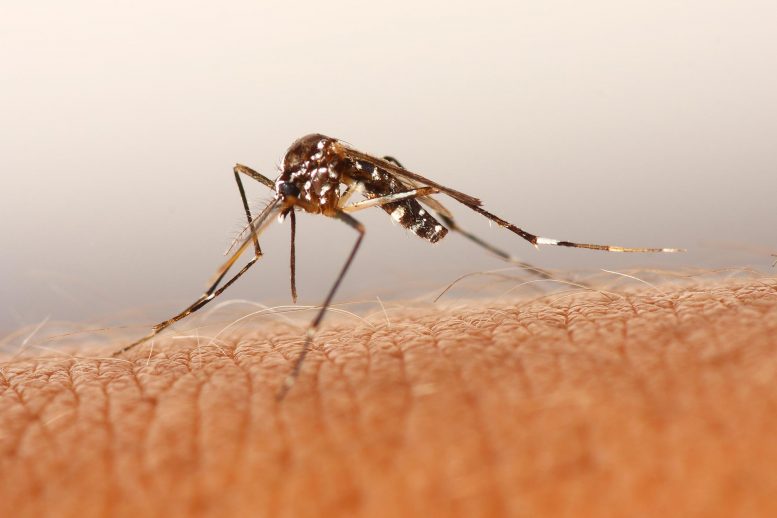
Fluoridated DDT swiftly kills disease-carrying mosquitoes, which may lower its environmental impact.
A new study published today (October 11, 2019) in the Journal of the American Chemical Society explores the chemistry as well as the complicated and alarming history of DFDT, a fast-acting insecticide.
“We set out to study the growth of crystals in a little-known insecticide and uncovered its surprising history, including the impact of World War II on the choice of DDT—and not DFDT—as a primary insecticide in the 20th century,” said Bart Kahr, professor of chemistry at New York University and one of the study’s senior authors.
Discovering solid forms of DFDT
Kahr and another NYU chemistry professor Michael Ward researched crystal development, which led them to the discovery of a novel crystal version of the deadly poison DDT two years ago. DDT is notorious for having a negative impact on the environment and wildlife. However, the new formulation created by Kahr and Ward, on the other hand, was shown to be more effective against insects—and in lower numbers, possibly reducing its environmental impact.
In continuing to explore the crystal structure of insecticides, the research team began studying fluorinated forms of DDT, swapping out chlorine atoms for fluorine. They prepared two solid forms of the compound—a monofluoro and a difluoro analog—and tested them on fruit flies and mosquitoes, including mosquito species that carry malaria, yellow fever, Dengue, and Zika. The solid forms of fluorinated DDT killed insects more quickly than did DDT; the difluoro analog, known as DFDT, killed mosquitoes two to four times faster.

“Speed thwarts the development of resistance,” said Ward, a senior author on the study. “Insecticide crystals kill mosquitoes when they are absorbed through the pads of their feet. Effective compounds kill insects quickly, possibly before they are able to reproduce.”
The researchers also made a detailed analysis of the relative activities of the solid-state forms of fluorinated DDT, noting that less thermodynamically stable forms—in which the crystals liberate molecules more easily—were more effective at quickly killing insects.
The forgotten history of DFDT
In addition to their chemical analyses, the researchers sought to determine if their creation had a precedent. In doing so, they uncovered a rich and unsettling backstory for DFDT. Through historical documents, they learned that DFDT was created as an insecticide by German scientists during World War II and was used by the German military for insect control in the Soviet Union and North Africa, in parallel with the use of DDT by American armed forces in Europe and the South Pacific.
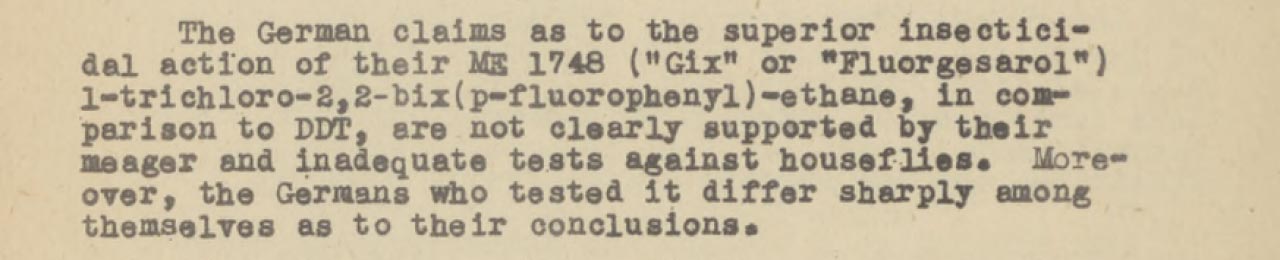
In the post-war chaos, however, DFDT manufacturing came to an abrupt end. Allied military officials who interviewed Third Reich scientists dismissed the Germans’ claims that DFDT was faster and less toxic to mammals than DDT, calling their studies “meager” and “inadequate” in military intelligence reports.
In his 1948 Nobel Prize address for the discovery of the insect-killing capability of DDT, Paul Müller noted that DFDT should be the insecticide of the future, given that it works more quickly than DDT. Despite this, DFDT has largely been forgotten and was unknown to contemporary entomologists with whom the NYU researchers consulted.
“We were surprised to discover that at the outset DDT had a competitor which lost the race because of geopolitical and economic circumstances, not to mention its connection to the German military, and not necessarily because of scientific considerations. A faster, less persistent insecticide, as is DFDT, might have changed the course of the 20th century; it forces us to imagine counterfactual science histories,” said Kahr.
The need for new insecticides
Mosquito-borne diseases such as malaria—which kills a child every two minutes—are major public health concerns, resulting in 200 million illnesses annually. Newer diseases like Zika may pose growing threats to health in the face of a changing climate.
Mosquitoes are increasingly resistant and are failing to respond to the pyrethroid insecticides built into bed nets. Public health officials are concerned and have reconsidered the use of DDT—which has been banned for decades in much of the world with the exception of selective use for malaria control—but its controversial history and environmental impact encourage the need for new insecticides.
“While more research is needed to better understand the safety and environmental impact of DFDT, we, along with the World Health Organization, recognize the urgent need for new, fast insecticides. Not only are fast-acting insecticides critical for fighting the development of resistance, but less insecticide can be used, potentially reducing its environmental impact,” said Ward.
Reference: “Manipulating Solid Forms of Contact Insecticides for Infectious Disease Prevention” by Xiaolong Zhu, Chunhua T. Hu, Jingxiang Yang, Leo A. Joyce, Mengdi Qiu, Michael D. Ward and Bart Kahr, 11 October 2019, Journal of the American Chemical Society.
DOI: 10.1021/jacs.9b08125
In addition to Ward and Kahr, the study authors are Xiaolong Zhu, Chunhua T. Hu, Jingxiang Yang, and Mengdi Qi of NYU’s Department of Chemistry, as well as Leo A. Joyce of Arrowhead Pharma. This work was supported by the NYU Materials Research Science and Engineering Center (MRSEC) program of the National Science Foundation (award number DMR-1420073). The NYU X-ray facility is supported partially by the NSF (award number CRIF/CHE-0840277).
Never miss a breakthrough: Join the SciTechDaily newsletter.
Follow us on Google and Google News.