
Close Menu
    Facebook X (Twitter) Instagram
    SciTechDaily
    • Biology
    • Chemistry
    • Earth
    • Health
    • Physics
    • Science
    • Space
    • Technology
    Facebook X (Twitter) Pinterest YouTube RSS
    SciTechDaily
    Home»Space»Fast and Furious: A Massive Cosmic Shock Wave That Extends for 6.5 Million Light Years
    Space

    Fast and Furious: A Massive Cosmic Shock Wave That Extends for 6.5 Million Light Years

    By South African Radio Astronomy ObservatoryMarch 1, 2022No Comments4 Mins Read
    Facebook Twitter Pinterest Telegram LinkedIn WhatsApp Email Reddit
    Share
    Facebook Twitter LinkedIn Pinterest Telegram Email Reddit
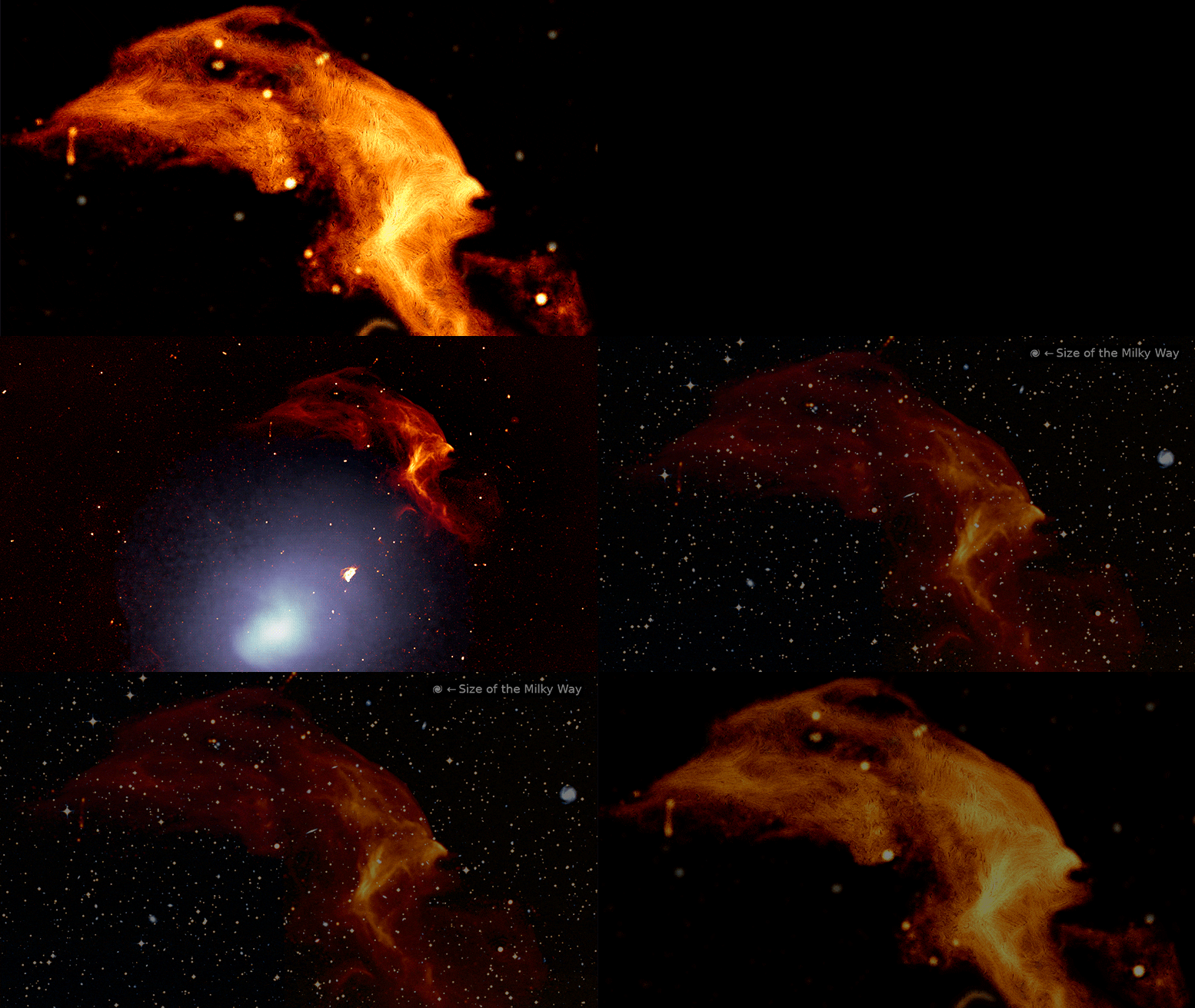
    Cosmic Shockwave
    Cosmic shock wave images.

    An international team of astronomers made the most detailed images of the largest cosmic shock wave visible from Earth. These gigantic shock waves are much larger than our entire galaxy and they form when clusters of galaxies collide in what are the most energetic events after the Big Bang.

    Our Universe is populated by galaxies that are not uniformly spread but concentrated in vast structures. The largest ones contain thousands of galaxies and are called “galaxy clusters.” Sometimes, two galaxy clusters start attracting each other via the force of gravity leading to an inevitable collision. Collisions of galaxy clusters are the most powerful events that occur in our Universe since its formation and they can generate spectacular “fireworks” that we can observe using modern radio telescopes.

    Galaxy Cluster Abell 3667
    The massive galaxy cluster Abell 3667. Individual galaxies are too small to be distinguished in this image. The white smooth color shows the distribution of the gas that permeates the space within the galaxies of this galaxy cluster. The red structures trace the two big shock waves that were generated during the formation of the galaxy cluster. Credit: Francesco de Gasperin, SARAO

    When two galaxy clusters collide, we can witness the propagation of a pair of gigantic shock waves through the newly formed cluster, similar to the sonic booms from supersonic aircraft. An international team of astronomers made the most detailed study of such cosmic shock waves that were generated during the collision of two massive galaxy clusters more than a billion years ago, forming the galaxy cluster called Abell 3667.

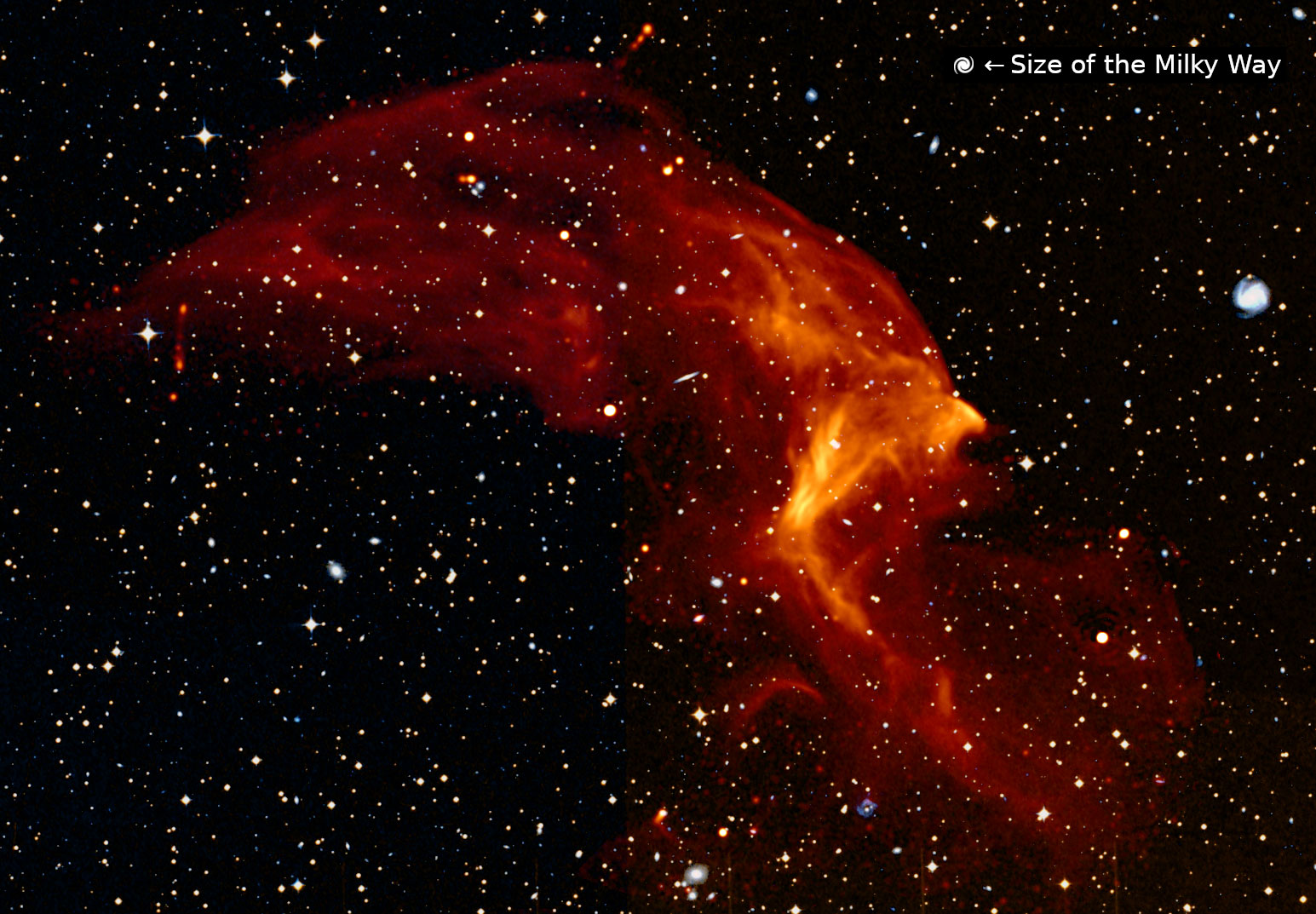
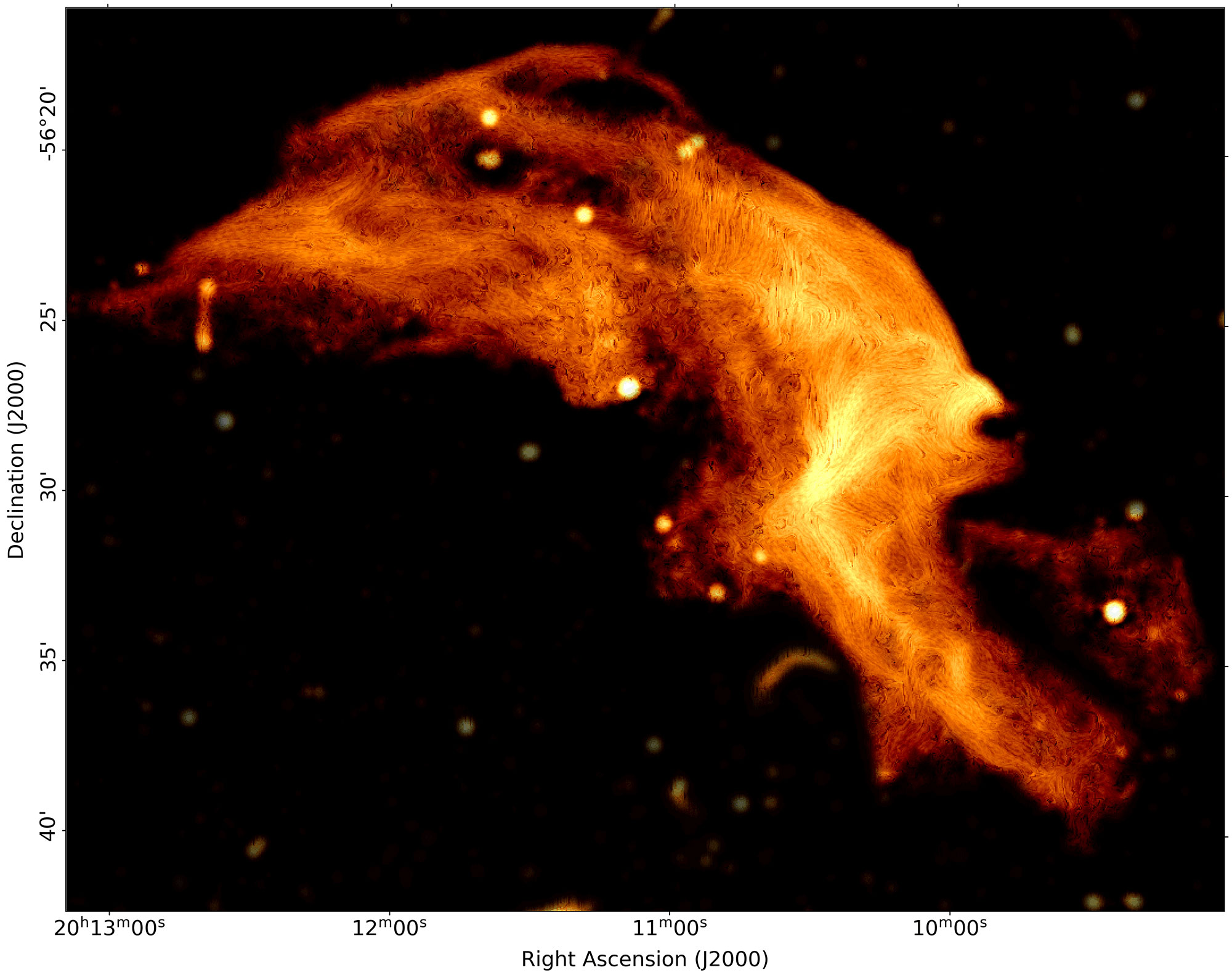
    “These structures are full of surprises and much more complex than what we initially thought,” says Prof. Francesco de Gasperin, (University of Hamburg and INAF) lead author of the study. “The shock waves act as giant particle accelerators that accelerate electrons to speeds close to the speed of light. When these fast electrons cross a magnetic field they emit the radio waves that we see. The shocks are threaded by an intricate pattern of bright filaments that trace the location of giant magnetic field lines and the regions where electrons are accelerated.”
    Milky Way Shockwave Complex Filamentary Structure
    A zoom-in on the largest of the two shock waves, where the complex filamentary structure is evident. Most of the visible galaxies are not part of the cluster, being either in the background or in front of it. The size of the Milky Way if it was at the same distance of the shock wave is also shown. Credit: Francesco de Gasperin, SARAO

    These shock waves are still propagating through the newly formed galaxy cluster at the very high speed of 1500 km/s (3.4 million mph), corresponding to a Mach number of 2.5. This means that the shock front would cross the entire Earth in the time needed to read this sentence. The size of the main shock wave is impressive, spanning the entire width of the galaxy cluster for a total size of 6.5 million light-years. For comparison, the Milky Way, the galaxy we live in, is more than 60 times smaller than this shock wave.

    These unique observations were carried out using the novel MeerKAT radio telescope, located in South Africa. This telescope consists of 64 individual radio dishes that are 13.5 m (44 ft) in diameter and are distributed over an area of 8 km (5 mi).
    Magnetic Field Lines Cluster Shock
    A view of the orientation of the magnetic field lines across the cluster shock. Credit: Francesco de Gasperin, SARAO

    “The presence of the shocks in Abell 3667 is detected using sharp changes in the properties of the hot gas, traced by its X-ray emission,” added Prof. Finoguenov at the University of Helsinki, who assisted the research by analyzing the X-ray data, collected by the XMM-Newton observatory.

    Never miss a breakthrough: Join the SciTechDaily newsletter.
    Follow us on Google and Google News.

    Astronomy Astrophysics Popular South African Radio Astronomy Observatory
    Share. Facebook Twitter Pinterest LinkedIn Email Reddit

    Related Articles

    Star Formation History of the Universe Revealed by Distant Milky Way-Like Galaxies

    A Molecular Directional Dark Matter Detector Made From Gold and DNA

    NASA Data Reveals Significant Changes in Exoplanet’s Atmosphere

    Lonestar Supercomputer Helps Explore Dark Matter

    Astronomers Obtain Precise Measurements of the Two Kepler-16 Stars

    Possible Death of Solar System Seen in White Dwarf Stars

    Ancient Galactic Collision Created Stellar Swirls of NGC 5907

    The Bolshoi Simulation: Boxing the Universe

    Scientists Convene to Take a Picture of the Supermassive Black Hole at the Center of the Milky Way

    Leave A Reply Cancel Reply

    • Facebook
    • Twitter
    • Pinterest
    • YouTube

    Don't Miss a Discovery

    Subscribe for the Latest in Science & Tech!

    Trending News

    The Universe Is Expanding Too Fast and Scientists Can’t Explain Why

    “Like Liquid Metal”: Scientists Create Strange Shape-Shifting Material

    Early Warning Signals of Esophageal Cancer May Be Hiding in Plain Sight

    Common Blood Pressure Drug Shows Surprising Power Against Deadly Antibiotic-Resistant Superbug

    Scientists Uncover Dangerous Connection Between Serotonin and Heart Valve Disease

    Scientists Discover a “Protector” Protein That Could Help Reverse Hair Loss

    Bone-Strengthening Discovery Could Reverse Osteoporosis

    Scientists Uncover Hidden Trigger Behind Stem Cell Aging

    Follow SciTechDaily
    • Facebook
    • Twitter
    • YouTube
    • Pinterest
    • Newsletter
    • RSS
    SciTech News
    • Biology News
    • Chemistry News
    • Earth News
    • Health News
    • Physics News
    • Science News
    • Space News
    • Technology News
    Recent Posts
    • A Common Diabetes Drug May Hold the Key to Stopping HIV From Coming Back
    • Ancient “Syphilis-Like” Disease in Vietnam Challenges Key Scientific Assumptions
    • Drinking Alcohol To Cope in Your 20s Could Damage Your Brain for Life
    • Scientists Crack Alfalfa’s Chromosome Mystery After Decades of Debate
    • Ancient Ant-Plant Alliance Collapses As Predatory Wasps Move In
    Copyright © 1998 - 2026 SciTechDaily. All Rights Reserved.
    • Science News
    • About
    • Contact
    • Editorial Board
    • Privacy Policy
    • Terms of Use

    Type above and press Enter to search. Press Esc to cancel.