
Close Menu
    Facebook X (Twitter) Instagram
    SciTechDaily
    • Biology
    • Chemistry
    • Earth
    • Health
    • Physics
    • Science
    • Space
    • Technology
    Facebook X (Twitter) Pinterest YouTube RSS
    SciTechDaily
    Home»Biology»Fast DNA Origami Allows Molecules to be Folded in Minutes
    Biology

    Fast DNA Origami Allows Molecules to be Folded in Minutes

    By SciTechDailyDecember 14, 2012No Comments3 Mins Read
    Facebook Twitter Pinterest Telegram LinkedIn WhatsApp Email Reddit
    Share
    Facebook Twitter LinkedIn Pinterest Telegram Email Reddit
    dna-origami-artificial
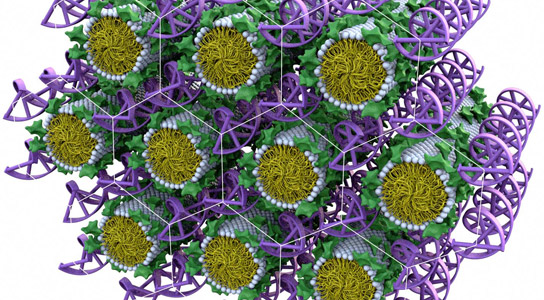
    Artificial DNA nanostructures, or DNA origami. Credit: Core.form-ula

    A new study indicates that DNA strands can be coaxed to fold into shapes in a matter of minutes. This could speed up progress in the field of DNA origami.

    The scientists published their findings in the journal Science. So far, biotechnologists have only been able to make simple forms out of DNA, like tubes, boxes, and triangles. The process has been laborious and time-consuming, and there has been no nanoscale machinery available yet.

    The new technique uses short strands of DNA to hold a longer, folded strand in place at certain points. Until now, scientists had to assemble the shape by heating the DNA and allowing it to cool over a week. The waiting time has been cut down to minutes by Hendrik Dietz, a biophysicist at the Technical University in Munich, Germany, and his team.

    Dietz and his colleagues strained the DNA with fluorescent dye and watched what happened as it cooled and folded. By stopping the reaction at different states, they checked on how far the folding and sticking had gone. They found that for most of the temperature range nothing happens; but once a crucial temperature is reached, the whole structure suddenly forms.

    Dietz analyzed the folding of 19 different DNA shapes, including cylindrical, brick-like, and cog-like objects. Each shape was folded in a narrow temperature range, between 45 °C and 60 °C (113 °F and 140 °F).

    After the temperatures were attributed to specific shapes, the scientists subjected the unfolded DNA reaction mixtures to these temperatures for just a few minutes to see whether they would fold into the desired shape. They did and the scientists obtained a high yield.

    DNA-origami experts will be able to speed up their work, and this will help them move beyond simple shapes. Dietz noticed that certain traits of the shapes that he made were correlated with the temperature at which they folded and hoped to build a computer model that would allow him to predict how to make other DNA objects. The goal is to design nanostructures with optimal folding temperatures close to 37 °C (98.6 °F), the temperature at which mammalian cell cultures are grown, so that DNA machines could one day be used in biological settings.

    Reference: “Rapid Folding of DNA into Nanoscale Shapes at Constant Temperature” by Jean-Philippe J. Sobczak, Thomas G. Martin, Thomas Gerling and Hendrik Dietz, 14 December 2012, Science.
    DOI: 10.1126/science.1229919

    Never miss a breakthrough: Join the SciTechDaily newsletter.
    Follow us on Google and Google News.

    Bionanotechnology DNA Genetics Nanotechnology
    Share. Facebook Twitter Pinterest LinkedIn Email Reddit

    Related Articles

    Scientists Discover New Type of Extra-Chromosomal DNA

    3-D Image Shows How DNA Packs Itself into a “Fractal Globule”

    Rare Example of Bacterial Gene Transfer Providing Evolutionary Benefit

    Human Y-Chromosome Has Enough Genes to Stay for Millions of Years

    Researchers Develop DNA Nanorobot to Seek Specific Cell Targets

    Researchers Study Regulatory Gene’s Role in Sperm Quality Control

    Researcher Studies Root Growth to Develop Hardier, Weather-resistant Crops

    Researchers Complete Genome Sequence of a Denisovan Human Finger Bone

    Researchers May Be Able to Sequence Genomes of Any Microbes

    Leave A Reply Cancel Reply

    • Facebook
    • Twitter
    • Pinterest
    • YouTube

    Don't Miss a Discovery

    Subscribe for the Latest in Science & Tech!

    Trending News

    Scientists Uncover Potential Brain Risks of Popular Fish Oil Supplements

    Scientists Discover a Surprising Way To Make Bread Healthier and More Nutritious

    After 60 Years, Scientists Uncover Unexpected Brain Effects of Popular Diabetes Drug Metformin

    New Research Uncovers Hidden Side Effects of Popular Weight-Loss Drugs

    Scientists Rethink Extreme Warming After Surprising Ocean Discovery

    Landmark Study Links Never Marrying to Significantly Higher Cancer Risk

    Researchers Discover Unknown Beetle Species Just Steps From Their Lab

    Largest-Ever Study Finds Medicinal Cannabis Ineffective for Anxiety, Depression, PTSD

    Follow SciTechDaily
    • Facebook
    • Twitter
    • YouTube
    • Pinterest
    • Newsletter
    • RSS
    SciTech News
    • Biology News
    • Chemistry News
    • Earth News
    • Health News
    • Physics News
    • Science News
    • Space News
    • Technology News
    Recent Posts
    • Not Just Alzheimer’s: Scientists Uncover Clues to a Second, Overlooked Disorder
    • Scientists Uncover Dangerous Connection Between Serotonin and Heart Valve Disease
    • Scientists Discover a “Protector” Protein That Could Help Reverse Hair Loss
    • Powerful Lasers Reveal How Matter Becomes Plasma in Trillionths of a Second
    • A Simpler Path to Super-Resolution: Scientists Reinvent Microscopy
    Copyright © 1998 - 2026 SciTechDaily. All Rights Reserved.
    • Science News
    • About
    • Contact
    • Editorial Board
    • Privacy Policy
    • Terms of Use

    Type above and press Enter to search. Press Esc to cancel.