
Close Menu
    Facebook X (Twitter) Instagram
    SciTechDaily
    • Biology
    • Chemistry
    • Earth
    • Health
    • Physics
    • Science
    • Space
    • Technology
    Facebook X (Twitter) Pinterest YouTube RSS
    SciTechDaily
    Home»Health»Fat Accumulates Inside Lungs of Overweight People – May Cause Asthma Symptoms
    Health

    Fat Accumulates Inside Lungs of Overweight People – May Cause Asthma Symptoms

    By European Lung FoundationOctober 21, 2019No Comments4 Mins Read
    Facebook Twitter Pinterest Telegram LinkedIn WhatsApp Email Reddit
    Share
    Facebook Twitter LinkedIn Pinterest Telegram Email Reddit
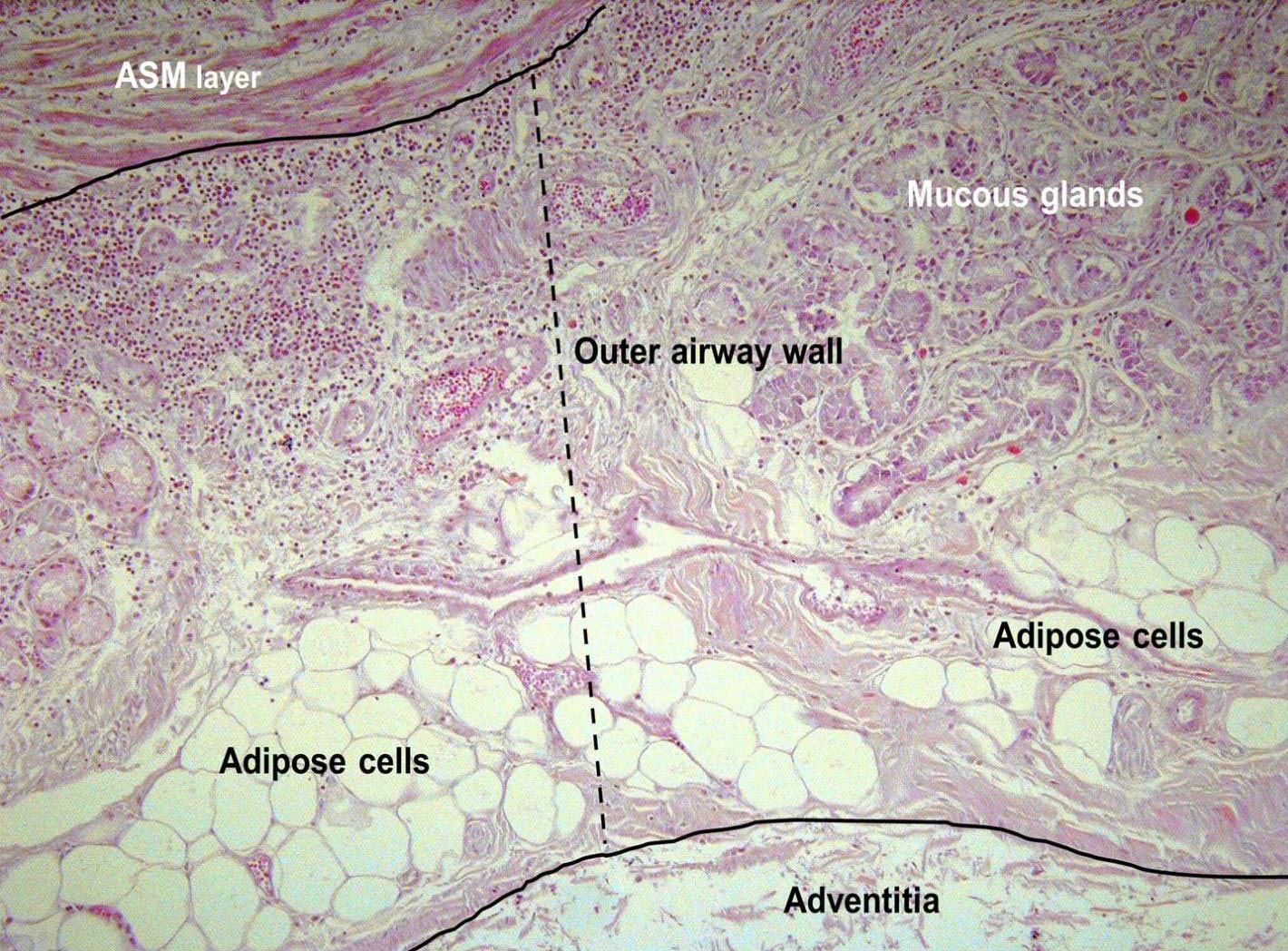
    Micrographs Fat Tissue in Lungs
    Micrographs (x200) of the (A.) outer airway wall, between the airway smooth muscle (ASM) layer and the airway adventitia (dashed line) showing adipose tissue and mucous glands and (B.) inner airway wall (submucosa), between the basement membrane and ASM layer (dashed line) in a case of fatal asthma stained with haematoxylin and eosin. Inflammatory cells were counted within the inner airway wall. Credit: European Respiratory Journal

    Researchers have shown for the first time that fatty tissue accumulates in the airway walls, particularly in people who are overweight or obese.

    Scientists already know that people who are overweight or obese are more likely to suffer from wheezing and asthma, but the reasons for this have not been completely explained.

    The new study, published in the European Respiratory Journal on October 17, 2019, suggests that this fatty tissue alters the structure of people’s airways and this could be one reason behind the increased risk of asthma.

    The study’s author is Mr. John Elliot, a senior research officer at Sir Charles Gairdner Hospital in Perth, Western Australia. He said: “Our research team studies the structure of the airways within our lungs and how these are altered in people with respiratory disease.

    “Looking at samples of lung, we spotted fatty tissue that had built up in the airway walls. We wanted to see if this accumulation was correlated with body weight.”

    The researchers examined post-mortem samples of lungs that had been donated for research and stored in the Airway Tissue Biobank. They studied samples from 52 people, including 15 who had no reported asthma, 21 who had asthma but died of other causes, and 16 who died of asthma.
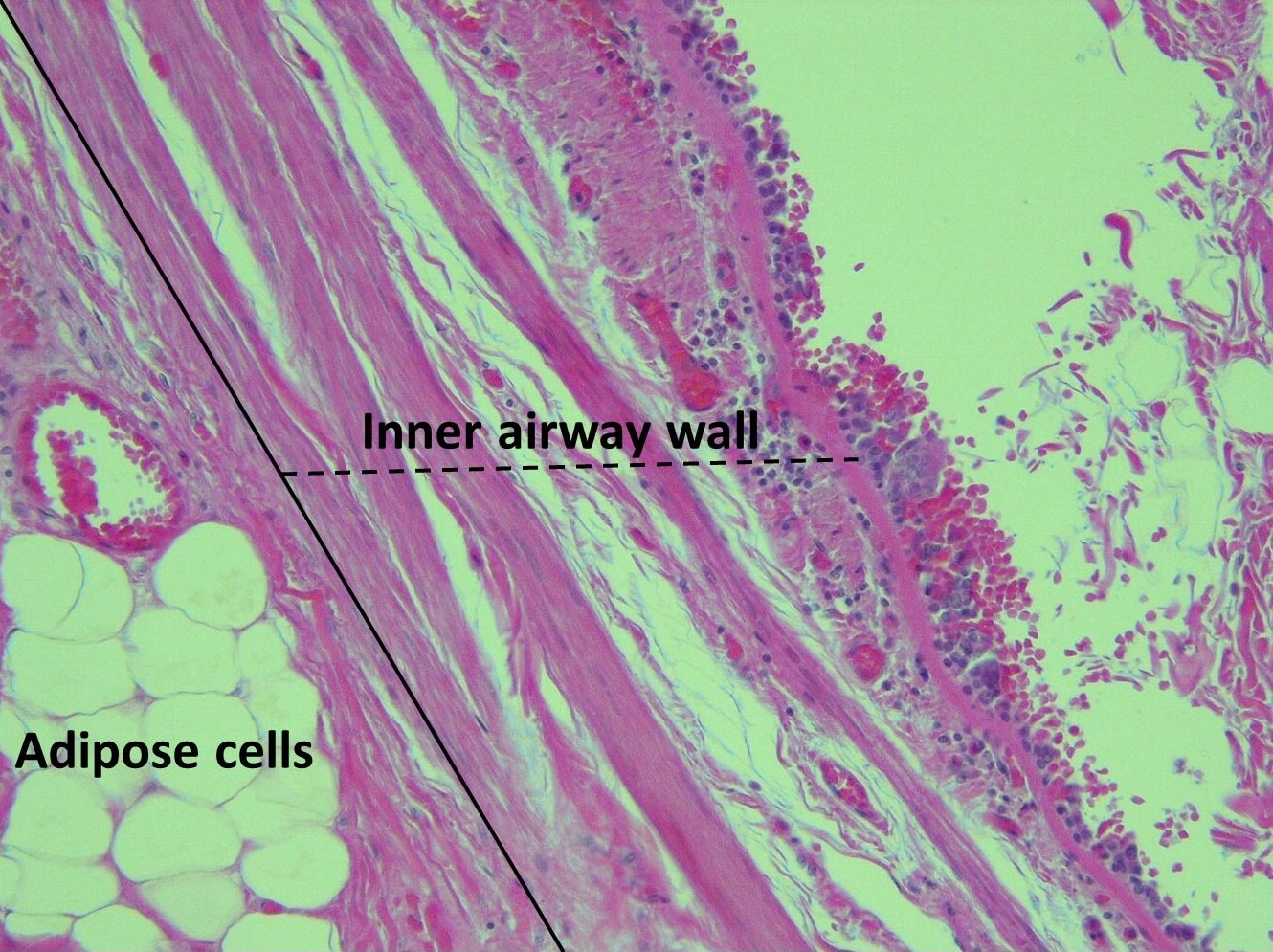
    Micrographs Adipose Tissue Lungs Asthma
    Micrographs (x200) of the (A.) outer airway wall, between the airway smooth muscle (ASM) layer and the airway adventitia (dashed line) showing adipose tissue and mucous glands and (B.) inner airway wall (submucosa), between the basement membrane and ASM layer (dashed line) in a case of fatal asthma stained with haematoxylin and eosin. Inflammatory cells were counted within the inner airway wall. Credit: European Respiratory Journal

    Using dyes to help visualize the structures of 1373 airways under a microscope, they identified and quantified any fatty tissue present. They compared this data with each person’s body mass index (BMI).

    For the first time, the study showed that fatty tissue accumulates in the walls of the airways. The analysis revealed that the amount of fat present increases in line with increasing BMI. The research also suggests that this increase in fat alters the normal structure of the airways and leads to inflammation in the lungs.

    Co-author, Dr. Peter Noble, an associate professor at the University of Western Australia in Perth said: “Being overweight or obese has already been linked to having asthma or having worse asthma symptoms. Researchers have suggested that the link might be explained by the direct pressure of excess weight on the lungs or by a general increase in inflammation created by excess weight.

    “This study suggests that another mechanism is also at play. We’ve found that excess fat accumulates in the airway walls where it takes up space and seems to increase inflammation within the lungs. We think this is causing a thickening of the airways that limits the flow of air in and out of the lungs, and that could at least partly explain an increase in asthma symptoms.”

    The team is looking for new ways to study and measure fatty tissue in the lungs. They want to confirm the relationship with respiratory disease and to find out whether the effect can be reversed by weight loss therapy.

    Professor Thierry Troosters is President of the European Respiratory Society and was not involved in the study. He said: “This is an important finding on the relationship between body weight and respiratory disease because it shows how being overweight or obese might be making symptoms worse for people with asthma. This goes beyond the simple observation that patients with obesity need to breathe more with activity and exercise hence adding to their ventilatory burden. The observation points to true airway changes that are associated with obesity.

    “We need to investigate this finding in more detail and particularly whether this phenomenon can be reversed with weight loss. In the meantime, we should support asthma patients to help them achieve or maintain a healthy weight.”

    Reference: “Fatty Airways: Implications for Obstructive Disease” by John G. Elliot, Graham M. Donovan, Kimberley C.W. Wang, Francis H.Y. Green, Alan L. James and Peter B. Noble, 17 October  2019, European Respiratory Journal.
    DOI: 10.1183/13993003.00857-2019

    Never miss a breakthrough: Join the SciTechDaily newsletter.
    Follow us on Google and Google News.

    Asthma European Lung Foundation Obesity Overweight
    Share. Facebook Twitter Pinterest LinkedIn Email Reddit

    Related Articles

    Everyday Plastics Could Be Fueling Obesity, Infertility, and Asthma

    BMI Is Broken – A 2,000-Year-Old Discovery Offers a Smarter Way to Measure Body Fat

    1 in 2 Adults, 1 in 3 Kids Will Be Obese by 2050 – Can We Stop It?

    Up to 72% More Likely: New Study Links Insufficient Sleep to Teenage Obesity

    Bad News: Childhood Obesity Is Becoming Far More Common

    Bypass Surgery Results in Long Term Health Benefits and Weight Loss

    A Low-Glycemic Diet is More Effective at Burning Calories

    Obese Children with Genetic Variants Susceptible to Fatty Liver Disease

    Worldwide Rise in Type 1 Diabetes Could Be Linked to Obesity

    Leave A Reply Cancel Reply

    • Facebook
    • Twitter
    • Pinterest
    • YouTube

    Don't Miss a Discovery

    Subscribe for the Latest in Science & Tech!

    Trending News

    New Study Reveals Why Ozempic Works Better for Some People Than Others

    Climate Change Is Altering a Key Greenhouse Gas in a Way Scientists Didn’t Expect

    New Study Suggests Gravitational Waves May Have Created Dark Matter

    Scientists Discover Why the Brain Gets Stuck in Schizophrenia

    Scientists Engineer “Tumor-Eating” Bacteria That Devour Cancer From Within

    Even “Failed” Diets May Deliver Long-Term Health Gains, Study Finds

    NIH Scientists Discover Powerful New Opioid That Relieves Pain Without Dangerous Side Effects

    Collapsing Plasma May Hold the Key to Cosmic Magnetism

    Follow SciTechDaily
    • Facebook
    • Twitter
    • YouTube
    • Pinterest
    • Newsletter
    • RSS
    SciTech News
    • Biology News
    • Chemistry News
    • Earth News
    • Health News
    • Physics News
    • Science News
    • Space News
    • Technology News
    Recent Posts
    • JWST Reveals a “Forbidden” Planet With a Baffling Composition
    • New Research Challenges 30-Year-Old Theory of Eye Development
    • The Protein “Sabotaging” Aging Muscle Recovery Could Be Key to Surviving Aging
    • This Diet–Gut Interaction Could Transform Fat Into a Calorie-Burning Machine
    • Why Some People Reach 100: New Study Reveals Key Biological Differences
    Copyright © 1998 - 2026 SciTechDaily. All Rights Reserved.
    • Science News
    • About
    • Contact
    • Editorial Board
    • Privacy Policy
    • Terms of Use

    Type above and press Enter to search. Press Esc to cancel.