

Researchers modeling tectonic subduction found that plates weaken and crack as they bend but remain intact enough to continue sinking, like a slinky snake.
Our world’s surface is a jumble of jostling tectonic plates, with new ones emerging as others are pulled under. The ongoing cycle keeps our continents in motion and drives life on Earth. But what happens when a plate disappears into the planet’s interior?
The question has long puzzled scientists because conventional wisdom said that sinking tectonic plates must remain intact to keep pulling on the portion behind it, but according to geophysical evidence, they are destroyed.
Now, in a study published recently in Nature, scientists say they’ve found an answer that reconciles the two stories: Plates are significantly weakened as they sink but not so much that they break apart entirely.
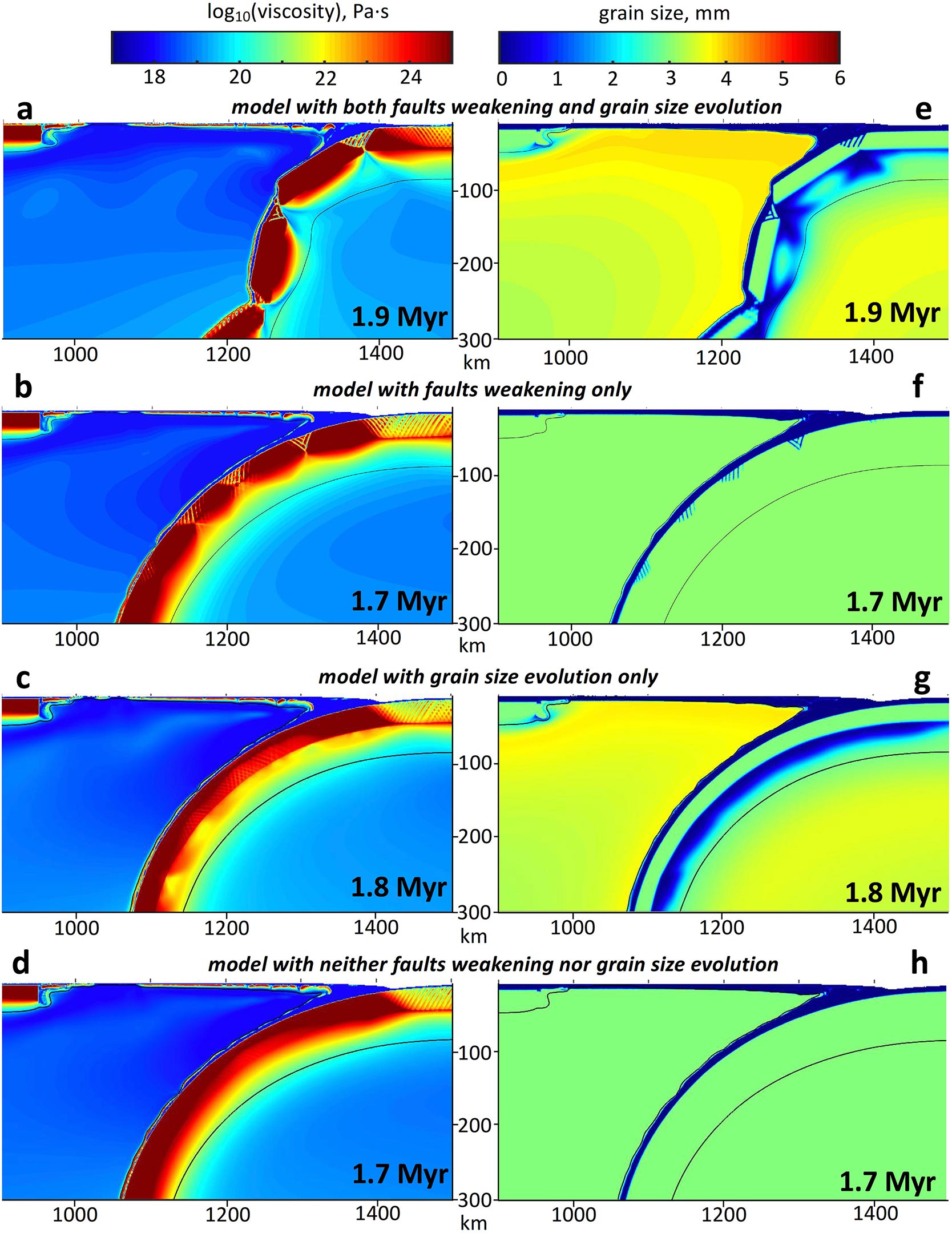
The finding came after scientists put tectonic plates through a computer-generated gauntlet of destructive geologic forces. The model showed that as the plate enters the mantle, it bends abruptly downward, cracking its cold, brittle back. At the same time, the bending changes the fine grain structure of the rock along its underbelly, leaving it weakened. Combined, the stresses pinch the plate along its weak points, leaving it mostly intact but segmented like a slinky snake.
This means the plate continues to be pulled under despite becoming folded and distorted.
Evidence From Japan
According to the researchers, the model predicted a scenario that matches observations from Japan. Studies of the region where the Pacific tectonic plate dives — or subducts — under Japan have turned up large cracks where the plate bends downward, and they have shown signs of weaker material underneath. Deep seismic imaging conducted by The University of Texas at Austin’s Steve Grand has also revealed tectonic shapes in the Earth’s mantle under Japan that appear a close match for the slinky snake in the model.
Co-author Thorsten Becker, a professor in UT’s Jackson School of Geosciences, said that the study does not necessarily close the book on what happens to subducting plates, but it certainly gives a compelling case to explain several important geologic processes.
“It’s an example of the power of computational geosciences,” said Becker who assisted in developing the model and is a faculty associate at UT’s Oden Institute for Computational Engineering & Sciences. “We combined these two processes that geology and rock mechanics are telling us are happening, and we learned something about the general physics of how the Earth works that we wouldn’t have expected. As a physicist, I find that exciting.”
The study’s lead author, Taras Gerya, a professor of geophysics at ETH Zurich, added that until now, geophysicists had lacked a comprehensive explanation for how tectonic plates bend without breaking.
Hotter Early Earth May Have Delayed Plate Tectonics
Things got interesting when the researchers ran their simulations with a hotter interior, similar to the early Earth. In these simulations, the tectonic snake segments made it only a few miles into the mantle before breaking off. That means that subduction would have occurred intermittently, raising the possibility that modern plate tectonics began only within the past billion years.
“Personally, I think there are a lot of good arguments for plate tectonics being much older,” Becker said, “but the mechanism revealed by our model suggests things might be more sensitive to the temperature of the mantle than we thought, and that, I think, could lead to interesting new avenues of discussion.”
Becker and Gerya were joined by David Bercovici, a geophysicist at Yale University whose investigation into how rock grains are altered in the deep mantle helped motivate the research. The study is based on a two-dimensional computer model of plate tectonics incorporating Bercovici’s rock deformation research and other plate-weakening mechanics. The researchers are now studying the phenomena using 3D models and plan to investigate what those models can tell them about the occurrence of earthquakes.
Reference: “Dynamic slab segmentation due to brittle–ductile damage in the outer rise” by T. V. Gerya, D. Bercovici and T. W. Becker, 10 November 2021, Nature.
DOI: 10.1038/s41586-021-03937-x
The research was supported by grants from the Swiss National Science Foundation, ETH Zurich, and the U.S. National Science Foundation. The simulations were run on high-performance computing clusters at ETH Zurich.
Never miss a breakthrough: Join the SciTechDaily newsletter.
Follow us on Google and Google News.
3 Comments
“Now They’ve Found an Answer”
And, that ‘answer’ is opposite of what an earlier, but recent, study concluded: https://scitechdaily.com/tectonic-plates-used-to-sink-much-further-than-they-do-today/
Whoever wrote the title for this news article needs to realize that not every published study finds the correct answer to a problem. It may shed some light on the issue (or not); however, acceptance needs to be withheld until the work is replicated many times.
Why does the layer in the middle of the outcrop show pinching, while the lower layer that the person is standing next to, which appears to be the same kind of rock, not show it?
https://en.wikipedia.org/wiki/Boudinage
“Why does the layer in the middle of the outcrop show pinching, while the lower layer that the person is standing next to, which appears to be the same kind of rock, not show it?”
A clue might be found through taking a look at the structure of the white layer, possibly limestone, between the layer shewing boudinage and the layer containing possibly same type of non-boudinaged rock as forms the boudins. That middle layer appears to contain a low angle fault; therefore one could argue that some type of strain partitioning has occurred across the fault, and perhaps because of the fault. There could well be other factors also involved, including the different rheological properties amongst the beds of white rock.
You ask a good question.
I always figured the subducted plate rock melted in the high temperatures of the lower mantle.