
An immune molecule sometimes produced during infection can influence the social behavior of mice.
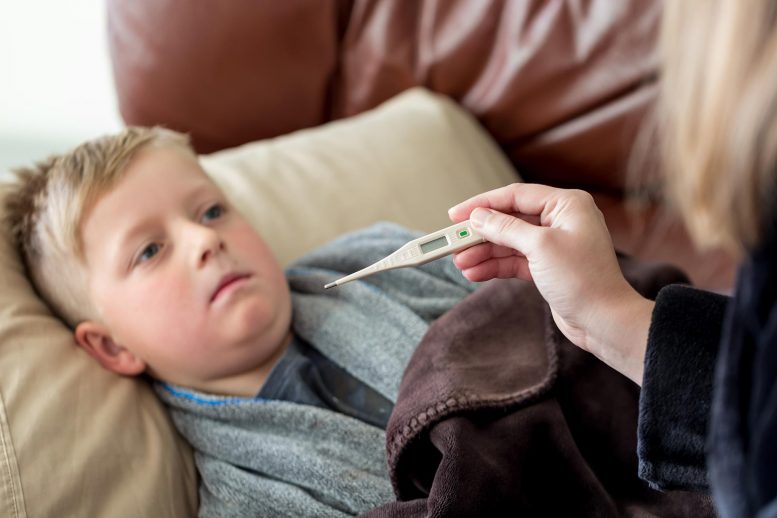
For many years, some parents have noticed that their autistic children’s behavioral symptoms diminished when they had a fever. This phenomenon has been documented in at least two large-scale studies over the past 15 years, but it was unclear why fever would have such an effect.
A new study from MIT and Harvard Medical School sheds light on the cellular mechanisms that may underlie this phenomenon. In a study of mice, the researchers found that in some cases of infection, an immune molecule called IL-17a is released and suppresses a small region of the brain’s cortex that has previously been linked to social behavioral deficits in mice.
“People have seen this phenomenon before [in people with autism], but it’s the kind of story that is hard to believe, which I think stems from the fact that we did not know the mechanism,” says Gloria Choi, the Samuel A. Goldblith Career Development Assistant Professor of Applied Biology and an assistant professor of brain and cognitive sciences at MIT. “Now the field, including my lab, is trying hard to show how this works, all the way from the immune cells and molecules to receptors in the brain, and how those interactions lead to behavioral changes.”

Although findings in mice do not always translate into human treatments, the study may help to guide the development of strategies that could help to reduce some behavioral symptoms of autism or other neurological disorders, says Choi, who is also a member of MIT’s Picower Institute for Learning and Memory.
Choi and Jun Huh, an assistant professor of immunology at Harvard Medical School, are the senior authors of the study, which was published in Nature on December 18, 2019. The lead authors of the paper are MIT graduate student Michael Douglas Reed and MIT postdoc Yeong Shin Yim.
Immune influence
Choi and Huh have previously explored other links between inflammation and autism. In 2016, they showed that mice born to mothers who experience a severe infection during pregnancy are much more likely to show behavioral symptoms such as deficits in sociability, repetitive behaviors, and abnormal communication. They found that this is caused by exposure to maternal IL-17a, which produces defects in a specific brain region of the developing embryos. This brain region, S1DZ, is part of the somatosensory cortex and is believed to be responsible for sensing where the body is in space.
“Immune activation in the mother leads to very particular cortical defects, and those defects are responsible for inducing abnormal behaviors in offspring,” Choi says.
A link between infection during pregnancy and autism in children has also been seen in humans. A 2010 study that included all children born in Denmark between 1980 and 2005 found that severe viral infections during the first trimester of pregnancy translated to a threefold increase in risk for autism, and serious bacterial infections during the second trimester were linked with a 1.42-fold increase in risk. These infections included influenza, viral gastroenteritis, and severe urinary tract infections.
In the new study, Choi and Huh turned their attention to the often-reported link between fever and reduction of autism symptoms.
“We wanted to ask whether we could use mouse models of neurodevelopmental disorders to recapitulate this phenomenon,” Choi says. “Once you see the phenomenon in animals, you can probe the mechanism.”
The researchers began by studying mice that exhibited behavioral symptoms due to exposure to inflammation during gestation. They injected these mice with a bacterial component called LPS, which induces a fever response, and found that the animals’ social interactions were temporarily restored to normal.
Further experiments revealed that during inflammation, these mice produce IL-17a, which binds to receptors in S1DZ — the same brain region originally affected by maternal inflammation. IL-17a reduces neural activity in S1DZ, which makes the mice temporarily more interested in interacting with other mice.
If the researchers inhibited IL-17a or knocked out the receptors for IL-17a, this symptom reversal did not occur. They also showed that simply raising the mice’s body temperature did not have any effect on behavior, offering further evidence that IL-17a is necessary for the reversal of symptoms.
“This suggests that the immune system uses molecules like IL-17a to directly talk to the brain, and it actually can work almost like a neuromodulator to bring about these behavioral changes,” Choi says. “Our study provides another example as to how the brain can be modulated by the immune system.”
“What’s remarkable about this paper is that it shows that this effect on behavior is not necessarily a result of fever but the result of cytokines being made,” says Dan Littman, a professor of immunology at New York University, who was not involved in the study. “There’s a growing body of evidence that the central nervous system, in mammals at least, has evolved to be dependent to some degree on cytokine signaling at various times during development or postnatally.”
Behavioral effects
The researchers then performed the same experiments in three additional mouse models of neurological disorders. These mice lack a gene linked to autism and similar disorders — either Shank3, Cntnap2, or Fmr1. These mice all show deficits in social behavior similar to those of mice exposed to inflammation in the womb, even though the origin of their symptoms is different.
Injecting those mice with LPS did produce inflammation, but it did not have any effect on their behavior. The reason for that, the researchers found, is that in these mice, inflammation did not stimulate IL-17a production. However, if the researchers injected IL-17a into these mice, their behavioral symptoms did improve.
This suggests that mice who are exposed to inflammation during gestation end up with their immune systems somehow primed to more readily produce IL-17a during subsequent infections. Choi and Huh have previously shown that the presence of certain bacteria in the gut can also prime IL-17a responses. They are now investigating whether the same gut-residing bacteria contribute to the LPS-induced reversal of social behavior symptoms that they found in the new Nature study.
“It was amazing to discover that the same immune molecule, IL-17a, could have dramatically opposite effects depending on context: Promoting autism-like behaviors when it acts on the developing fetal brain and ameliorating autism-like behaviors when it modulates neural activity in the adult mouse brain. This is the degree of complexity we are trying to make sense of,” Huh says.
Choi’s lab is also exploring whether any immune molecules other than IL-17a may affect the brain and behavior.
“What’s fascinating about this communication is the immune system directly sends its messengers to the brain, where they work as if they’re brain molecules, to change how the circuits work and how the behaviors are shaped,” Choi says.
Reference: “IL-17a promotes sociability in mouse models of neurodevelopmental disorders” by Michael Douglas Reed, Yeong Shin Yim, Ralf D. Wimmer, Hyunju Kim, Changhyeon Ryu, Gwyneth Margaret Welch, Matias Andina, Hunter Oren King, Ari Waisman, Michael M. Halassa, Jun R. Huh and Gloria B. Choi, 18 December 2019, Nature.
DOI: 10.1038/s41586-019-1843-6
The research was funded by the Jeongho Kim Neurodevelopmental Research Fund, Perry Ha, the Hock E. Tan and K. Lisa Yang Center for Autism Research, the Simons Center for the Social Brain, the Simons Foundation Autism Research Initiative, the Champions of the Brain Weedon Fellowship, and a National Science Foundation Graduate Research Fellowship.
Never miss a breakthrough: Join the SciTechDaily newsletter.
Follow us on Google and Google News.
1 Comment
Just imagine how much faster science would progress if doctors actually LISTENED to parents!
First we told them that vaccines were a factor, then we told them that diet was a factor which led to studies that showed the gut connection(leaky/porosity) which connects to inflammatory/immune response which of course can cross the blood/brain barrier and begin in the womb (that’s the point of the mommy/baby cord connection)…etc.
But instead of getting to the root of the problem: prescription meds, herbicides, pesticides, vaccines, plastics, birth control pills, stress, poverty, etc., they will look for a pill that can make them a ton of money that treats SYMPTOMS!