
Close Menu
    Facebook X (Twitter) Instagram
    SciTechDaily
    • Biology
    • Chemistry
    • Earth
    • Health
    • Physics
    • Science
    • Space
    • Technology
    Facebook X (Twitter) Pinterest YouTube RSS
    SciTechDaily
    Home»Biology»Finding Nemo’s Cousins: Meet the Little Fish That Can See UV Light
    Biology

    Finding Nemo’s Cousins: Meet the Little Fish That Can See UV Light

    By University of QueenslandNovember 11, 2019No Comments3 Mins Read
    Facebook Twitter Pinterest Telegram LinkedIn WhatsApp Email Reddit
    Share
    Facebook Twitter LinkedIn Pinterest Telegram Email Reddit
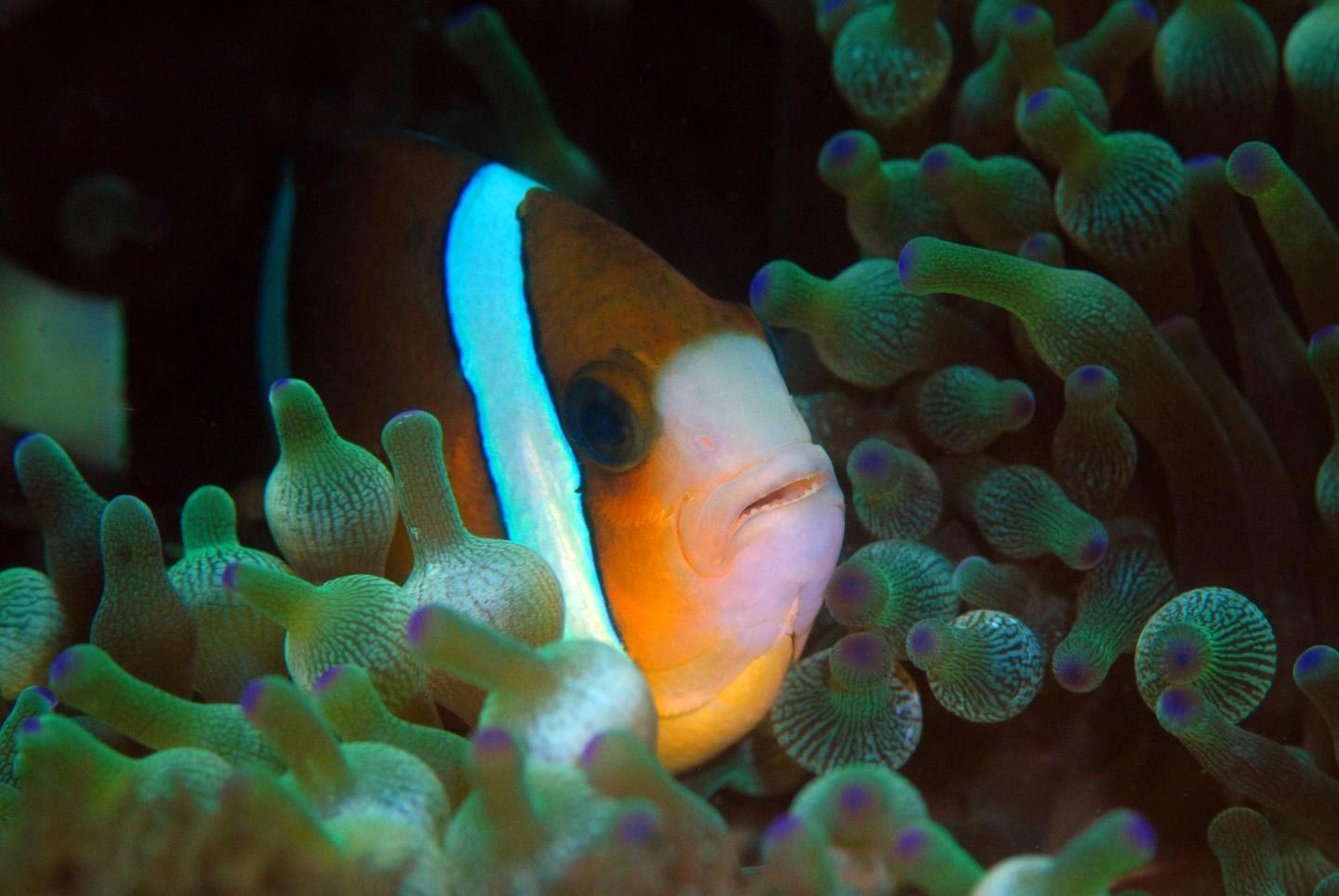
    Great Barrier Reef Anemonefish
    Great Barrier Reef anemonefish can see UV light and may use this to find anemones and other anemonefish. Credit: Prof Justin Marshall, University of Queensland

    The fish made famous in Finding Nemo can see ultraviolet (UV) light and may use it as a ‘secret channel’ to find both friends and food, according to researchers.

    Anemonefish are easily recognized by their striking orange and white patterning, but University of Queensland scientists set out to find out how ‘clownfish’ see their world and how that influences their behavior.

    Researchers at UQ’s Queensland Brain Institute (QBI) and the University of Maryland (USA) analyzed the visual systems of a particular species of anemonefish, Amphiprion akindynos.

    QBI researcher Dr. Fabio Cortesi said the Great Barrier Reef anemonefish was basically Nemo’s cousin. “We looked at everything starting with the genes they use to see and what proteins they express, and in combination with anatomical data, predicted what these anemonefish can see,” he said. “Proteins involved in detecting light have minute, well-known differences that influence which wavelengths of light they absorb.”

    QBI researcher Dr. Fanny de Busserolles, who shares lead authorship on the study with Dr. Sara Stieb, said the team was able to discover a unique specialization in the eye of the fish that may allow them to better detect friends and their anemone.

    “In the part of the anemonefish’s eye that looks forward, the photoreceptors detect a combination of violet light and ultraviolet light,” Dr. de Busserolles said. “They seem to be very good at distinguishing color, and very good at seeing UV — it looks like they use it a lot.”

    Dr. Sara Stieb said the special ability made sense, based on the fish’s environment and food source.

    “Anemonefish live very close to the surface, where UV light can easily penetrate,” Dr. Stieb said. “They live in symbiosis with anemones, and the anemones use UV to grow. Moreover, anemonefish feed on zooplankton which absorb UV light, so it would appear like dark dots against the background, making it easy to find.”

    Dr. Cortesi said UV vision lent anemonefish another important advantage.

    “Their visual system seems to be very tuned to recognizing who is their friend and who is not,” he said. “The white stripes on anemonefish reflect UV, which means they should be easier for other anemonefish to recognize. By contrast, a lot of the bigger fish — including ones that eat anemonefish — cannot see UV, so if you want to communicate on the reef over short distances, then UV is a very good way to do this.

    “UV is essentially a secret channel that only these little fish can use to talk to each other,” he said.

    “They can be as flashy as they want and they won’t be seen — and it might be how Nemo’s cousin finds its friends.”

    The findings were published in the journal Scientific Reports today, November 11, 2019.

    Reference: “A detailed investigation of the visual system and visual ecology of the Barrier Reef anemonefish, Amphiprion akindynos” by Sara M. Stieb, Fanny de Busserolles, Karen L. Carleton, Fabio Cortesi, Wen-Sung Chung, Brian E. Dalton, Luke A. Hammond and N. Justin Marshall, 11 November 2019, Scientific Reports.
    DOI: 10.1038/s41598-019-52297-0

    Never miss a breakthrough: Join the SciTechDaily newsletter.
    Follow us on Google and Google News.

    Evolution Fish Marine Biology University of Queensland Zoology
    Share. Facebook Twitter Pinterest LinkedIn Email Reddit

    Related Articles

    Unexpected Discovery of a 410-Million-Year-Old Fossil Forces Rethink of Shark Evolution

    Sexual Parasitism: Loss of Adaptive Immunity Helps Deep Sea Anglerfish Physically Fuse With Their Mates

    Sexual Parasitism: Deep-Sea Anglerfish Evolved a New Type of Immune System to Physically Fuse With Their Mates

    Dramatic Fish Evolution in Action: Land Fish Forced to Adapt After Leap Out of Water

    Otters Juggle Stones – Now Researchers Think They Know Why [Video]

    Sturgeon “Methuselah Fish” Genome Sequenced – Important Piece of Evolutionary Puzzle

    Jaw-Some Wombats: Flexible Jaws May Help Wombats Survive Change

    Old Theory on How Piranhas Keep Their Teeth Sharp Finally Proven With New Technology

    European Catfish Learn to Catch Pigeons

    Leave A Reply Cancel Reply

    • Facebook
    • Twitter
    • Pinterest
    • YouTube

    Don't Miss a Discovery

    Subscribe for the Latest in Science & Tech!

    Trending News

    Scientists Warn That This Common Pet Fish Can Wreck Entire Ecosystems

    Scientists Make Breakthrough in Turning Plastic Trash Into Clean Fuel Using Sunlight

    This Popular Supplement May Interfere With Cancer Treatment, Scientists Warn

    Scientists Finally Solved One of Water’s Biggest Mysteries

    Could This New Weight-Loss Pill Disrupt the Entire Market? Here’s What You Should Know About Orforglipron

    Earth’s Crust Is Tearing Open in Africa, and It Could Form a New Ocean

    Breakthrough Bowel Cancer Trial Leaves Patients Cancer-Free for Nearly 3 Years

    Natural Compound Shows Powerful Potential Against Rheumatoid Arthritis

    Follow SciTechDaily
    • Facebook
    • Twitter
    • YouTube
    • Pinterest
    • Newsletter
    • RSS
    SciTech News
    • Biology News
    • Chemistry News
    • Earth News
    • Health News
    • Physics News
    • Science News
    • Space News
    • Technology News
    Recent Posts
    • Ancient Roman Ship Coating Reveals Secrets Hidden for 2,200 Years
    • Enormous Prehistoric Insects Puzzle Scientists
    • College Student Identifies Bizarre New Carnivorous Dinosaur Three Times Older Than T. rex
    • The Most Effective Knee Arthritis Treatments Aren’t What You Expect
    • Scientists Develop Bioengineered Chewing Gum That Could Help Fight Oral Cancer
    Copyright © 1998 - 2026 SciTechDaily. All Rights Reserved.
    • Science News
    • About
    • Contact
    • Editorial Board
    • Privacy Policy
    • Terms of Use

    Type above and press Enter to search. Press Esc to cancel.