
Close Menu
    Facebook X (Twitter) Instagram
    SciTechDaily
    • Biology
    • Chemistry
    • Earth
    • Health
    • Physics
    • Science
    • Space
    • Technology
    Facebook X (Twitter) Pinterest YouTube RSS
    SciTechDaily
    Home»Technology»Inexpensive Sensor to Save Lives of Children, Pets Left in Vehicles
    Technology

    Inexpensive Sensor to Save Lives of Children, Pets Left in Vehicles

    By University of WaterlooNovember 11, 2019No Comments3 Mins Read
    Facebook Twitter Pinterest Telegram LinkedIn WhatsApp Email Reddit
    Share
    Facebook Twitter LinkedIn Pinterest Telegram Email Reddit
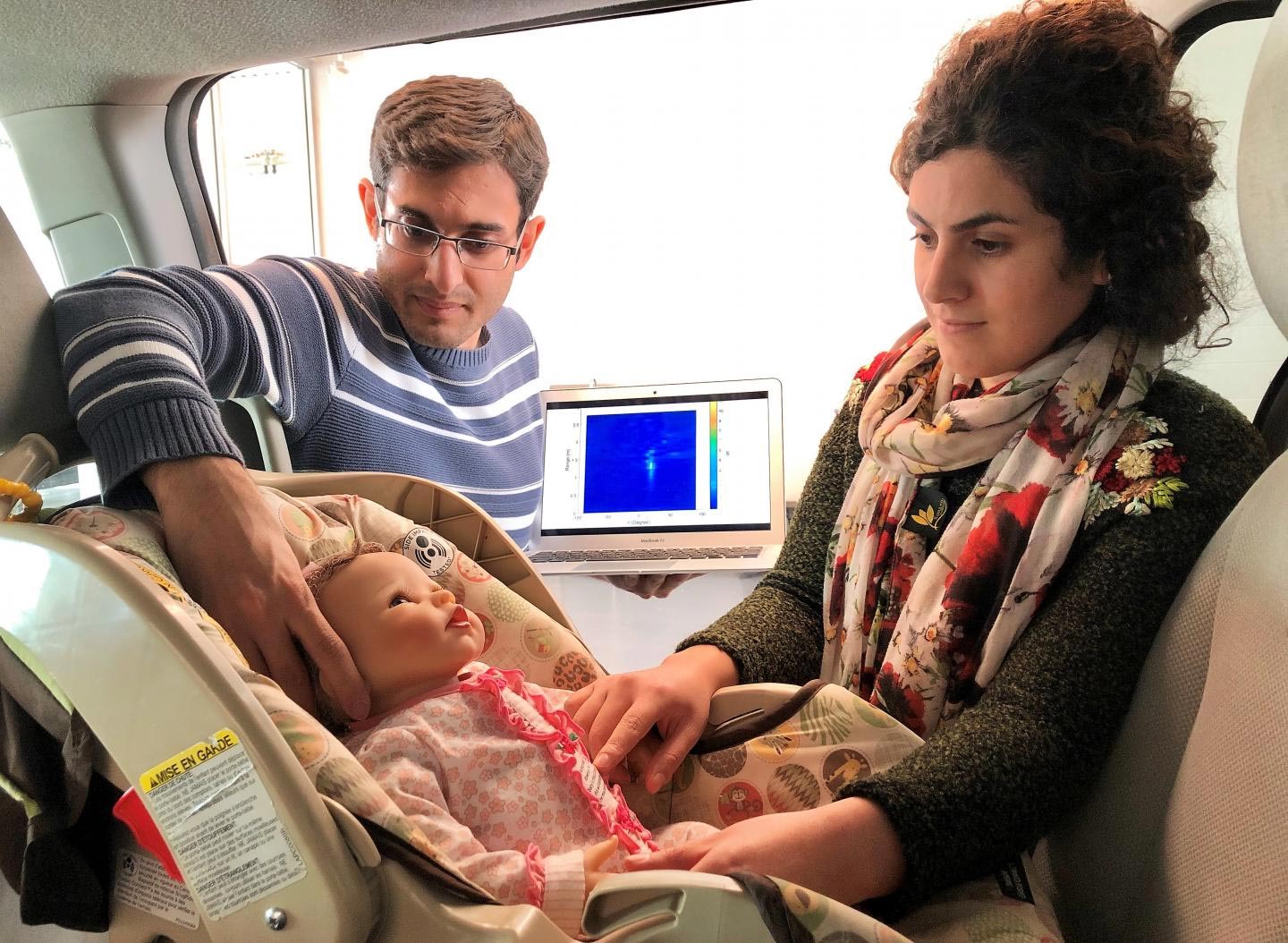
    Mostafa Alizadeh and Hajar Abedi
    Graduate students Mostafa Alizadeh, left, and Hajar Abedi position a doll, modified to simulate breathing, in a minivan during testing of a new sensor. Credit: University of Waterloo

    A small, inexpensive sensor could save lives by triggering an alarm when children or pets are left alone in vehicles.

    The new device, developed by researchers at the University of Waterloo, combines radar technology with artificial intelligence (AI) to detect unattended children or animals with 100 percent accuracy.

    Small enough to fit in the palm of a hand at just three centimeters in diameter, the device is designed to be attached to a vehicle’s rear-view mirror or mounted on the ceiling.

    It sends out radar signals that are reflected back by people, animals, and objects in the vehicle. Built-in AI then analyzes the reflected signals.

    “It addresses a serious, worldwide problem,” said George Shaker, an engineering professor at Waterloo. his system is so affordable it could become standard equipment in all vehicles.”

    The development of the wireless, disc-shaped sensor was funded in part by a major automotive parts manufacturer that is aiming to bring it to market by the end of 2020.

    Analysis by the device determines the number of occupants and their locations in a vehicle. That information could be used to set rates for ride-sharing services and toll roads, or to qualify vehicles for car-pool lanes.

    Its primary purpose, however, is to detect when a child or pet has been accidentally or deliberately left behind, a scenario that can result in serious harm or death in extremely hot or cold weather.

    In such cases, the system would prevent vehicle doors from locking and sound an alarm to alert the driver, passengers and other people in the area that there is a problem.

    “Unlike cameras, this device preserves privacy and it doesn’t have any blind spots because radar can penetrate seats, for instance, to determine if there is an infant in a rear-facing car seat,” said Shaker, a cross-appointed professor of electrical and computer engineering, and mechanical and mechatronics engineering.

    The low-power device, which runs on a vehicle’s battery, distinguishes between living beings and inanimate objects by detecting subtle breathing movements.

    Researchers are now exploring the use of that capability to monitor the vital signs of drivers for indications of fatigue, distraction, impairment, illness or other issues.

    ###

    Shaker supervised graduate students Mostafa Alizadeh and Hajar Abedi on the research.

    A paper on their project, Low-cost low-power in-vehicle occupant detection with mm-wave FMCW radar, was recently presented at an international conference in Montreal.

    Reference: “Low-cost low-power in-vehicle occupant detection with mm-wave FMCW radar” by Mostafa Alizadeh; Hajar Abedi and George Shaker, 27 October 2018, 2019 IEEE Sensors.
    DOI: 10.1109/SENSORS43011.2019.8956880

    Never miss a breakthrough: Join the SciTechDaily newsletter.
    Follow us on Google and Google News.

    Safety Sensor University of Waterloo
    Share. Facebook Twitter Pinterest LinkedIn Email Reddit

    Related Articles

    Cutting-Edge Quantum Sensor Unveils the Hidden Atomic World

    “Electronic Spider Silk” Sensors: Revolutionizing Bioelectronics With Eco-Friendly Technology

    MIT Engineers Create Game-Changing Lead Detection Device

    The Gentle Prick: Sea Slug-Inspired Stretchable Microneedles Revolutionize Biomedical Sensors

    Revolutionizing Wireless Communication: How Tiny Chips Could Transform Medical Technology

    Scientists Develop Groundbreaking Sensor That Can Wirelessly Detect Chemical Warfare Agents

    MIT’s Wearable Ultrasound Sticker Monitors Health of Deep Internal Organs

    New Game-Changing Sound-Powered Sensors Could Save Millions of Batteries

    New Biosensors Allow Earbuds To Record Brain Activity and Exercise Levels

    Leave A Reply Cancel Reply

    • Facebook
    • Twitter
    • Pinterest
    • YouTube

    Don't Miss a Discovery

    Subscribe for the Latest in Science & Tech!

    Trending News

    Largest-Ever Study Finds Medicinal Cannabis Ineffective for Anxiety, Depression, PTSD

    250-Million-Year-Old Egg Solves One of Evolution’s Biggest Mysteries

    Living With Roommates Might Be Changing Your Gut Microbiome Without You Knowing

    Century-Old Cleaning Chemical Linked to 500% Increased Risk of Parkinson’s Disease

    What if Your Memories Never Happened? Physicists Take a New Look at the Boltzmann Brain Paradox

    One of the Universe’s Largest Stars May Be Getting Ready To Explode

    Scientists Discover Enzyme That Could Supercharge Ozempic-Like Weight Loss Drugs

    Popular Sweetener Linked to DNA Damage – “It’s Something You Should Not Be Eating”

    Follow SciTechDaily
    • Facebook
    • Twitter
    • YouTube
    • Pinterest
    • Newsletter
    • RSS
    SciTech News
    • Biology News
    • Chemistry News
    • Earth News
    • Health News
    • Physics News
    • Science News
    • Space News
    • Technology News
    Recent Posts
    • Scientists Prove There Are Just Six Degrees of Separation in a Social Network
    • Bee Bacteria Could Fix a Major Flaw in Plant-Based Milk
    • Scientists Discover a Surprising Way To Make Bread Healthier and More Nutritious
    • Natural Compounds Boost Bone Implant Success While Killing Bacteria and Cancer Cells
    • After 60 Years, Scientists Uncover Unexpected Brain Effects of Popular Diabetes Drug Metformin
    Copyright © 1998 - 2026 SciTechDaily. All Rights Reserved.
    • Science News
    • About
    • Contact
    • Editorial Board
    • Privacy Policy
    • Terms of Use

    Type above and press Enter to search. Press Esc to cancel.