

Close Menu
    Facebook X (Twitter) Instagram
    SciTechDaily
    • Biology
    • Chemistry
    • Earth
    • Health
    • Physics
    • Science
    • Space
    • Technology
    Facebook X (Twitter) Pinterest YouTube RSS
    SciTechDaily
    Home»Technology»Scientists Develop Groundbreaking Sensor That Can Wirelessly Detect Chemical Warfare Agents
    Technology

    Scientists Develop Groundbreaking Sensor That Can Wirelessly Detect Chemical Warfare Agents

    By Aerospace Information Research Institute, Chinese Academy of SciencesMarch 18, 2024No Comments3 Mins Read
    Facebook Twitter Pinterest Telegram LinkedIn WhatsApp Email Reddit
    Share
    Facebook Twitter LinkedIn Pinterest Telegram Email Reddit
    Red Danger Sensor
    A breakthrough sensor using SAW technology provides wireless, highly sensitive detection of chemical warfare agents, marking a major advancement in safety technology by allowing for efficient and reliable monitoring in challenging environments. (Artist’s concept). Credit: SciTechDaily.com

    Researchers have developed a revolutionary sensor capable of detecting chemical warfare agents without wires, representing a major advancement in technology for public safety.This innovative device, capable of identifying substances like dimethyl methylphosphonate (DMMP), offers a new level of efficiency and reliability in monitoring and responding to chemical threats, without the need for direct power sources or physical connections.

    The urgent need for advanced detection of chemical warfare agents (CWAs) to ensure global security has led to the development of a novel gas sensor. This sensor is distinguished by its rapid response, high sensitivity, and compact size, crucial for the early detection of CWAs. Accurate detection and monitoring of CWAs are vital for effective defense operations, both military and civilian. Due to the hazardous nature of CWAs, research is typically limited to authorized laboratories using simulants that mimic CWAs’ chemical structure without their toxic effects.

    Research Findings and Sensor Capabilities

    A recent study led by a team of experts, published on January 3, 2024, in the journal Microsystems & Nanoengineering, have developed a cutting-edge sensor that wirelessly identifies chemical warfare agents, revolutionizing safety measures. This device efficiently detects DMMP, enhancing threat response capabilities without relying on power sources or connections.

    In the study, researchers have innovated a passive, wireless sensor system using surface acoustic wave (SAW) technology, set to revolutionize chemical warfare agent detection by specifically targeting dimethyl methylphosphonate (DMMP), a simulant for nerve agents. This sensor operates at 433 MHz, using a unique coating of fluoroalcohol polysiloxane (SXFA) on a lithium niobate substrate, enhancing its sensitivity and stability under various environmental conditions.
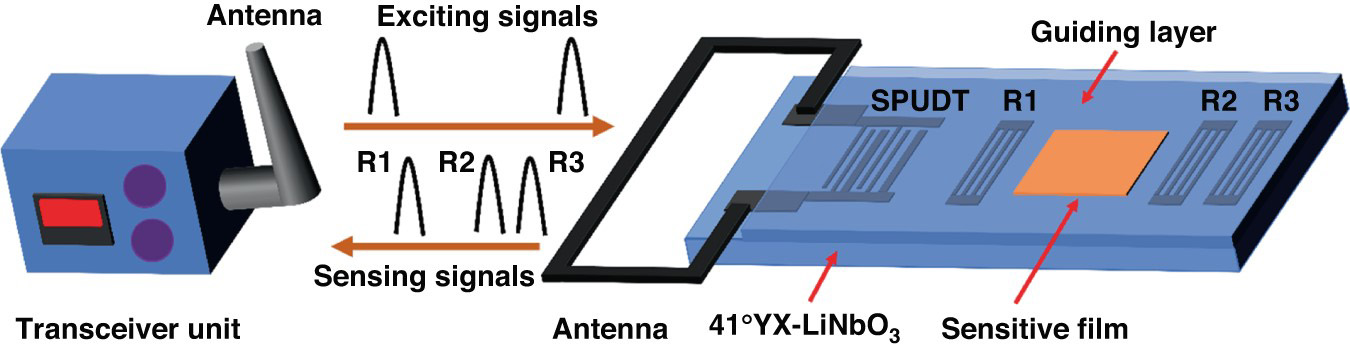
    Schematic and Working Principle of the Proposed SAW Chemical Sensor
    Schematic and working principle of the proposed SAW chemical sensor. Credit: Microsystems & Nanoengineering

    The system’s core is built around a YZ lithium niobate substrate equipped with metallic interdigital transducers (IDTs) and an attached antenna. The SXFA film’s interaction with DMMP alters the SAW’s properties, such as velocity, enabling precise detection. This design ensures stable operation within a 0-90 cm transmission range and is resilient across a wide temperature range (-30 °C to 100 °C) and humidity levels up to 60% RH.

    According to the research team, this sensor system marks a significant leap forward in CWA detection technology. Its passive wireless nature allows operation in inaccessible or hazardous areas, ensuring safety and efficiency.

    This technology has immense potential in military and civilian defense, offering a reliable, efficient means of early CWA detection. Its ability to operate wirelessly and in challenging environments makes it a valuable tool for ensuring public safety and preparedness against chemical threats.

    Reference: “A passive wireless surface acoustic wave (SAW) sensor system for detecting warfare agents based on fluoroalcohol polysiloxane film” by Yong Pan, Cancan Yan, Xu Gao, Junchao Yang, Tengxiao Guo, Lin Zhang and Wen Wang, 3 January 2024, Microsystems & Nanoengineering.
    DOI: 10.1038/s41378-023-00627-8

    Never miss a breakthrough: Join the SciTechDaily newsletter.
    Follow us on Google and Google News.

    Chinese Academy of Sciences Sensor
    Share. Facebook Twitter Pinterest LinkedIn Email Reddit

    Related Articles

    New Computational Method Improves Resolution of Time-of-Flight Depth Sensors 1,000-Fold

    More Than 80% Efficiency Attained in New Ultralow-power Circuit

    New Wireless Sensor Detects Hazardous Chemicals or Food Spoilage

    DARPA Creates First Solid State Receiver to Demonstrate Gain at 0.85 THz

    Floating Robots Demonstrate Their Water Monitoring Technology

    Cost Effective Sensor Measures Fruits’ Ripeness

    DSRS Triples Microbial Production of Diesel Fuel

    Iridescent Butterfly Wing Properties to Lead to Better Thermal Imaging Cameras

    Smart Pills Will Track Patients from the Inside Out

    Leave A Reply Cancel Reply

    • Facebook
    • Twitter
    • Pinterest
    • YouTube

    Don't Miss a Discovery

    Subscribe for the Latest in Science & Tech!

    Trending News

    289-Million-Year-Old Reptile Mummy Reveals Origin of Human Breathing System

    New Brain Discovery Challenges Long-Held Theory of Teenage Brain Development

    Scientists Discover Plants “Scream” – We Just Couldn’t Hear Them Until Now

    Scientists Discover a Surprising Reason Intermittent Fasting Extends Life

    This Simple Fruit Wash Could Make Produce Safer and Last Days Longer

    Scientists Say Adding This Unusual Seafood to Your Diet Could Reverse Signs of Aging

    Scientists Say a Hidden Structure May Exist Inside Earth’s Core

    Doctors Surprised by the Power of a Simple Drug Against Colon Cancer

    Follow SciTechDaily
    • Facebook
    • Twitter
    • YouTube
    • Pinterest
    • Newsletter
    • RSS
    SciTech News
    • Biology News
    • Chemistry News
    • Earth News
    • Health News
    • Physics News
    • Science News
    • Space News
    • Technology News
    Recent Posts
    • Scientists Just Discovered Light Can Actually Slow Plant Growth
    • Scientists Finally Solved One of Water’s Biggest Mysteries
    • 7,000-Year-Old DNA Rewrites the Story of the “Neolithic Revolution”
    • Missing Medieval Relic of Legendary English King Found After Being Missing for 40 Years
    • New Study Challenges Long-Held Assumptions About Cancer and Aging
    Copyright © 1998 - 2026 SciTechDaily. All Rights Reserved.
    • Science News
    • About
    • Contact
    • Editorial Board
    • Privacy Policy
    • Terms of Use

    Type above and press Enter to search. Press Esc to cancel.