
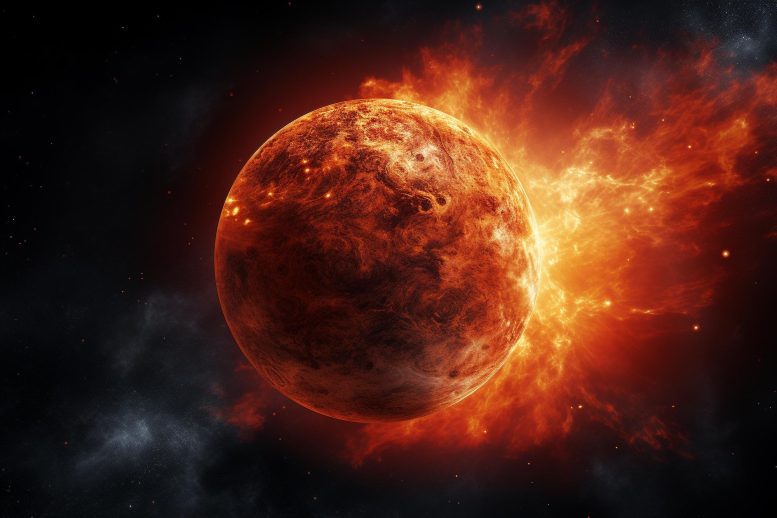
A study has identified 11 chemical elements in the atmosphere of the extremely hot exoplanet WASP-76 b. The findings suggest the planet’s overall composition reflects that of the protoplanetary disc from which it formed, and its high temperatures cause rock-forming elements to vaporize in the atmosphere. Interestingly, the team also noted the absence of certain elements requiring higher temperatures to vaporize, leading to the hypothesis that WASP-76 b could have swallowed material from a Mercury-like planet.
An international team led by Stefan Pelletier, a Ph.D. student at Université de Montréal’s Trottier Institute for Research on Exoplanets recently announced that they made a detailed study of the extremely hot giant exoplanet WASP-76 b.
Using the MAROON-X instrument on the Gemini-North Telescope, the team was able to identify and measure the abundance of 11 chemical elements in the atmosphere of the planet.
Those include rock-forming elements whose abundances are not even known for giant planets in the Solar System such as Jupiter or Saturn. The team’s study is published in the journal Nature.
“Truly rare are the times when an exoplanet hundreds of light years away can teach us something that would otherwise likely be impossible to know about our own Solar System,” said Pelletier. “This is the case with this study.”
A Big, Hot, Strange World
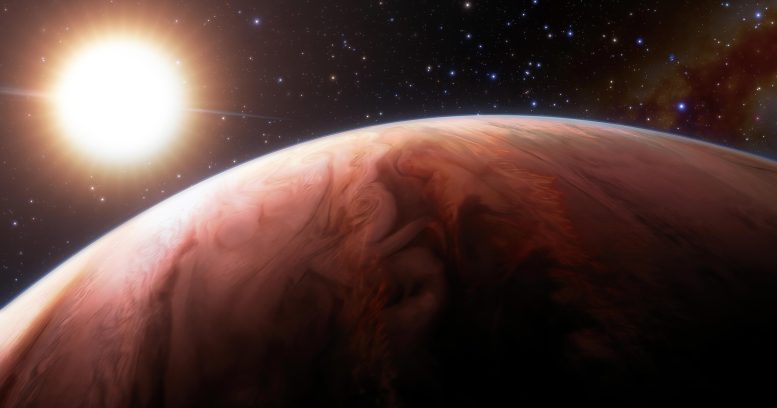
WASP-76 b is a strange world. It reaches extreme temperatures because it is very close to its parent star, a massive star 634 light-years away in the constellation of Pisces: approximately 12 times closer than Mercury is to the Sun. With a mass similar to that of Jupiter, but almost six times bigger by volume, it is quite “puffy”.
Since its discovery by the Wide Angle Search for Planets (WASP) program in 2013, many teams have studied it and identified various elements in its atmosphere. Notably, in a study also published in Nature in March 2020, a team found an iron signature and hypothesized that there could be iron rain on the planet.
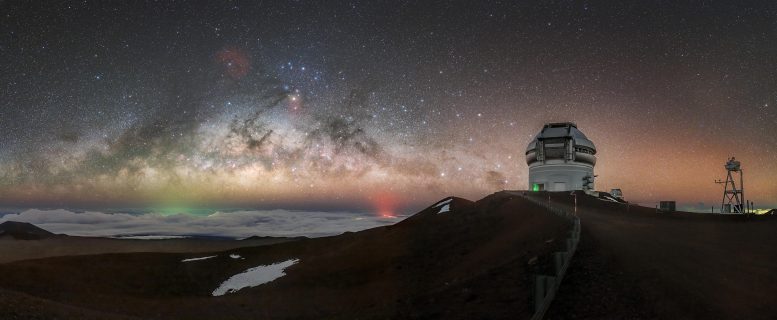
Aware of these studies, Pelletier became motivated to obtain new, independent observations of WASP-76 b using the MAROON-X high-resolution optical spectrograph on the Gemini-North 8-metre Telescope in Hawai’i, part of the International Gemini Observatory, operated by NSF’s NOIRLab.
“We recognized that the powerful new MAROON-X spectrograph would enable us to study the chemical composition of WASP-76 b with a level of detail unprecedented for any giant planet,” says UdeM astronomy professor Björn Benneke, co-author of the study and Stefan Pelletier’s PhD research supervisor.
A Composition Similar to the Sun’s
Within the Sun, the abundances of almost all elements in the periodic table are known with great accuracy. In the giant planets in our Solar System, however, that’s true for only a handful of elements, whose compositions remain poorly constrained. And this has hampered understanding of the mechanisms governing the formation of these planets.
As it is so close to its star, WASP-76 b has a temperature well above 2000°C. At these degrees, many elements that would normally form rocks here on Earth (like magnesium and iron) are vaporized and present in gaseous form in the upper atmosphere. Studying this peculiar planet enables unprecedented insight into the presence and abundance of rock-forming elements in giant planets, since in colder giant planets like Jupiter these elements are lower in the atmosphere and impossible to detect.
The abundance of many elements measured by Pelletier and his team in the exoplanet’s atmosphere – such as manganese, chromium, magnesium, vanadium, barium, and calcium – matches those of its host star as well as of our own Sun very closely.
These abundances are not random: they are the direct product of the Big Bang, followed by billions of years of stellar nucleosynthesis, so scientists measure roughly the same composition in all stars. It is, however, different from the composition of rocky planets like Earth, which are formed in a more complex manner.
The results of this new study indicate that giant planets could maintain an overall composition that reflects that of the protoplanetary disc from which they formed.
Depletion of Other Elements Very Interesting
However, other elements were depleted in the planet compared to the star – a result Pelletier found particularly interesting.
“These elements that appear to be missing in WASP-76 b’s atmosphere are precisely those that require higher temperatures to vaporize, like titanium and aluminum,” he said. “Meanwhile, the ones that matched our predictions, like manganese, vanadium, or calcium, all vaporize at slightly lower temperatures.”
The discovery team’s interpretation is that the observed composition of the upper atmospheres of giant planets can be extremely sensitive to temperature. Depending on an element’s temperature of condensation, it will be in gas form and present in the upper part of the atmosphere, or condense into liquid form where it will sink to deeper layers. When in gas form, it plays an important role in absorbing light and can be seen in astronomers’ observations. When condensed, it cannot be detected by astronomers and becomes completely absent from their observations.
“If confirmed, this finding would mean that two giant exoplanets that have slightly different temperatures from one another could have very different atmospheres, “ said Pelletier. “Kind of like two pots of water, one at -1°C that is frozen, and one that is at +1°C that is liquid. For example, calcium is observed on WASP-76 b, but it may not be on a slightly colder planet.”
First Detection of Vanadium Oxide
Another interesting finding by Pelletier’s team is the detection of a molecule called vanadium oxide. This is the first time it has been unambiguously detected on an exoplanet, and is of great interest to astronomers because they know it can have a big impact on hot giant planets.
“This molecule plays a similar role to ozone in Earth’s atmosphere: it is extremely efficient at heating up the upper atmosphere,” explained Pelletier. “This causes the temperatures to increase as a function of altitude, instead of decreasing as is typically seen on colder planets.”
One element, nickel, is clearly more abundant in the exoplanet’s atmosphere than what the astronomers were expecting. Many hypotheses could explain that; one is that WASP-76 b could have accreted material from a planet similar to Mercury. In our Solar System, the small rocky planet is enriched with metals like nickel because of how it was formed.
Pelletier’s team also found that the asymmetry in iron absorption between the east and west hemispheres of WASP-76 b reported in previous studies is similarly present for many other elements. This means the underlying phenomenon causing this is thus probably a global process such as a difference in temperature or clouds being present on one side of the planet but not the other, rather than being the result of condensation into liquid form as was previously suggested.
Confirming and Leveraging Lessons Learned
Pelletier and his team are very keen to learn more about this exoplanet and other ultra-hot giant planets, in part to confirm their hypothesis about the vastly different atmospheres that could prevail on planets differing slightly in temperature.
They also hope other researchers will leverage what they learned from this giant exoplanet and apply it to better our understanding of our own Solar System planets and how they came to be.
“Generations of researchers have used Jupiter, Saturn, Uranus, and Neptune’s measured abundances for hydrogen and helium to benchmark formation theories of gaseous planets,” said Benneke. “Likewise, the measurements of heavier elements such as calcium or magnesium on WASP-76 b will help further understanding the formation of gaseous planets.
Reference: “Vanadium oxide and a sharp onset of cold-trapping on a giant exoplanet” by Stefan Pelletier, Björn Benneke, Mohamad Ali-Dib, Bibiana Prinoth, David Kasper, Andreas Seifahrt, Jacob L. Bean, Florian Debras, Baptiste Klein, Luc Bazinet, H. Jens Hoeijmakers, Aurora Y. Kesseli, Olivia Lim, Andres Carmona, Lorenzo Pino, Núria Casasayas-Barris, Thea Hood and Julian Stürmer, 14 June 2023, Nature.
DOI: 10.1038/s41586-023-06134-0
In addition to Pelletier and Björn Benneke, the team also includes: Luc Bazinet and Olivia Lim, two graduate students at Université de Montréal’s Trottier Institute for Research on Exoplanets (iREx); Mohamad Ali-Dib, a former Trottier postdoctoral fellow at iREx, now at NYU Abu Dhabi; and 13 other co-authors from Canada, the United Arab Emirates, Sweden, France, the United Kingdom, the United States, Italy, the Netherlands and Germany.
Never miss a breakthrough: Join the SciTechDaily newsletter.
Follow us on Google and Google News.