
Close Menu
    Facebook X (Twitter) Instagram
    SciTechDaily
    • Biology
    • Chemistry
    • Earth
    • Health
    • Physics
    • Science
    • Space
    • Technology
    Facebook X (Twitter) Pinterest YouTube RSS
    SciTechDaily
    Home»Space»Webb Space Telescope Reveals Atmospheric Effects of CO2 on Earth and Exoplanets
    Space

    Webb Space Telescope Reveals Atmospheric Effects of CO2 on Earth and Exoplanets

    By The Hebrew University of JerusalemNovember 27, 2023No Comments3 Mins Read
    Facebook Twitter Pinterest Telegram LinkedIn WhatsApp Email Reddit
    Share
    Facebook Twitter LinkedIn Pinterest Telegram Email Reddit
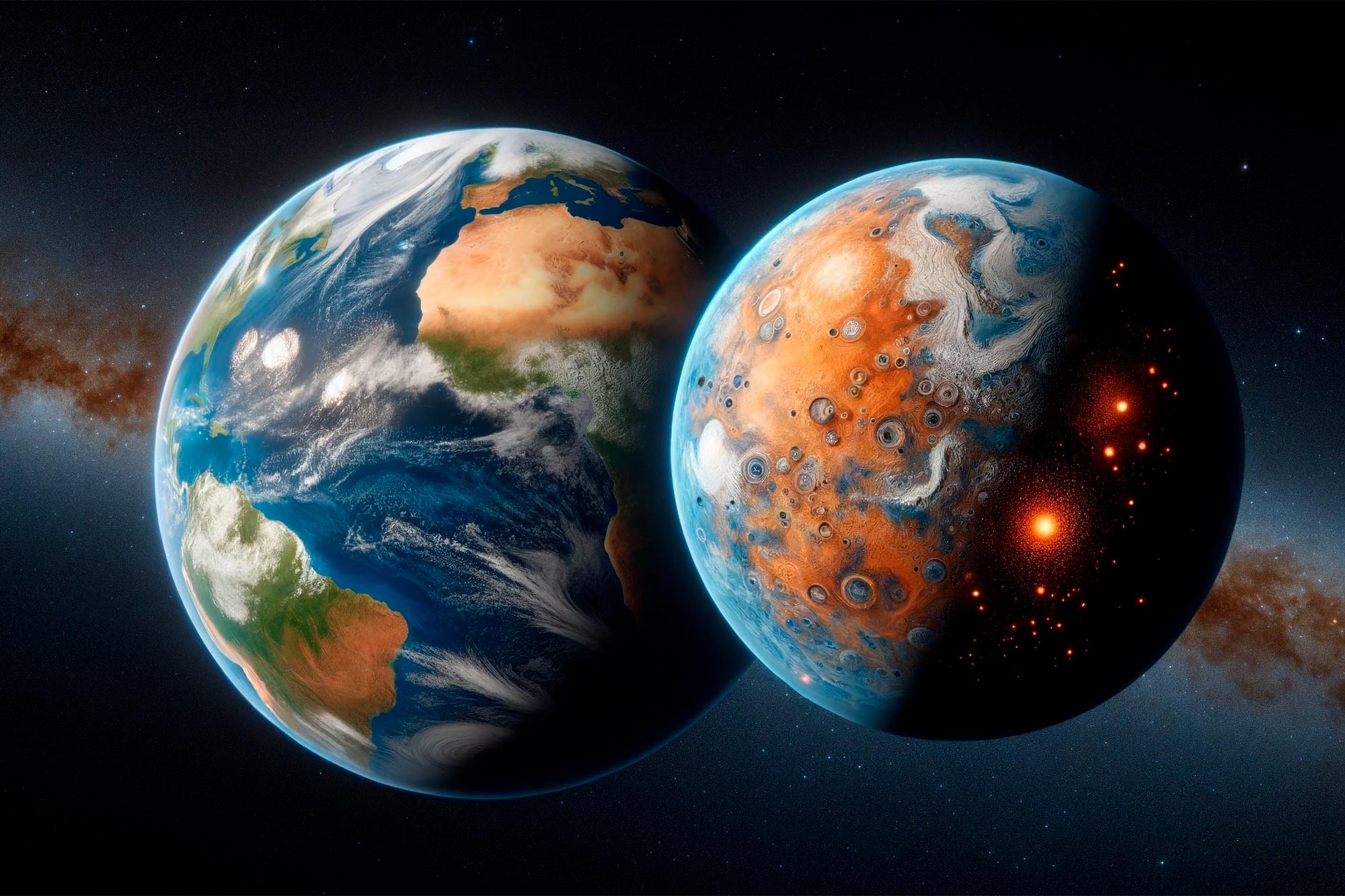
    Earth and Exoplanet
    A research team used the James Webb Space Telescope to explore the impact of increased CO2 on Earth and exoplanets. Their research found that CO2 additions cause more warming in areas without direct sunlight, affecting global circulation. This phenomenon is consistent on both Earth and TRAPPIST-1e, highlighting the importance of understanding greenhouse gases for exoplanet habitability and Earth’s climate. This study marks a significant advancement in exoplanetary science and climate research.

    A research team, utilizing the James Webb Space Telescope, has discovered that increased CO2 levels lead to more intense warming in regions without direct sunlight on both Earth and exoplanets. This finding is crucial for understanding the habitability of exoplanets and the impact of greenhouse gases on Earth’s climate.

    With the launch of the James Webb Space Telescope (JWST), the study of exoplanetary atmospheres and their potential habitability reached new heights. A team of researchers, delved into the effects of greenhouse gas supplements on temperate terrestrial exoplanets and Earth. Their findings demonstrate a parallel relationship between CO2 supplement and intensified warming in non-irradiated regions, impacting global circulation patterns.

    The team was led by Dr. Assaf Hochman from the Institute of Earth Sciences at the Hebrew University of Jerusalem, Dr. Thaddeus D. Komacek from The University of Maryland, College Park, and Paolo De Luca from the Barcelona Supercomputing Center. The results were published in the journal Scientific Reports.

    Uncovering Global Circulation Dynamics

    Analyzing ExoCAM and CMIP6 model simulations, the research team discovered that the addition of CO2 leads to heightened warming in areas shielded from direct sunlight, i.e., the night side and polar regions. These localized temperature changes can bring about significant alterations in global circulation. Employing a dynamical systems framework, the researchers gained additional insights into the vertical dynamics of the atmospheres.

    Greenhouse Gases and Atmospheric Stability

    The study also reveals that introducing a greater supplement of CO2 into the atmosphere enhances temporal stability near the surface but decreases stability at low pressures. Surprisingly, this observation holds true for both Earth and TRAPPIST-1e, despite their distinct climate states. Dr. Assaf Hochman, from the Hebrew University of Jerusalem, emphasized the importance of comprehending the intricate connections between greenhouse gases and climate dynamics on both Earth and potentially habitable exoplanets.

    Expanding the Horizon of Exoplanetary Science

    “These findings shed light on the complex interactions between greenhouse gases and climate dynamics, offering crucial insights into the habitability of exoplanets and the potential impacts of greenhouse gas emissions on Earth’s climate,” said Dr. Assaf Hochman.

    This study contributes to expanding knowledge in exoplanetary science and climate research. As the quest for habitable exoplanets continues, studying Earth’s climate dynamics becomes pivotal in identifying and characterizing potentially habitable worlds beyond our solar system.

    Reference: “Analogous response of temperate terrestrial exoplanets and Earth’s climate dynamics to greenhouse gas supplement” by Assaf Hochman, Thaddeus D. Komacek and Paolo De Luca, 10 July 2023, Scientific Reports.
    DOI: 10.1038/s41598-023-38026-8

    Dr. Assaf Hochman is a researcher at the Institute of Earth Sciences, Hebrew University of Jerusalem. Dr. Thaddeus D. Komacek is an assistant professor in the Department of Astronomy at The University of Maryland, College Park. Paolo De Luca is a Marie-Curie Postdoctoral Fellow at the Earth Sciences Department of the Barcelona Supercomputing Center.

    Never miss a breakthrough: Join the SciTechDaily newsletter.
    Follow us on Google and Google News.

    Atmospheric Science Exoplanet Greenhouse Gas James Webb Space Telescope Planets Popular The Hebrew University of Jerusalem
    Share. Facebook Twitter Pinterest LinkedIn Email Reddit

    Related Articles

    When Dinosaurs Roamed, New Worlds Were Born – Now Scientists Are Studying Them

    A 2,000°C Inferno That Still Shimmers: An Ultra-Hot Neptune’s Mystery

    James Webb Unveils a Mysterious Planet Unlike Anything in Our Solar System

    TRAPPIST-1b: Bare Rock or Hazy Alien World? Webb’s Surprising Discovery

    Webb’s Super-Jupiter Breakthrough: Oldest and Coldest Exoplanet Ever Imaged

    Webb Uncovers Unexpected Phenomena Above Jupiter’s Great Red Spot

    Unexpected Find: Webb Discovers Mystery Sulfur on Distant Planet

    Webb Does the “Impossible” – Space Telescope Captures First Glimpse of an Exoplanet’s Interior

    Webb Space Telescope Cracks Case of Puffy “Microwaved Marshmallow” Exoplanet

    Leave A Reply Cancel Reply

    • Facebook
    • Twitter
    • Pinterest
    • YouTube

    Don't Miss a Discovery

    Subscribe for the Latest in Science & Tech!

    Trending News

    Your Blood Pressure Reading Could Be Wrong Because of One Simple Mistake

    Astronomers Stunned by Ancient Galaxy With No Spin

    Physicists May Be on the Verge of Discovering “New Physics” at CERN

    Scientists Solve 320-Million-Year Mystery of Reptile Skin Armor

    Scientists Say This Daily Walking Habit May Be the Secret to Keeping Weight Off After Dieting

    New Therapy Rewires the Brain To Restore Joy in Depression Patients

    Giant Squid Detected off Western Australia in Stunning Deep-Sea Discovery

    Popular Sugar-Free Sweetener Linked to Liver Disease, Study Warns

    Follow SciTechDaily
    • Facebook
    • Twitter
    • YouTube
    • Pinterest
    • Newsletter
    • RSS
    SciTech News
    • Biology News
    • Chemistry News
    • Earth News
    • Health News
    • Physics News
    • Science News
    • Space News
    • Technology News
    Recent Posts
    • Fur Seals’ Hearts Suddenly Spike Hours After Returning to Land
    • Scientists Say Cognitive Decline Isn’t Inevitable — Your Brain Can Improve at Any Age
    • This Weird Sea Creature May Have Rewritten Life’s Genetic Rulebook
    • The Hidden Types of Dementia Most People Have Never Heard Of
    • Scientists Discover Why Alcohol Prevents the Liver From Healing, Even After You Quit
    Copyright © 1998 - 2026 SciTechDaily. All Rights Reserved.
    • Science News
    • About
    • Contact
    • Editorial Board
    • Privacy Policy
    • Terms of Use

    Type above and press Enter to search. Press Esc to cancel.