
Close Menu
    Facebook X (Twitter) Instagram
    SciTechDaily
    • Biology
    • Chemistry
    • Earth
    • Health
    • Physics
    • Science
    • Space
    • Technology
    Facebook X (Twitter) Pinterest YouTube RSS
    SciTechDaily
    Home»Space»Major Asteroid Impact May Have Caused Mars Megatsunami
    Space

    Major Asteroid Impact May Have Caused Mars Megatsunami

    By Scientific ReportsDecember 1, 20221 Comment3 Mins Read
    Facebook Twitter Pinterest Telegram LinkedIn WhatsApp Email Reddit
    Share
    Facebook Twitter LinkedIn Pinterest Telegram Email Reddit
    Mars Impact Illustration
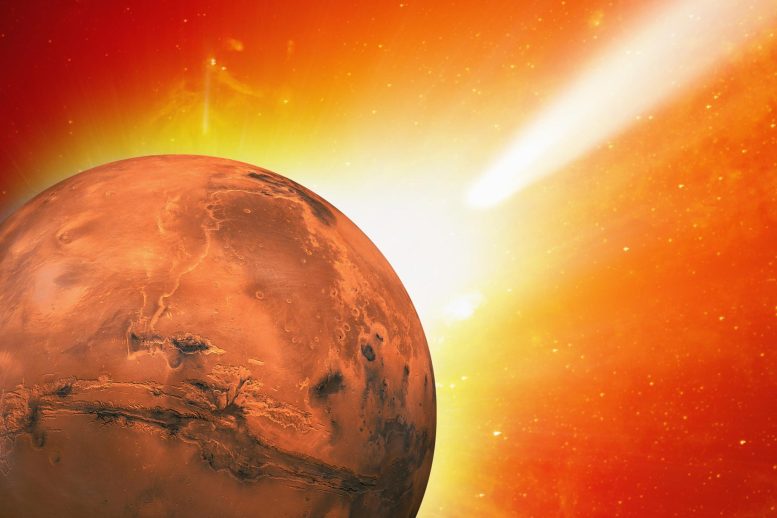
    An asteroid collision may have caused a Martian megatsunami approximately 3.4 billion years ago. New research has identified an impact crater that could have resulted from the asteroid impact that caused the megatsunami.

    Mars Megatsunami May Have Been Caused by Chicxulub-Like Asteroid Impact

    A Martian megatsunami may have been caused by an asteroid collision similar to the Chicxulub impact – which contributed to the mass extinction of all non-avian dinosaurs on Earth 66 million years ago – in a shallow ocean region. This is according to a study published today (December 1) in the journal Scientific Reports.

    Previous research has proposed that an asteroid or comet impact within an ocean in the Martian northern lowlands may have caused a megatsunami approximately 3.4 billion years ago. However, prior to this study, the location of the resulting impact crater was unclear.

    Alexis Rodriguez and colleagues analyzed maps of Mars’ surface, created by combining images from previous missions to the planet, and identified an impact crater that could have resulted from the asteroid collision that caused the megatsunami. The crater – which they have named Pohl – has a diameter of about 70 miles (110 kilometers) and is located within an area of the northern lowlands that previous studies have suggested may have been covered by an ocean, in a region around 400 feet (120 meters) below its proposed sea level. The authors suggest that Pohl may have formed around 3.4 billion years ago based on its position above and below rocks previously dated to this time.

    Simulating the Asteroid Impact

    The authors simulated asteroid and comet collisions with this region to test what type of impact that could have created Pohl and whether this could have led to a megatsunami. They found that the simulations that formed craters with similar dimensions to Pohl were caused by either a nine-kilometer asteroid encountering strong ground resistance – releasing 13 million megatons of TNT energy – or a three-kilometer asteroid encountering weak ground resistance – releasing 0.5 million megatons of TNT energy. The amount of energy released by Tsar Bomba, the most powerful nuclear bomb ever tested, was approximately 57 megatons of TNT energy.

    Both simulated impacts formed craters measuring 70 miles (110 kilometers) in diameter and generated megatsunamis that reached as far as 900 miles (1,500 kilometers) from the center of the impact site. Analysis of the megatsunami caused by the two-mile (three-kilometer) asteroid impact indicated that this tsunami may have measured up to approximately 820 feet (250 meters) tall on land.

    The authors suggest that the aftermath of the proposed Pohl impact may have had similarities with the Chicxulub impact on Earth, which previous research has suggested occurred within a region 650 feet (200 meters) below sea level, generated a crater with a temporary diameter of 60 miles (100 kilometers), and led to a megatsunami that was 650 feet (200 meters high) on land.

    Reference: “Evidence of an oceanic impact and megatsunami sedimentation in Chryse Planitia, Mars” 1 December 2022, Scientific Reports.
    DOI: 10.1038/s41598-022-18082-2

    Never miss a breakthrough: Join the SciTechDaily newsletter.
    Follow us on Google and Google News.

    Asteroid Mars Planets Popular Scientific Reports
    Share. Facebook Twitter Pinterest LinkedIn Email Reddit

    Related Articles

    Intriguing Martian Scars: An Ancient Crater Triplet on Mars

    NASA InSight Lander Takes Deep Mars Measurements: Seismograph Data Reveals Boundaries From Crust to Core

    How Venus and Mars Can Teach Us About the Past and Future of Earth

    New Findings Throw Cold Water on Ancient Mars Hypothesis

    “Puzzling and Surprising” New Gas Signatures Discovered by ExoMars Orbiter in the Martian Atmosphere

    Reading Martian Rocks in Unparalleled Detail to Find Ancient Water on Mars

    Stanford: Promising Signs for Past Martian Life at Jezero Crater, Mars

    Mars InSight Lander Yields a Year of Surprising Discoveries Above and Below the Surface of the Red Planet

    Journey to the Center of Mars – Investigating the Composition of the Red Planet

    1 Comment

    1. jms on December 1, 2022 7:05 pm

      After Fred Pohl?

      Reply
    Leave A Reply Cancel Reply

    • Facebook
    • Twitter
    • Pinterest
    • YouTube

    Don't Miss a Discovery

    Subscribe for the Latest in Science & Tech!

    Trending News

    Breakthrough Bowel Cancer Trial Leaves Patients Cancer-Free for Nearly 3 Years

    Natural Compound Shows Powerful Potential Against Rheumatoid Arthritis

    100,000-Year-Old Neanderthal Fossils in Poland Reveal Unexpected Genetic Connections

    Simple “Gut Reset” May Prevent Weight Gain After Ozempic or Wegovy

    2.8 Days to Disaster: Scientists Warn Low Earth Orbit Could Suddenly Collapse

    Common Food Compound Shows Surprising Power Against Superbugs

    5 Simple Ways To Remember More and Forget Less

    The Atomic Gap That Could Cost the Semiconductor Industry Billions

    Follow SciTechDaily
    • Facebook
    • Twitter
    • YouTube
    • Pinterest
    • Newsletter
    • RSS
    SciTech News
    • Biology News
    • Chemistry News
    • Earth News
    • Health News
    • Physics News
    • Science News
    • Space News
    • Technology News
    Recent Posts
    • ADHD Isn’t Just a Deficit: Study Reveals Powerful Hidden Strengths
    • Scientists Uncover “Astonishing” Hidden Property of Light
    • Scientists Discover Stem Cells That Could Regrow Teeth and Bone
    • Scientists Discover Natural Molecule That Stops Alzheimer’s Protein Clumps From Forming
    • Early Cannabis Use May Stall Key Brain Skills in Teens
    Copyright © 1998 - 2026 SciTechDaily. All Rights Reserved.
    • Science News
    • About
    • Contact
    • Editorial Board
    • Privacy Policy
    • Terms of Use

    Type above and press Enter to search. Press Esc to cancel.