
Close Menu
    Facebook X (Twitter) Instagram
    SciTechDaily
    • Biology
    • Chemistry
    • Earth
    • Health
    • Physics
    • Science
    • Space
    • Technology
    Facebook X (Twitter) Pinterest YouTube RSS
    SciTechDaily
    Home»Science»Fires in the Far East Captured From Space
    Science

    Fires in the Far East Captured From Space

    By Adam Voiland, NASA Earth ObservatoryApril 24, 20211 Comment2 Mins Read
    Facebook Twitter Pinterest Telegram LinkedIn WhatsApp Email Reddit
    Share
    Facebook Twitter LinkedIn Pinterest Telegram Email Reddit
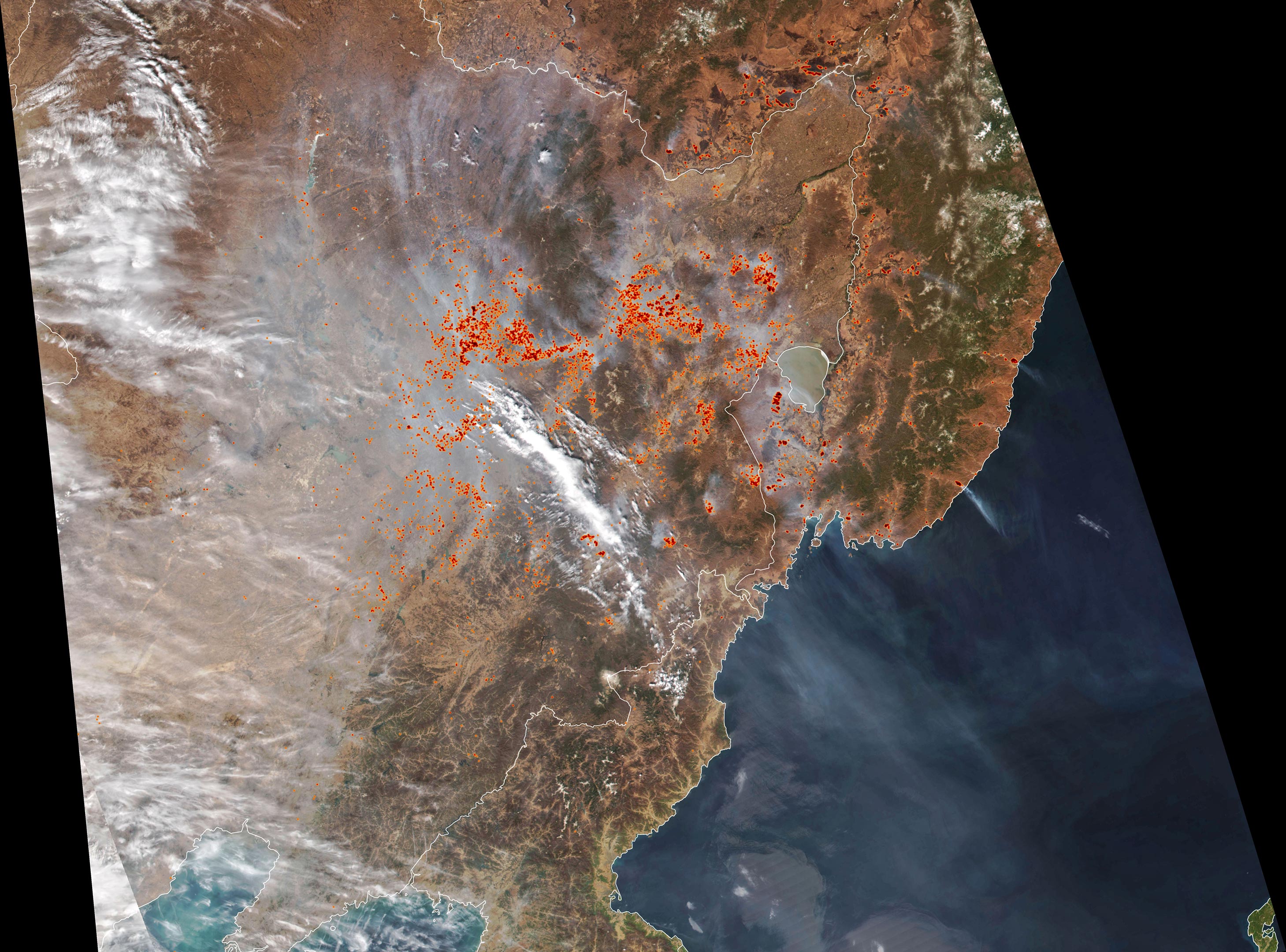
    Fires in the Far East Annotated
    April 21, 2021. (Click image for wider, high-resolution view.)

    Many farmers in northeastern China and eastern Russia use fire to clear fields and get them ready for planting.

    With millions of hectares of corn, rice, and beans sown in Heilongjiang each year, the province in northeastern China is one of the country’s most important food-producing areas. For many Heilongjiang farmers, one of the first steps in raising this year’s crop involves burning off the remaining bits of last year’s plants to remove debris from the fields and get them ready for planting in May.

    This practice sometimes leads to hazy, smoke-filled skies, as shown by this natural-color satellite image from the Visible Infrared Imaging Radiometer Suite (VIIRS) on the NOAA-NASA Suomi NPP satellite. Throughout the spring, VIIRS has detected large numbers of “hotspots” associated with fires. These hotspots appear red and orange in the image above.

    VIIRS began detecting sporadic fire activity in the region in mid-March 2021, as soon as warmer weather melted the snow cover. The number of fire detections then ballooned in mid-April, particularly around Harbin, as the spring burning season reached its peak.

    Most straw burning in this area used to happen in the fall, but satellite observations collected over several years show that there has been a strong shift toward spring fires since 2015. That was the year that local authorities enacted fall burning restrictions—part of an effort to limit air pollution—and started encouraging farmers to find other uses for leftover straw. Most crop fires in Heilongjiang now happen in March and April, a change that has coincided with a reduction in overall greenhouse gas and particulate pollution emissions from the area’s fires, according to one recent study.

    Fire activity has not been limited to China. Across the border in Russia, fires—many likely lit by farmers for similar reasons—have also been common along the Amur River. In some areas, including near Vladivostok, Russian authorities and news media reported significant numbers of grass and forests. While some of these likely began as crop fires that spread into forests, Russian authorities pointed to a mix of human activities‐ranging from cooking outdoors to stray cigarettes—for triggering wildfires.

    NASA Earth Observatory image by Joshua Stevens, using VIIRS data from NASA EOSDIS LANCE, GIBS/Worldview, and the Joint Polar Satellite System (JPSS).

    Never miss a breakthrough: Join the SciTechDaily newsletter.
    Follow us on Google and Google News.

    Agriculture Geography NASA NASA Earth Observatory
    Share. Facebook Twitter Pinterest LinkedIn Email Reddit

    Related Articles

    The Hidden Logic Behind Poland’s Stunningly Striped Fields

    From Space to Soil, Tracking the Explosive Rise of Greenhouses in China

    Romania’s Fields of Gold Captured From Space

    Satellite Reveals Larger Wheat Harvest in Ukraine Than Expected – And Barren Boundary of War

    Satellite Images Reveal a Rough Year for Rice in California

    Russia-Ukraine Conflict: Measuring War’s Effect on a Global Breadbasket

    A Sandy Flower in the Pacific: Unusual Island Growing in Shallow Coastal Waters Near Hainan, China

    Dazzling Photo of Chinese Port Cities at Night Taken by an Astronaut on the International Space Station

    How Satellites Track Status of Nation’s Food Supply and Help Farmers

    1 Comment

    1. Amrit Kapoor on April 24, 2021 11:25 pm

      What are these Red Dots in China?

      Sea Heart

      Reply
    Leave A Reply Cancel Reply

    • Facebook
    • Twitter
    • Pinterest
    • YouTube

    Don't Miss a Discovery

    Subscribe for the Latest in Science & Tech!

    Trending News

    Scientists Discover How Coffee Impacts Memory, Mood, and Gut Health

    Why Did the Neanderthals Disappear? Scientists Reveal Humans Had a Hidden Advantage

    Physicists Propose Strange Experiment Where Time Goes Quantum

    Magnesium Magic: New Drug Melts Fat Even on a High-Fat, High-Sugar Diet

    Weight-Loss Drugs Like Ozempic May Come With an Unexpected Cost

    Mezcal “Worm” in a Bottle Mystery: DNA Testing Reveals a Surprise

    New Research Reveals That Your Morning Coffee Activates an Ancient Longevity Switch

    This Is What Makes You Irresistible to Mosquitoes

    Follow SciTechDaily
    • Facebook
    • Twitter
    • YouTube
    • Pinterest
    • Newsletter
    • RSS
    SciTech News
    • Biology News
    • Chemistry News
    • Earth News
    • Health News
    • Physics News
    • Science News
    • Space News
    • Technology News
    Recent Posts
    • Harvard Scientists Reveal Secret Structure Behind How You Smell
    • Scientists Just Discovered the Hidden Trick That Keeps Your Cells Alive
    • This Simple Movement Could Be Secretly Cleaning Your Brain
    • Male Birth Control Breakthrough: Scientists Find Way To Turn Sperm Production Off and Back On
    • A Common Vitamin Could Hold the Key to Treating Fatty Liver Disease
    Copyright © 1998 - 2026 SciTechDaily. All Rights Reserved.
    • Science News
    • About
    • Contact
    • Editorial Board
    • Privacy Policy
    • Terms of Use

    Type above and press Enter to search. Press Esc to cancel.