
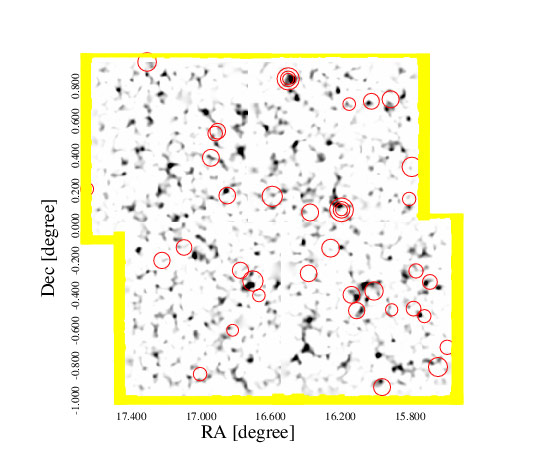
An international team of scientists present the first detailed analysis of the weak lensing peaks, finding that the abundance of peaks detected in CS82 is consistent with predictions from a Lambda cold dark matter cosmological model once noise effects are properly included.
A number of studies have shown that Dark Matter is the principal mass component of the Universe making up about 80% of the mass budget. The most direct technique to reveal the Dark Matter distribution is by using the gravitational lensing technique. Indeed, following Einstein’s theory of Gravitation, we know that a mass concentration will deform locally the Space-Time and the observed shapes of distant galaxies seen through such concentration will be deflected and distorted. By measuring the exact shapes of millions of these distant galaxies we can then map accurately the mass distribution in the Universe, and identify the mass peaks tracing mass concentration along their line of sight. Importantly, the number of mass peaks as a function of the mass peak significance encodes important information on the cosmological world model. In particular, this distribution is sensitive to the nature of Gravitational force at large scales as well as the geometry of the Universe. Measuring mass peaks is thus one of the most attractive ways to probe the relative importance and nature of Dark Matter and Dark Energy, measure the evolution of the Universe, and predict its fate.
In a new publication of the Monthly Notice of Royal Astronomical Society, an international team, comprising researchers from Swiss, France, Brazil, Canada, and Germany present the first detailed analysis of the weak lensing peaks. This work is considered as a milestone, given the possible importance of the weak lensing peaks for cosmology. Because mass peaks are identified in two–dimensional dark matter maps directly, they can provide constraints that are free from potential selection effects and biases involved in identifying and measuring the masses of galaxy clusters. In fact, a small fraction of the max peaks are just mass concentration excess along the line of sight, and not genuine massive clusters.
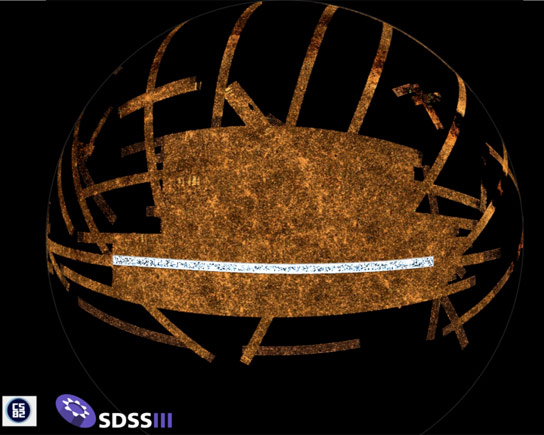
To detect the weak lensing mass peaks, the research team used the Canada-France-Hawaii Telescope Stripe 82 Survey (CS82 in short), still one of the largest weak lensing survey yet. The Survey covers ~170 square degrees of the Stripe 82 of the Sloan Digital Sky Survey (SDSS), an equatorial region of the South Galactic Cap that has been extensively studied by the SDSS project. With the precise shape measurement for more than four million faint distant galaxies, a dark matter mass map was generated. Huan Yuan Shan, the lead author of this publication explains that: “By studying the mass peaks in the map, we found that the abundance of mass peaks detected in CS82 is consistent with predictions from a ΛCDM cosmological model. This result confirms that the dark matter distribution from weak lensing measurement can be used as a cosmological probe”.
Jean-Paul Kneib, co-author of the publication explains that: “This work opens a new window to constrain cosmology with weak gravitational lensing. We can not only reveal where the dark matter is located using space-time distortion, but also use the distributions of mass peaks to better constrain and understand our Universe”.
Huan Yuan Shan, adds that: “Because of their large number, the small mass peaks in the Dark Matter maps contain more resolving power than the most massive peaks to constrain cosmological models”. As a cosmological probe, the weak lensing mass peak abundance is very complementary to the other cosmology probes, such as the study of the Cosmological Microwave Background (CMB), the study of distant SuperNovae, the measure of the Baryonic Accoustic Oscillation and the cosmic shear.
The abundance of mass peaks in the Dark Matter mass map confirms the theories of structure formation. In the near future, with the upcoming weak lensing surveys (to be conducted with the DES survey, LSST, and Euclid), by precisely counting the peaks of dark matter mass maps, we will be able to set constraints on the nature of Dark Matter and Dark Energy.
Reference: “Weak lensing mass map and peak statistics in Canada-France-Hawaii Telescope Stripe 82 survey” by HuanYuan Shan, Jean-Paul Kneib, Johan Comparat, Eric Jullo, Aldee Charbonnier, Thomas Erben, Martin Makler, Bruno Moraes, Ludovic Van Waerbeke, Frederic Courbin, Georges Meylan, Charling Tao and James E. Taylor, 24 June 2014, MNRAS.
DOI: 10.1093/mnras/stu1040
arXiv: 1311.1319
Never miss a breakthrough: Join the SciTechDaily newsletter.
Follow us on Google and Google News.
1 Comment
At only 4 square degrees, in cosmos,it is fantastic sight to see multi-numerous galaxies spread like pearls spaced by the weak lensing effect of the Dark Matter intervening in between them. Initially, astronomers saw only the kaleidoscopic effect of gravitational lensing effect of Dark matter on the nearby galaxies. Now, a fine spectrum, confirms the existence of the web of Dark Matter throughout the Universe. Of course, they are the boss of this Universe, and seems to be creator of visible universe which is only 4% after all. As I have always been saying, in all my previous analyses, it is the Dark Matter which triggers the creation of galaxies and the store of energy in them is spent slowly to become light matter and light energy, no doubt.
Thank You.