
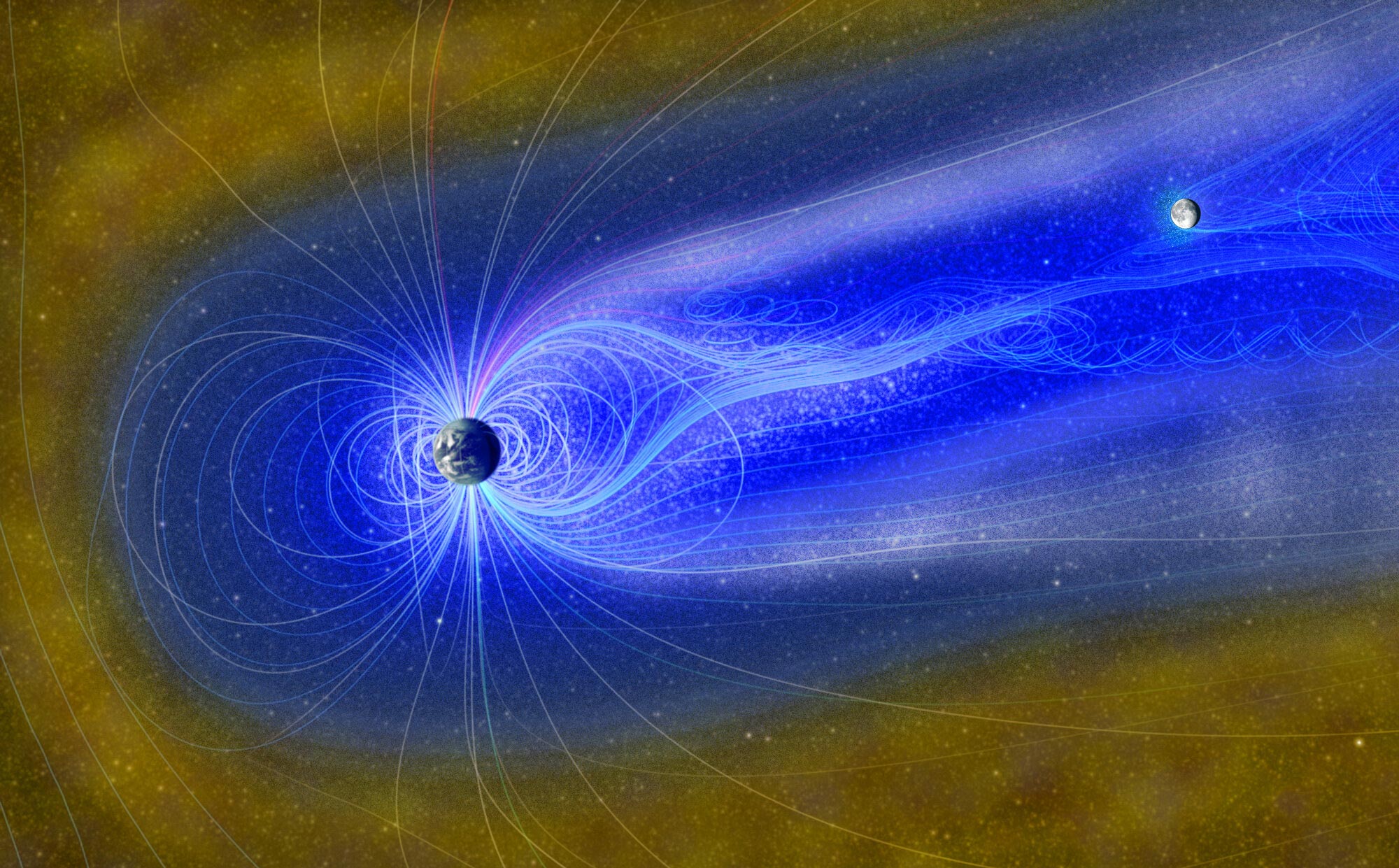
A new study suggests that lunar water is not only formed by the solar wind but also by particles from Earth’s magnetosphere, known as “Earth wind.”
Before the Apollo era, the moon was thought to be dry as a desert due to the extreme temperatures and harshness of the space environment. Many studies have since discovered lunar water: ice in shadowed polar craters, water bound in volcanic rocks, and unexpected rusty iron deposits in the lunar soil. Despite these findings, there is still no true confirmation of the extent or origin of lunar surface water.
The prevailing theory is that positively charged hydrogen ions propelled by the solar wind bombard the lunar surface and spontaneously react to make water (as hydroxyl (OH–) and molecular (H2O)). However, a new multinational study published in Astrophysical Journal Letters proposes that solar wind may not be the only source of water-forming ions. The researchers show that particles from Earth can seed the moon with water, as well, implying that other planets could also contribute water to their satellites.
Water is far more prevalent in space than astronomers first thought, from the surface of Mars to Jupiter’s moons and Saturn’s rings, comets, asteroids and Pluto; it has even been detected in clouds far beyond our solar system. It was previously assumed that water was incorporated into these objects during the formation of the solar system, but there is growing evidence that water in space is far more dynamic. Though the solar wind is a likely source for lunar surface water, computer models predict that up to half of it should evaporate and disappear at high-latitude regions during the approximately three days of the full moon when it passes within Earth’s magnetosphere.
Surprisingly, the latest analysis of surface hydroxyl/water surface maps by the Chandrayaan-1 satellite’s Moon Mineralogy Mapper (M3) showed that lunar surface water does not disappear during this magnetosphere shielding period. Earth’s magnetic field was thought to block the solar wind from reaching the moon so that water could not be regenerated faster than it was lost, but the researchers found this was not the case.
Earth Wind: A Second Source of Lunar Water
By comparing a time series of water surface maps before, during and after the magnetosphere transit, the researchers argue that lunar water could be replenished by flows of magnetospheric ions, also known as “Earth wind.” The presence of these Earth-derived ions near the moon was confirmed by the Kaguya satellite, while THEMIS-ARTEMIS satellite observations were used to profile the distinctive features of ions in the solar wind versus those within the magnetosphere Earth wind.
Previous Kaguya satellite observations during the full moon detected high concentrations of oxygen isotopes that leaked out of Earth’s ozone layer and embedded in lunar soil, along with an abundance of hydrogen ions in our planet’s vast extended atmosphere, known as the exosphere. These combined flows of magnetosphere particles are fundamentally different from those in the solar wind. Thus, the latest detection of surface water in this study refutes the shielding hypothesis and instead suggest that the magnetosphere itself creates a “water bridge” that can replenish the moon.
The study employed a multidisciplinary team of experts from cosmochemistry, space physics and planetary geology to contextualize the data. Prior interpretations of surface water did not consider the effects of Earth ions and did not examine how surface water changed over time. The only surface maps and particle data available during a full moon in the magnetosphere were in winter and summer 2009, and it took the past several years to analyze and interpret the results. The analysis was especially difficult due to the scarce observations, which were required to compare the same lunar surface conditions over time and to control for temperature and surface composition.
In light of these findings, future studies of the solar wind and planetary winds can reveal more about the evolution of water in our solar system and the potential effects of solar and magnetosphere activity on other moons and planetary bodies. Expanding this research will require new satellites equipped with comprehensive hydroxyl/water mapping spectrometers, and particle sensors in orbit and on the lunar surface to fully confirm this mechanism. These tools can help to predict the best regions for future exploration, mining, and eventual settlement on the moon. Practically, this research can influence the design of upcoming space missions to better safeguard humans and satellites from particle radiation hazards, and also improve computer models and laboratory experiments of water formation in space.
Reference: “Earth Wind as a Possible Exogenous Source of Lunar Surface Hydration” by H. Z. Wang, J. Zhang, Q. Q. Shi, Y. Saito, A. W. Degeling, I. J. Rae, J. Liu, R. L. Guo, Z. H. Yao, A. M. Tian, X. H. Fu, Q.G. Zong, J. Z. Liu, Z. C. Ling, W. J. Sun, S. C. Bai, J. Chen, S. T. Yao, H. Zhang, Y. Wei, W. L. Liu, L. D. Xia, Y. Chen, Y. Y. Feng, S. Y. Fu and Z. Y. Pu, 28 January 2021, Astrophysical Journal Letters.
DOI: 10.3847/2041-8213/abd559
arXiv: 1903.04095
Never miss a breakthrough: Join the SciTechDaily newsletter.
Follow us on Google and Google News.