
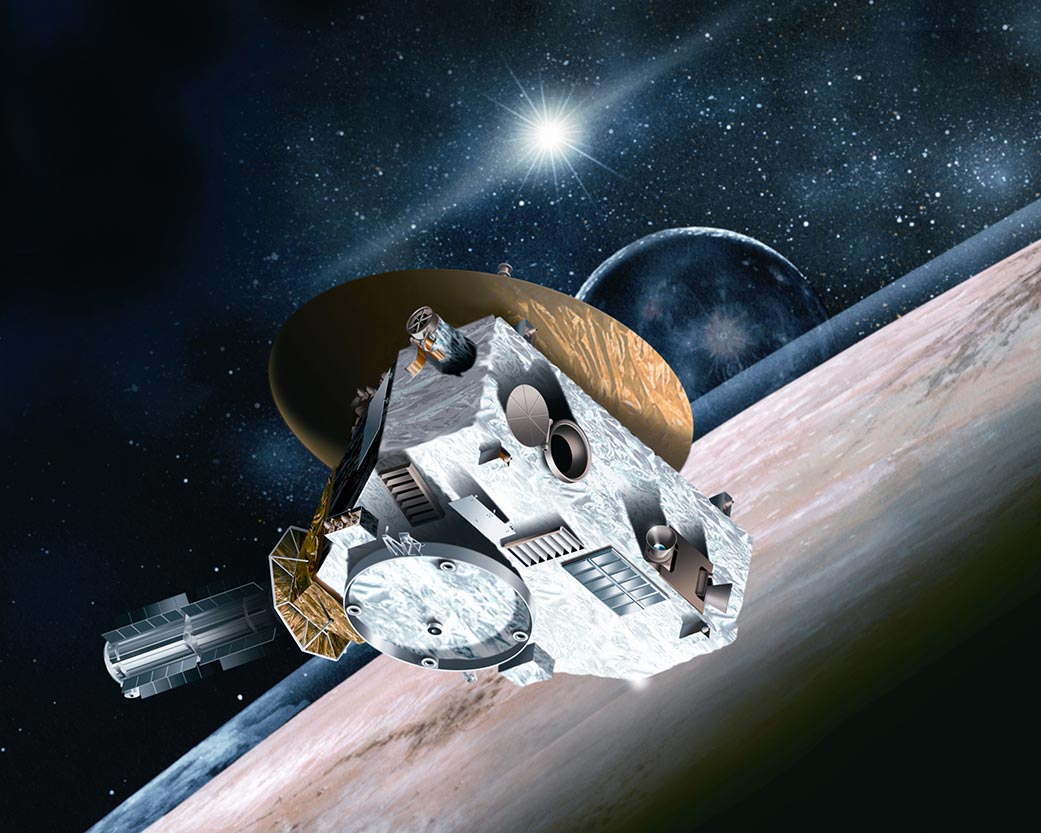
For the first time, a spacecraft has sent back pictures of the sky from so far away that some stars appear to be in different positions than we’d see from Earth.
More than four billion miles from home and speeding toward interstellar space, NASA’s New Horizons has traveled so far that it now has a unique view of the nearest stars. “It’s fair to say that New Horizons is looking at an alien sky, unlike what we see from Earth,” said Alan Stern, New Horizons principal investigator from Southwest Research Institute (SwRI) in Boulder, Colorado. “And that has allowed us to do something that had never been accomplished before — to see the nearest stars visibly displaced in the sky from the positions we see them on Earth.”
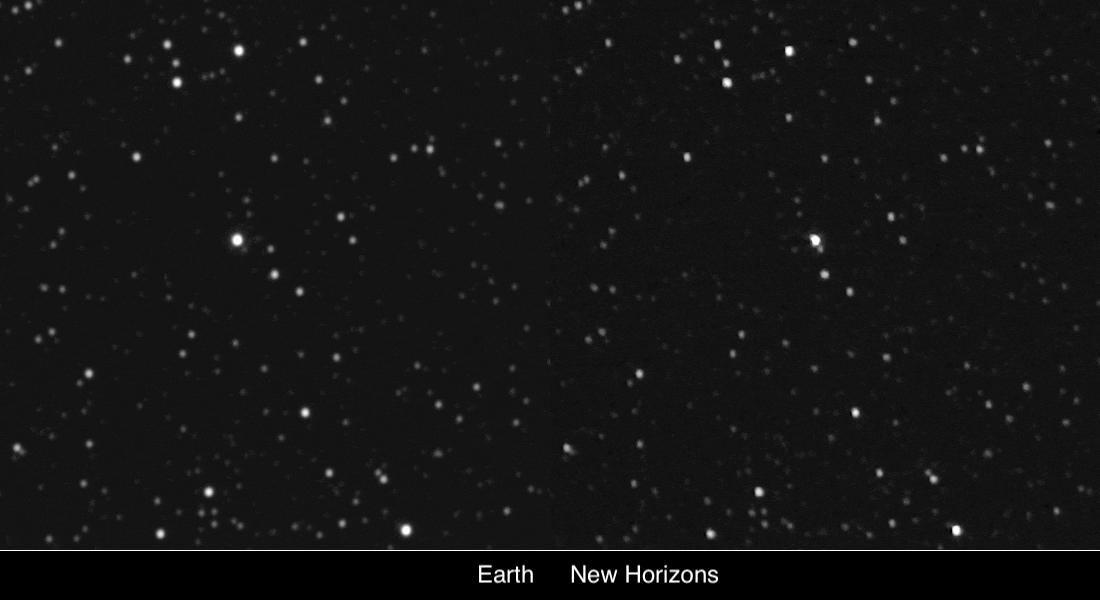
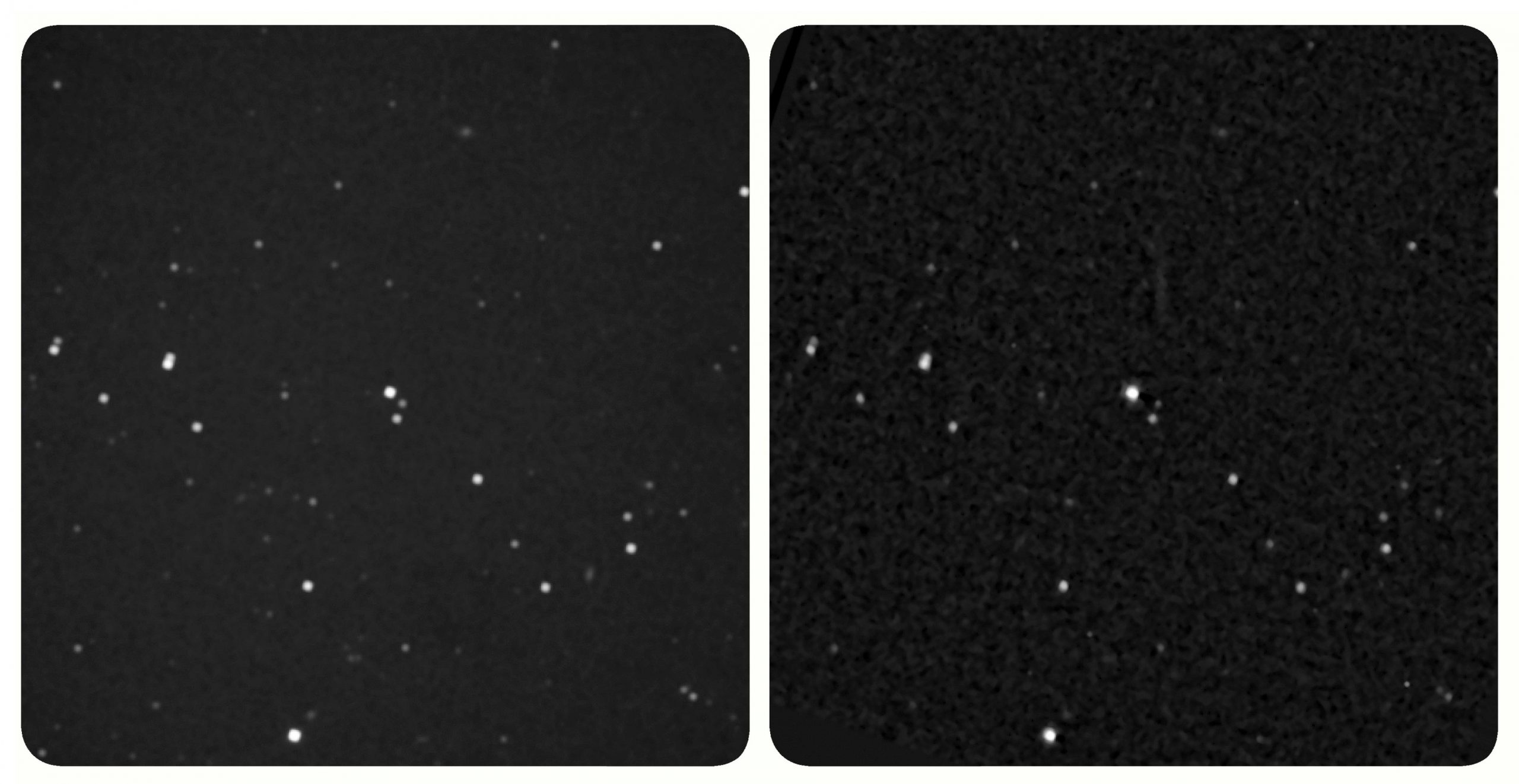
On April 22-23, the spacecraft turned its long-range telescopic camera to a pair of the “closest” stars, Proxima Centauri and Wolf 359, showing just how they appear in different places than we see from Earth. Scientists have long used this “parallax effect” – how a star appears to shift against its background when seen from different locations — to measure distances to stars.
An easy way to see parallax is to place one finger at arm’s length and watch it jump back and forth when you view it successively with each eye. Similarly, as Earth makes its way around the Sun, the stars shift their positions. But because even the nearest stars are hundreds of thousands of times farther away than the diameter of Earth’s orbit, the parallax shifts are tiny, and can only be measured with precise instrumentation.
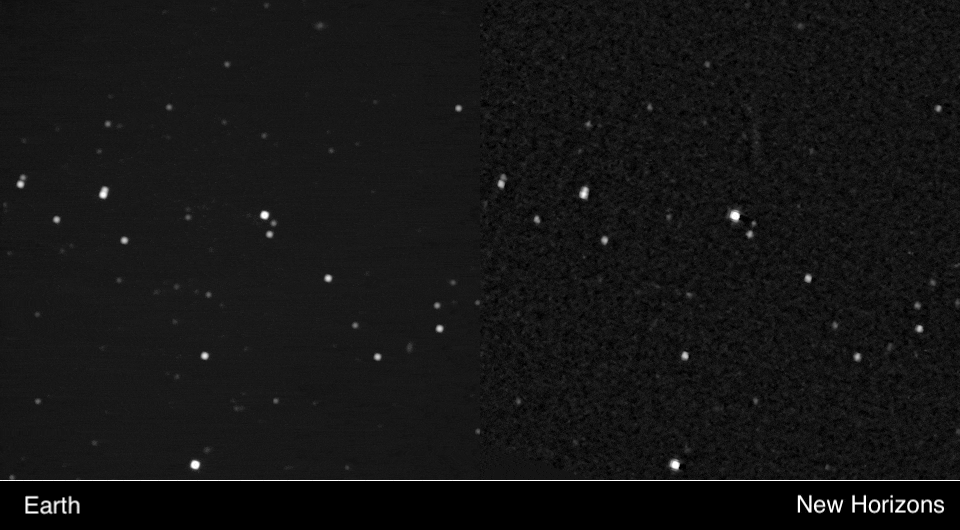
“No human eye can detect these shifts,” Stern said.
But when New Horizons images are paired with pictures of the same stars taken on the same dates by telescopes on Earth, the parallax shift is instantly visible. The combination yields a 3D view of the stars “floating” in front of their background star fields.
“The New Horizons experiment provides the largest parallax baseline ever made — over 4 billion miles — and is the first demonstration of an easily observable stellar parallax,” said Tod Lauer, New Horizons science team member from the National Science Foundation’s National Optical-Infrared Astronomy Research Laboratory who coordinated the parallax demonstration.
“The New Horizons spacecraft is truly a mission of firsts, and this demonstration of stellar parallax is no different,” said Kenneth Hansen, New Horizons program scientist at NASA Headquarters in Washington. “The New Horizons spacecraft continues to speed away from Earth toward interstellar space and is continuing to return exciting new data for planetary science.”
Working in Stereo
Lauer, New Horizons Deputy Project Scientist John Spencer, of SwRI, and science team collaborator, astrophysicist, Queen guitarist, and stereo imaging enthusiast Brian May created the images that clearly show the effect of the vast distance between Earth and the two nearby stars.
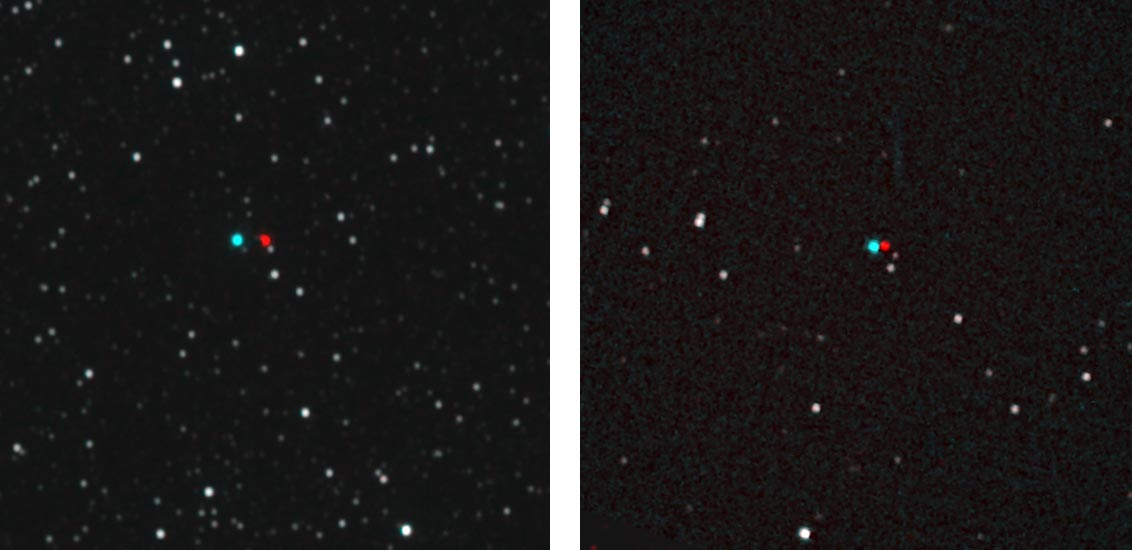
“It could be argued that in astro-stereoscopy — 3D images of astronomical objects – NASA’s New Horizons team already leads the field, having delivered astounding stereoscopic images of both Pluto and the remote Kuiper Belt object Arrokoth,” May said. “But the latest New Horizons stereoscopic experiment breaks all records. These photographs of Proxima Centauri and Wolf 359 – stars that are well-known to amateur astronomers and science fiction aficionados alike — employ the largest distance between viewpoints ever achieved in 180 years of stereoscopy!”
The companion images of Proxima Centauri and Wolf 359 were provided by the Las Cumbres Observatory, operating a remote telescope at Siding Spring Observatory in Australia, and astronomers John Kielkopf, University of Louisville, and Karen Collins, Harvard and Smithsonian Center for Astrophysics, operating a remote telescope at Mt. Lemmon Observatory in Arizona.

“The professional and amateur astronomy communities had been waiting to try this, and were very excited to make a little space exploration history,” said Lauer. “The images collected on Earth when New Horizons was observing Proxima Centauri and Wolf 359 really exceeded my expectations.”
Download the images (and learn more about creating and posting your own parallax perspectives) at http://pluto.jhuapl.edu/Learn/Parallax/Parallax-Images.php
An Interstellar Navigation First
Throughout history, navigators have used measurements of the stars to establish their position on Earth. Interstellar navigators can do the same to establish their position in the galaxy, using a technique that New Horizons has demonstrated for the first time. While radio tracking by NASA’s Deep Space Network is far more accurate, its first use is a significant milestone in what may someday become human exploration of the galaxy.
At the time of the observations, New Horizons was more than 4.3 billion miles (about 7 billion kilometers) from Earth, where a radio signal, traveling at the speed of light, needed just under 6 hours and 30 minutes to reach home.
Launched in 2006, New Horizons is the first mission to Pluto and the Kuiper Belt. It explored Pluto and its moons in July 2015 — completing the space-age reconnaissance of the planets that started 50 years earlier — and continued on its unparalleled voyage of exploration with the close flyby of Kuiper Belt object Arrokoth in January 2019. New Horizons will eventually leave the solar system, joining the Voyagers and Pioneers on their paths to the stars.
The Johns Hopkins University Applied Physics Laboratory in Laurel, Maryland, designed, built, and operates the New Horizons spacecraft, and manages the mission for NASA’s Science Mission Directorate. The MSFC Planetary Management Office provides NASA oversight for the New Horizons. Southwest Research Institute, based in San Antonio, directs the mission via Principal Investigator Stern, and leads the science team, payload operations, and encounter science planning. New Horizons is part of the New Frontiers Program managed by NASA’s Marshall Space Flight Center in Huntsville, Alabama.
Never miss a breakthrough: Join the SciTechDaily newsletter.
Follow us on Google and Google News.
12 Comments
Is there any possibility to use this ability for real science? We already know the distances to Proxima and Wolf 359 very well. Can we use New Horizons to measure the distance to less well measured, more distant stars… especially those that are too bright for the Gaia telescope to observe?
Good question!
Since they present it here as an illustration of what you can’t easily see by eye in telescopes – need precision spectrometers and data analysis – I suspect the precision is too low.
The farther the distance, the greater the “baseline” needed. In this case, four billion miles was enough to give us depth on a stereo pair of these two closest stars. Yes, indeed they might be able to do this with other, similarly nearby stars. To image, say, the Andromeda Galaxy in this way would require orders of magnitude greater distance between the viewpoints. The rule of thumb with stereo photography is “the farther, the wider”.
Why don’t all the stars shown in the photo shift as does Proxima Centari? Aren’t they subject to the same parallax effect? If they are not, why not?
“Why don’t all the stars shown in the photo shift as does Proxima Centari?”
It’s a matter of distance. From the article:
“An easy way to see parallax is to place one finger at arm’s length and watch it jump back and forth when you view it successively with each eye.”
If you try this, you’ll see your finger move. If you try the same thing with a radio tower, tall building, or something similar a mile away or so, you won’t see it move. The reason for this is because as something gets further away, the angular shift between eyes lessens. This is why parallax measurements on Earth take extremely precise instruments to measure. Instead of having one eye on each side of the Earth, 7,900 miles or so apart, we now have one eye on Earth, and the other eye 4.7 billion miles away. This is why the nearby stars “move.” The distant stars are still too far away to visibly see a shift, even with our “eyes” 4.3 billion miles apart.
Grant Gussie: That’s precisely what we have in fact done here. This is “real science”. The distances to the closest stars, determined by parallax measurements from Earth, are a very important part of how other measurements of astronomical distances are measured. The measurements using the far greater baseline available by using the New Horizons spacecraft are far more accurate than those done from earth,
Michael Ridey: The parallax effect depends upon the distance to the star. The closer the star, the greater the effect. The farther away the star, the smaller the effect. The other stars are at widely varying distances, all much greater than the distance to Proxima Centauri, which is one of a very small number of stars very close to Earth. The others are all too far away to show the effect.
References?
When will you people test an interferometer on the ISS?
Maybe you need to be more specific? 😀
“UV-Vis-NIR collimator and laser unequal path-length interferometer supplied by Optical Surfaces helped set up the DESIS hyperspectral Earth-observation instrument. … now functioning on-board the International Space Station (ISS).”
https://www.laserfocusworld.com/optics/article/14168719/collimator-and-interferometric-alignment-system-enable-environmental-monitoring-from-the-iss
I assume the displacement measurement and the known distance from Earth of the probe would allow for a more exact calculation of the distance to these stars, or a confirmation of previously calculated distance. Wonder why the article didn’t include this. If the probe is around 6.5 light-hours away, while the star’s calculated distance has been listed as 37,200 light-hours away, do the photos support or change this calculation?
since it would take about 137,000 years to get there these are all abstract conversations.. we aren’t going anywhere and no aliens are coming here.. I too read Heinlein and Asimov, etc.. I still enjoy rereading the stories.. but reality is we will never see aliens.. and we will never leave our solar system.. the moves being made on the moon and mars are just to gain patents using our tax dollars as funding.. technology is improved by science we all pay for but corporations will steal the work and make a lot of money off it.. just like everything else.. drugs, communications, etc..
The distances makes interstellar space flight difficult, technologically and economically.
But most everyone knows that, and further: so what? New Horizon shows we can do science from here. And that is a far better outcome than your unsupported dystopian ideas.