
Close Menu
    Facebook X (Twitter) Instagram
    SciTechDaily
    • Biology
    • Chemistry
    • Earth
    • Health
    • Physics
    • Science
    • Space
    • Technology
    Facebook X (Twitter) Pinterest YouTube RSS
    SciTechDaily
    Home»Space»First Multiple-Sol Drive on Mars for NASA’s Perseverance Rover
    Space

    First Multiple-Sol Drive on Mars for NASA’s Perseverance Rover

    By Vandi Verma, NASA/JPLMarch 1, 20221 Comment3 Mins Read
    Facebook Twitter Pinterest Telegram LinkedIn WhatsApp Email Reddit
    Share
    Facebook Twitter LinkedIn Pinterest Telegram Email Reddit
    Mars Perseverance Sol 351
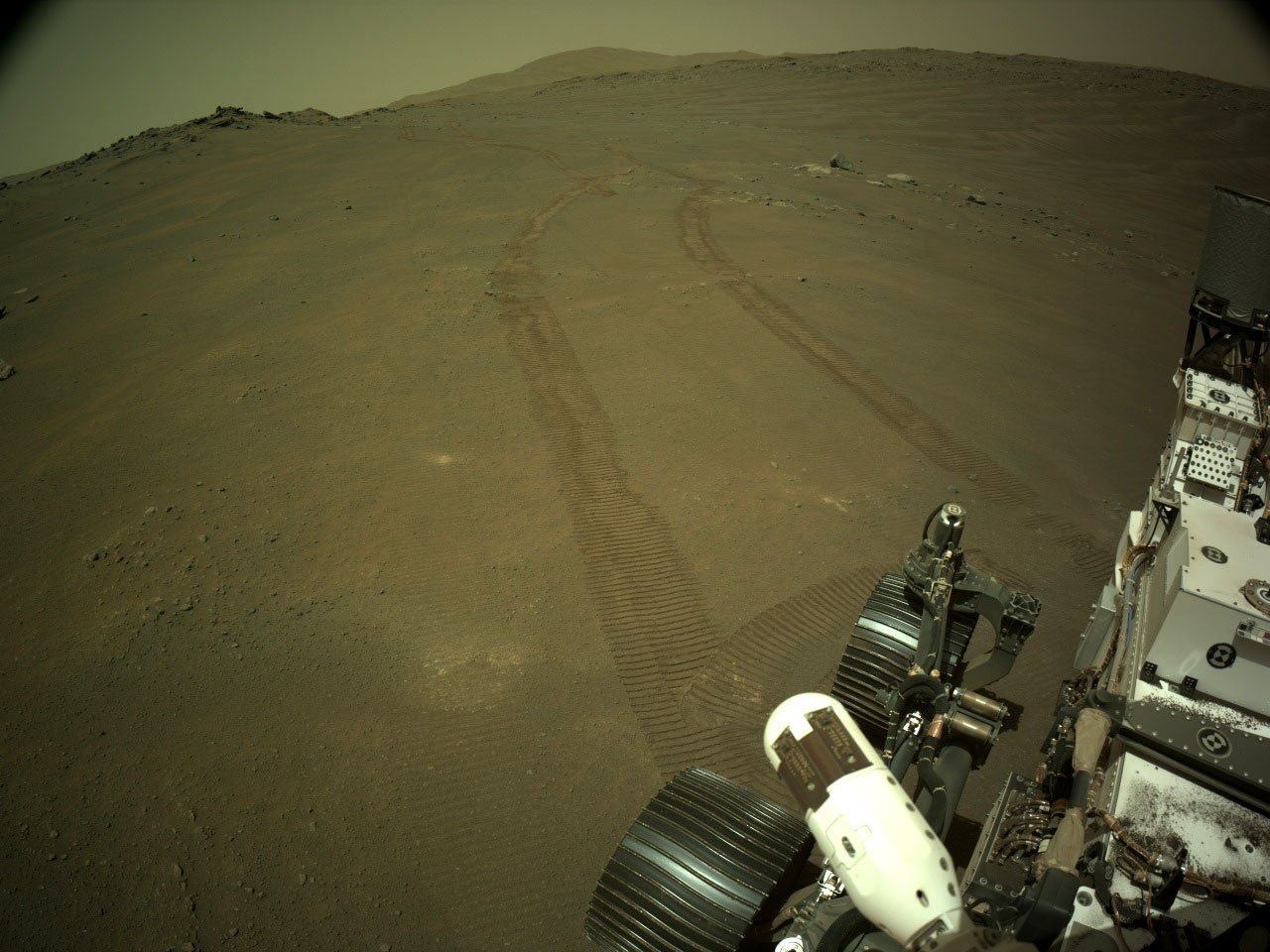
    Mars Perseverance Sol 351 – Left Navigation Camera: Sol 351 Perseverance Navcam image. Looking back at rover tracks and over South Séítah during the sol 350-352 multiple-sol drive as the rover autonomously navigated around Séítah from the Western to the Eastern edge. The image was taken after the second sol of the multiple-sol drive. The rover started at the extreme upper right, beyond the ripple field. Also in the image are faint tracks from the inbound journey. Credit: NASA/JPL-Caltech

    Perseverance set a distance record during its first multi-sol drive, overcoming challenges in autonomous navigation. 

    Perseverance capped its first year on Mars by speeding back around Séítah toward what is expected to be the final sampling location in its crater floor campaign. The drive on Mars was split across three different sols executing instructions planned in a single day on Earth, making this Perseverance’s first multiple-sol drive.

    Why are we excited about the multiple-sol drive? It creates an opportunity to drive a great distance in a longer plan, typically during holidays or weekends when new planning doesn’t occur on Earth. Recently in the sol 350-352 plan we commanded a three-sol drive that resulted in the longest-single-sol total distance recorded by any Mars rover (319.79m or 1,049.2ft) on sol 351, and the longest distance of any Mars rover in a single plan without ground intervention (509.75m or 1,672.4ft). Two reasons that made the multiple-sol drive more challenging than driving the same distance in three single-sol plans are uncertainty and complexity.

    Autonav is very good at detecting the geometric obstacles it encounters near the rover (like large rocks and high slopes) and avoids these. There are certain non-geometric hazards, like sand that it does not detect on its own, and rover planners mark these areas using “keep-out-zone” locations in the rover’s world map, which serves as its map of Mars. As the rover drives it accumulates some uncertainty, or error, in its knowledge of where it is on Mars. Even though its Visual Odometry (VO) capability is able to measure and compensate for slip, making this relatively small, the uncertainty accumulates over large distances. The rover knows that as it’s driving its knowledge of where the keep-out-zones are is getting less certain. Perseverance models that knowledge as an accumulating “uncertainty distance” and will enlarge keep-out zones by that amount. A viable corridor with one or more edges along a keep-out-zone can therefore potentially shrink by tens of meters making it challenging for Autonav to find a path through terrain in the far distance. We reset the position uncertainty to zero every time we uplink a new set of drive instructions because we also localize the rover precisely on Mars. This makes corridors within a single-sol distance easier for Autonav to navigate and we used this in the sol 353 drive as we drove up North.

    Planning a three-sol drive is also more complex because we must create and evaluate three times as many drive path segments and associated terrain evaluations. At planning time we cannot know exactly where the previous autonomous drive will end up on Mars, and this needs to be factored into each sol’s drive plan. Longer command creation and review times are also compressed into a single planning day.

    We have arrived at Ch’ał for our final crater floor sampling and are looking forward to many more multiple-sol drives on our journey to the Jezero delta!

    Written by Vandi Verma, Chief Engineer for Robotic Operations at NASA/JPL

    Never miss a breakthrough: Join the SciTechDaily newsletter.
    Follow us on Google and Google News.

    JPL Mars Mars 2020 Perseverance Rover NASA
    Share. Facebook Twitter Pinterest LinkedIn Email Reddit

    Related Articles

    NASA’s Perseverance Rover Discovers Mysterious Striped Rock on Mars

    NASA’s Perseverance Rover Begins Ambitious Ascent of Jezero Crater Rim

    NASA’s Perseverance Mars Rover To Begin Epic Climb up Steep Martian Crater Rim

    Potential Evidence of Life Discovered on Mars by NASA’s Perseverance Rover

    Is There Life on Mars? NASA’s AI Rovers Might Soon Tell Us

    Charting the Red Planet: How Open Science Fuels Mars Exploration

    Perseverance Triumphs: How SHERLOC Was Brought Back to Life on Mars

    Atmospheric Time Capsules: Why Scientists Are Intrigued by Air in NASA’s Mars Sample Tubes

    NASA’s Perseverance Rover Crosses Ancient Martian River To Reach New Scientific Frontiers

    1 Comment

    1. The 10th Man on March 1, 2022 5:12 am

      STOP F*@KING ABOUT!, and do what you went there to do.

      Reply
    Leave A Reply Cancel Reply

    • Facebook
    • Twitter
    • Pinterest
    • YouTube

    Don't Miss a Discovery

    Subscribe for the Latest in Science & Tech!

    Trending News

    New “Nanozyme Hypothesis” Could Rewrite the Story of Life’s Origins

    Anatomy Isn’t Finished: The Human Body Still Holds Secrets

    “Pretty Close to Home”: The Hidden Earthquake Threat Beneath Seattle

    The Surprising Reason You Might Want To Sleep Without a Pillow

    Scientists Say This Natural Hormone Reverses Obesity by Targeting the Brain

    35-Million-Year-Old Mystery: Strange Arachnid Discovered Preserved in Amber

    Is AI Really Just a Tool? It Could Be Altering How You See Reality

    JWST Reveals a “Forbidden” Planet With a Baffling Composition

    Follow SciTechDaily
    • Facebook
    • Twitter
    • YouTube
    • Pinterest
    • Newsletter
    • RSS
    SciTech News
    • Biology News
    • Chemistry News
    • Earth News
    • Health News
    • Physics News
    • Science News
    • Space News
    • Technology News
    Recent Posts
    • NASA Artemis II Splashdown and Astronaut Recovery Operation [Image Gallery]
    • Splashdown! NASA Artemis II Returns From Record-Breaking Moon Mission
    • Scientists Freeze a Spinning Nanoparticle to Its Quantum Limit
    • A 100x Faster Breakthrough Could Fix Quantum Computers’ Biggest Problem
    • New Memory Chip Survives 1300°F, Hotter Than Lava
    Copyright © 1998 - 2026 SciTechDaily. All Rights Reserved.
    • Science News
    • About
    • Contact
    • Editorial Board
    • Privacy Policy
    • Terms of Use

    Type above and press Enter to search. Press Esc to cancel.