
Close Menu
    Facebook X (Twitter) Instagram
    SciTechDaily
    • Biology
    • Chemistry
    • Earth
    • Health
    • Physics
    • Science
    • Space
    • Technology
    Facebook X (Twitter) Pinterest YouTube RSS
    SciTechDaily
    Home»Space»First Sugar Ever Found in Interstellar Space Could Help Explain Life’s Origins
    Space

    First Sugar Ever Found in Interstellar Space Could Help Explain Life’s Origins

    By Spanish National Research CouncilJuly 24, 2026No Comments4 Mins Read
    Facebook Twitter Pinterest Telegram LinkedIn WhatsApp Email Reddit
    Share
    Facebook Twitter LinkedIn Pinterest Telegram Email Reddit
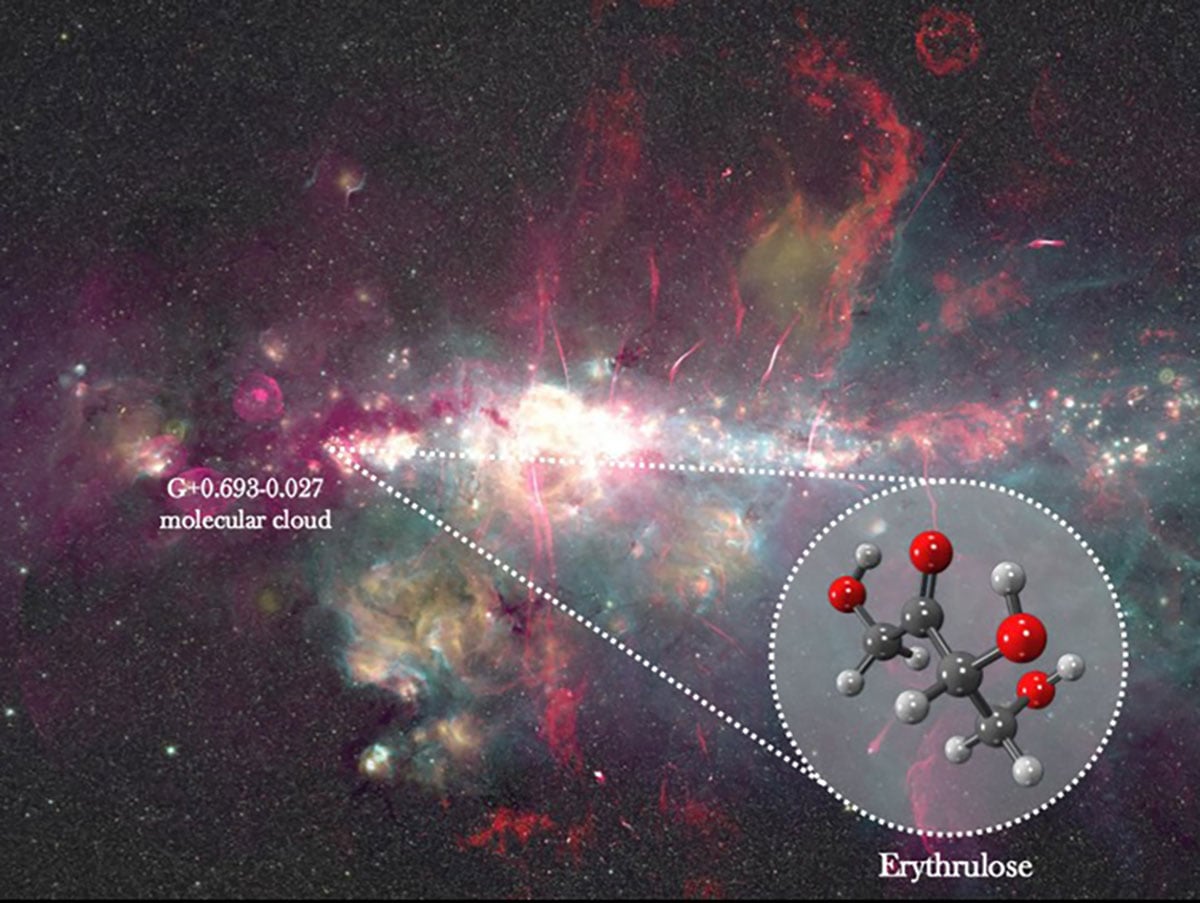
    Composite Image From the Galactic Center
    Composite image from the Galactic Center. Green and yellow: 8 µm and 24 µm emission observed with Spitzer (Churchwell et al. 2009; Carey et al. 2009). Red: 20 cm emission imaged with MeerKAT (Heywood et al. 2019, 2022) and the Green Bank Telescope (GBT; Law et al. 2008). Image adapted from Henshaw et al. (2023; doi: 10.48550/arXiv.2203.11223) and Longmore et al. (2026; 10.48550/arXiv.2602.20340). Credit: Ashley Barnes/Izaskun Jiménez-Serra/Juan García de la Concepción

    Researchers have detected a sugar in the interstellar medium for the first time.

    Sugars are central to life. They help form the structural backbone of DNA and RNA and participate in essential metabolic reactions.

    They are also thought to have been necessary for the formation of the earliest nucleic acids. Yet researchers studying life’s origins still face a major puzzle: laboratory experiments indicate that prebiotic conditions on early Earth would not have produced enough sugar.

    Ribose and glucose have been found in meteorites and asteroid material, raising the possibility that some sugars formed in the ancient molecular cloud that gave rise to the Solar System. Until now, however, no sugar had been identified directly in interstellar space.

    A four-carbon sugar appears in space

    An international group led by CAB researcher Izaskun Jiménez-Serra has detected erythrulose, the first sugar identified in the interstellar medium. Erythrulose is the only possible ketose containing four carbon atoms. On Earth, it occurs naturally in raspberries and is also used in sunless tanning products.

    Researchers found it toward G+0.693−0.027, a molecular cloud near the center of the Milky Way. The detection relied on highly sensitive broadband spectroscopic surveys conducted with the 40-m Yebes radio telescope and the 30-m telescope operated by the Institute for Radio Astronomy in the Millimeter Range (IRAM).

    The researchers detected 12 spectral lines that matched the laboratory spectrum of erythrulose measured at the University of the Basque Country. Their analysis indicated that erythrulose is at least eight times more abundant than comparable sugars containing three carbon atoms, none of which appeared in the same cloud.

    “This finding was unexpected, as the prevailing view in astrochemistry is that interstellar molecules grow in size through the sequential addition of carbon atoms,” says Izaskun Jimenez Serra (CAB), leading author of this work.

    In experiments conducted with chemists from the University of Extremadura and Radboud University (the Netherlands), the CAB researchers also found that erythrulose can develop inside interstellar ice from simpler alcohols and aldehydes containing two carbon atoms.

    Ancient impacts may have delivered sugars

    Using the measured abundance of erythrulose in G+0.693−0.027, the researchers estimated that roughly 0.5 million to 50 million tons of the sugar may have reached Earth during the Late Heavy Bombardment, approximately 4.1 to 3.8 billion years ago. Its presence in interstellar space points to another possible supply of sugars that may have contributed to the earliest metabolic and replication processes on Earth.

    “The detection of erythrulose is very exciting because it opens up the possibility of discovering in space other sugars such as ribose, which is part of RNA, and other important molecules for the origin of life,” says Carlos Briones, co-author of the study.

    Reference: “Detection of a four-carbon sugar in interstellar space” by Izaskun Jiménez-Serra, Juan García de la Concepción, Herma M. Cuppen, Marta Rey-Montejo, Miguel Sanz-Novo, Víctor M. Rivilla, Jesús Martín-Pintado, Andrés Megías, Carlos Briones, David San Andrés, Laura Colzi, Shaoshan Zeng, Sergio Martín, Joseph Salaris, Antonio Martínez-Henares, Álvaro López-Gallifa, Miguel Angel Requena-Torres, Belén Tercero, Pablo de Vicente, Aran Insausti, Elena R. Alonso and Emilio J. Cocinero, 13 July 2026, Nature Astronomy.
    DOI: 10.1038/s41550-026-02905-7

    This work is supported by ERC grant OPENS, GA no. 101125858, funded by the European Union.

    Never miss a breakthrough: Join the SciTechDaily newsletter.
    Follow us on Google and Google News.

    Astrobiology Astrochemistry Astronomy Life Milky Way Molecules Sugar
    Share. Facebook Twitter Pinterest LinkedIn Email Reddit

    Related Articles

    Largest ALMA Image Ever Reveals Hidden Chemistry at the Heart of the Milky Way

    Explosive Prebiotic Molecule Could Reveal Clues to Life in Space

    Did Life Begin in Space? The Surprising Discovery of a Crucial Sugar Acid

    Scientists Discover Potential Interstellar Origins of Life on Earth

    New Research on Intelligent Life Within Our Own Galaxy – 30 Active Communicating Civilizations in Milky Way?

    Astrochemists Discover How to Use Methanol to Measure Magnetic Fields in Space

    Titania May Provide False Signs of Life on Habitable Exoplanets

    “Chemical Fingerprints” Could Help Scientists Recognize Life on the Surface of Exoplanets

    Astrobiologists Search for Signs of Life on Dying Planets

    Leave A Reply Cancel Reply

    • Facebook
    • Twitter
    • Pinterest
    • YouTube

    Don't Miss a Discovery

    Subscribe for the Latest in Science & Tech!

    Trending News

    Sitting Up Straight Could Actually Help You Make Better Decisions

    Never-Before-Seen Vortices Are Swirling Across the Sun

    This Common Amino Acid May Help the Body Fight Cancer and Viruses

    Low-Protein “Longevity Diet” Linked to Fat Loss, Muscle Preservation, and Healthy Aging

    How Prehistoric Poop Changed Earth’s Ecosystems Forever

    This Fossil Upends a Decades-Old Debate About Snake Evolution

    A Blood Test Years Before Cancer May Reveal a Hidden Warning Sign

    Starlink Satellites Reveal a Hidden Atmosphere 300 Miles Above Earth

    Follow SciTechDaily
    • Facebook
    • Twitter
    • YouTube
    • Pinterest
    • Newsletter
    • RSS
    SciTech News
    • Biology News
    • Chemistry News
    • Earth News
    • Health News
    • Physics News
    • Science News
    • Space News
    • Technology News
    Recent Posts
    • Astronomers Caught a Star Exploding Almost the Instant It Began
    • Empty Space May Not Be Empty After All: Magnetar Reveals a Bizarre Quantum Effect
    • Humanity May Soon Have the Technology To Reach Other Star Systems
    • A “Double Punch” Nanoparticle Could Reveal and Destroy Brain Cancer Cells
    • Popular GLP-1 Weight-Loss Drugs Linked to 30% Lower Breast Cancer Risk
    Copyright © 1998 - 2026 SciTechDaily. All Rights Reserved.
    • Science News
    • About
    • Contact
    • Editorial Board
    • Privacy Policy
    • Terms of Use

    Type above and press Enter to search. Press Esc to cancel.