
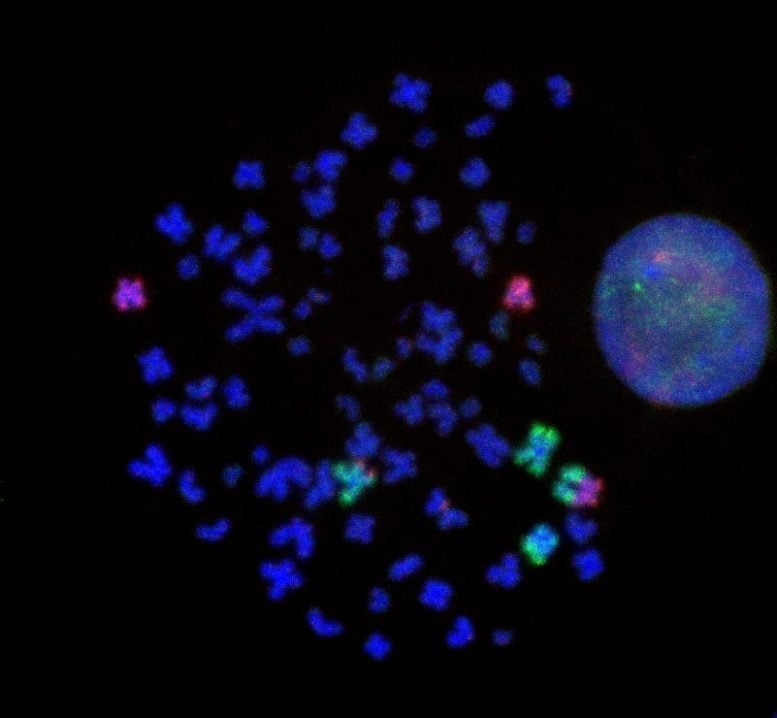
New discoveries about cancer-causing genetic mutations may lead to improved ways of predicting and treating the disease.
Cancer is the second-leading cause of death in the world, including in the United States. In fact, according to the CDC 1.7 million Americans are diagnosed with cancer and 600,000 people die from it each year. Moreover, 1 in 3 people will have cancer in their lifetime. It is a disease caused by an abnormal overgrowth of cells. Now, researchers from the Salk Institute in La Jolla, California have zeroed in on specific mechanisms that activate oncogenes, which are altered genes that can cause normal cells to become cancer cells.
Genetic mutations can cause cancer, yet the impact of specific types, such as structural variants that break and rejoin DNA, can vary widely. Published in the journal Nature on December 7, 2022, the findings show that the activity of those mutations depends on the distance between a particular gene and the sequences that regulate the gene, as well as on the level of activity of the regulatory sequences involved.
This work advances the ability to predict and interpret which genetic mutations found in cancer genomes are causing the disease.
Flipping the switch: Salk scientists shed light on genetic changes that turn “on” cancer genes. Credit: Salk Institute
“If we can better understand why a person has cancer, and what particular genetic mutations are driving it, we can better assess risk and pursue new treatments,” says Salk physician-scientist Jesse Dixon, senior author of the paper and an assistant professor in the Gene Expression Laboratory.
Most genetic mutations have no impact on a cancer and the molecular incidents that lead to oncogene activation are relatively rare. Dixon’s lab studies how genomes are organized in 3D space and seeks to understand why these changes happen in some, but not the majority, of circumstances. The team also wants to identify factors that might distinguish where and when these events occur.
Genes and Their Regulatory Sequences
“A gene is like a light and what regulates it are like the light switches,” says Dixon. “We are seeing that, because of structural variants in cancer genomes, there are a lot of switches that can potentially turn ‘on’ a particular gene.”
Decoding Cancer’s Genetic Drivers
Using CRISPR-Cas9 gene editing, the research team introduced genetic mutations by cutting DNA in certain locations of the genome. They found that some of the variants they created had major impacts on the expression of nearby genes, and could ultimately cause cancer, but that most had essentially no impact. Some genes appeared to go haywire when they were brought into environments with novel regulatory sequences, and others were not affected at all. The type of sequence that was introduced appeared to have a huge impact on whether or not the cell became cancerous.
“Our next move is to test whether there are other factors in the genome that contribute to the activation of oncogenes,” says Zhichao Xu, a postdoctoral fellow at Salk and the paper’s co-first author. “We are also excited about a new CRISPR genome editing technology we are developing to make this type of genome engineering work much more efficient.”
Reference: “Structural variants drive context-dependent oncogene activation in cancer” by Zhichao Xu, Dong-Sung Lee, Sahaana Chandran, Victoria T. Le, Rosalind Bump, Jean Yasis, Sofia Dallarda, Samantha Marcotte, Benjamin Clock, Nicholas Haghani, Chae Yun Cho, Kadir C. Akdemir, Selene Tyndale, P. Andrew Futreal, Graham McVicker, Geoffrey M. Wahl and Jesse R. Dixon, 7 December 2022, Nature.
DOI: 10.1038/s41586-022-05504-4
Other authors on the study are Sahaana Chandran, Victoria T. Le, Rosalind Bump, Jean Yasis, Sofia Dallarda, Samantha Marcotte, Benjamin Clock, Nicholas Haghani, Chae Yun Cho, Selene Tyndale, Graham McVicker, and Geoffrey M. Wahl of Salk; Dong-Sung Lee of the University of Seoul, South Korea; and Kadir Akdemir and P. Andrew Futreal of the University of Texas MD Anderson Cancer Center.
The research was supported by the National Institutes of Health (DP5OD023071), the Leona M. and Harry B. Helmsley Charitable Trust (2017-PG-MED001), the National Institutes of Health National Cancer Institute (R35 CA197687), and the Breast Cancer Research Foundation.
Never miss a breakthrough: Join the SciTechDaily newsletter.
Follow us on Google and Google News.