
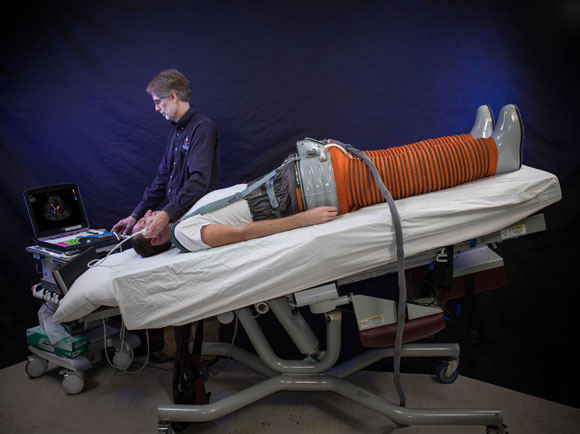
A research partnership between NASA’s Human Research Program and the Russian Space Agency is helping to prepare us for the journey to Mars.
NASA and the Russian Space Agency (Roscosmos) are studying the effects of how fluids shift to the upper body in space and how this adaptation to space flight affects changes in vision. This research will help prepare for a human journey to Mars. The Fluid Shift investigation is part of the groundbreaking research taking place during the One-Year Mission, in partnership between NASA’s Human Research Program and Roscosmos to tackle the complex, unanswered questions of how space flight changes the human body.
“The Fluid Shifts investigation is very complex because it’s really a combination of three independent research studies with similar goals but different specific aims,” said Michael Stenger, Ph.D. co-principal investigator for NASA’s Fluid Shifts investigation. “We brought together investigators from NASA, Henry Ford Medical Center, University of California, San Diego, and Wyle Science, Technology and Engineering Group. Additionally, we are working jointly with Roscosmos on the International Space Station to conduct the investigation and are using more crewmembers and crew time on this investigation than ever before.”
The investigation tests the hypothesis that the normal shift of fluids to the upper body in weightlessness contributes to increased intracranial pressure and decreased visual capacity in astronauts. It also tests whether this can be counteracted by returning the fluids to the lower body using a “lower body negative pressure” suit, called Chibis, provided by the Russians.
Learn about NASA’s 1YM research and how the Fluid Shifts Study Advances the Journey to Mars
While it sounds simple in theory, everyone responds differently to the upward fluid shift experienced in space flight, and this may explain the varying severity of the visual deficits experienced by astronauts. The physiological part of the investigation is only one challenge to the study.
This is not only the largest investigation on the space station, but one of the most challenging to set up. For the first time, substantial medical equipment is being moved from the U.S. segment to the Russian segment on the space station to perform this investigation.
The main complication is that the Chibis suit is located in the Zvezda service module on the Russian side of the space station and cannot be moved because its medical monitoring equipment and real-time data downlink are in fixed racks. This means all the necessary hardware and equipment from the U.S. side of the space station are being relocated from the opposite end of the station to the Russian module.
“From an engineering perspective, the setup for this investigation is no easy task but something we are working through,” said Erik Hougland, NASA flight project manager. “The physical and power interfaces are completely different too so we are redesigning these to work and fit the Russian outlets.”
This type of experiment may have its share of challenges but according to Stenger the information learned from this study will make it well worthwhile for not only the crew but for patients on Earth as well.
Rather than conducting invasive procedures to measure intracranial pressure such as a lumbar puncture or intraventricular catheter (drilling into the skull), the crew is using and testing new noninvasive techniques and technologies in space. For example, the cerebral and cochlear fluid pressure (CCFP) device and distortion product otoacoustic emissions (DPOAE) are being used in place of the invasive methods to measure changes in intracranial pressure. These devices work by assessing characteristics of sound and pressure waves reflecting off the inner ear, which are reflective of changes in intracranial pressure. In the future, these devices may become available for patients on Earth suffering from elevated intracranial pressure, such as hydrocephalus patients. Additionally, NASA converted the Optical Coherent Tomography (OCT) imaging machine, commonly used in optometrist offices, into a portable camera so it can maneuver in a free-floating area.
“We’ve never actually measured intracranial pressure inflight and its possible role in the Visual Impairment Syndrome,” said Stenger. “If we want to stay in space longer than six months to explore, we have to determine what causes these vision changes so that we can begin developing countermeasures to prevent them.”
While there is a need for these noninvasive technologies on Earth, NASA’s main focus is on the crews in space as it prepares for missions to Mars, which could be a 30-month trip. Several months without gravity is a challenge to the human body, which is why the Fluid Shifts study is so important. More than two-thirds of NASA crewmembers have experienced ocular changes during space flight. This is currently one of NASA’s highest priority medical concerns.
The One-Year Mission is the first step in determining the mechanisms associated with visual changes in space flight. NASA’s Human Research Program is carefully evaluating how the bodies of Scott Kelly and Mikhail Kornienko respond to a year in space because the opportunity to have humans explore Mars could lead to insights, discoveries, and technologies that will further humanity. And chances are, NASA won’t be doing it alone.
NASA’s Human Research Program enables space exploration beyond low Earth orbit by reducing the risks to human health and performance through a focused program of basic, applied, and operational research. This leads to the development and delivery of: human health, performance, and habitability standards; countermeasures and risk mitigation solutions; and advanced habitability and medical support technologies for a more compatible world wherever we explore.
Never miss a breakthrough: Join the SciTechDaily newsletter.
Follow us on Google and Google News.
1 Comment
“Colloid Osmotic Homeostasis in Humans”, J. Theoretical Biology
“Theoretical Aspects and Background”, (1970), 28, 1-14
“Intravascular Oncotic Energy Under Varying Gravitational Potential”, (1979), 80, 15-20