
Physicists propose that high-energy photon jets from collapsing stars may be secret factories of heavy elements like plutonium, challenging traditional theories and possibly explaining strange cosmic glows and metal traces in Earth’s crust.
One of the biggest unanswered questions in physics is how the universe creates the heaviest elements on the periodic table. To solve this, a team led by Los Alamos National Laboratory is exploring a previously uncharted environment: the intense jets and surrounding material, known as cocoons, produced by gamma-ray bursts during the collapse of massive stars.
In a study published in The Astrophysical Journal, the researchers propose that high-energy photons deep within these jets could break apart the outer layers of the collapsing star, converting protons into neutrons. This sudden burst of neutrons could trigger a chain of reactions that ultimately form heavy elements like uranium and plutonium.

A New Mechanism for Neutron Generation
“The creation of heavy elements such as uranium and plutonium necessitates extreme conditions,” said Matthew Mumpower, physicist at Los Alamos. “There are only a few viable yet rare scenarios in the cosmos where these elements can form, and all such locations need a copious amount of neutrons. We propose a new phenomenon where those neutrons don’t pre-exist but are produced dynamically in the star.”
Normally, free neutrons decay quickly, surviving only about 15 minutes, which limits the opportunities for them to participate in element-building reactions. But in the right setting, a process called the rapid neutron-capture process—or “r-process”—can occur. This is believed to be responsible for creating all naturally occurring thorium, uranium, and plutonium in the universe.
The team’s model offers a fresh solution to long-standing challenges in r-process physics by introducing new reaction pathways that could take place during stellar collapse.
Beyond explaining how heavy elements form, the researchers’ framework also addresses key scientific questions about how neutrons move through matter, how complex multiphysics systems behave, and how rare cosmic events can be detected. These insights have potential applications in fields like astrophysics and national security, where understanding the behavior of exotic particles and reactions is crucial.
Jet Power: Star Collapse and Element Creation
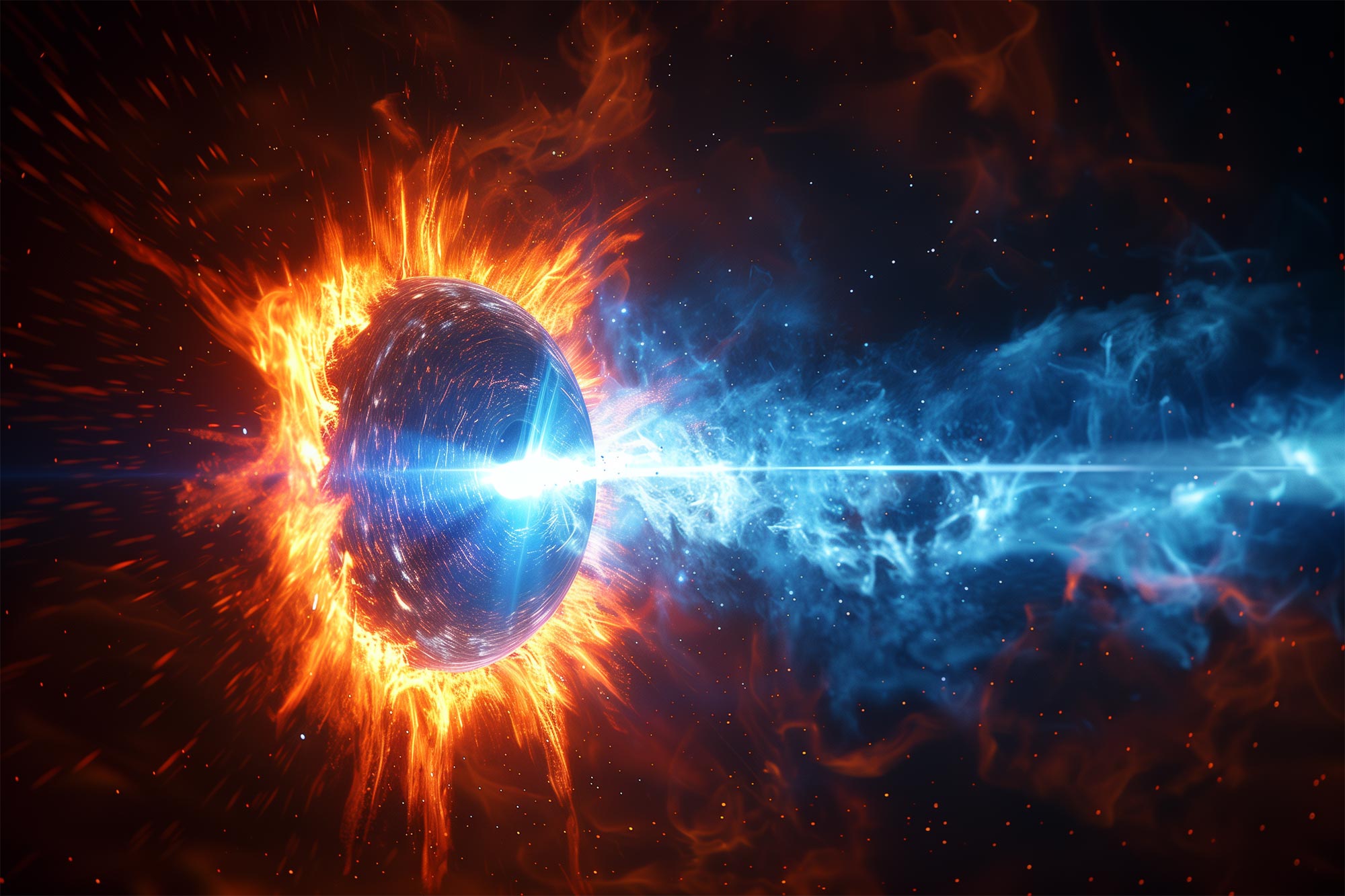
In the scenario Mumpower proposes, a massive star begins to die as its nuclear fuel runs out. No longer able to push up against its own gravity, a black hole forms at the star’s center. If the black hole is spinning fast enough, frame-dragging effects from the extremely strong gravity near the black hole wind up the magnetic field and launch a powerful jet. Through subsequent reactions, a broad spectrum of photons is created, some of which are at high energy.
The jet blasts through the star ahead of it, creating a hot cocoon of material around the jet, “like a freight train plowing through snow,” Mumpower said. At the interface of the jet with the stellar material, high-energy photons (that is, light) can interact with atomic nuclei, transmuting protons to neutrons. Existing atomic nuclei may also be dissolved into individual nucleons, creating more free neutrons to power the r process. The team’s calculations suggest the interaction with light and matter can create neutrons incredibly fast, on the order of a nanosecond.
How Neutrons Escape and Create
Because of their charge, protons get trapped in the jet by the strong magnetic fields. Neutrons, which are chargeless, are plowed out of the jet into the cocoon. Having experienced a relativistic shock, the neutrons are extremely dense compared with the surrounding stellar material, and thus the r process may ensue, with heavy elements and isotopes forged and then expelled out into space as the star is ripped apart.
The process of protons converting into neutrons, along with free neutrons escaping into the surrounding cocoon to form heavy elements, involves a broad range of physics principles and encompasses all four fundamental forces of nature: a true multiphysics problem, combining areas of atomic and nuclear physics with hydrodynamics and general relativity. Despite the team’s efforts, more challenges remain as the heavy isotopes created during the r-process have never been made on Earth. Researchers know little about their properties including their atomic weight, half-life and so on.
Kilonova and Cosmic Origins Explained?
The high-energy jet framework proposed by the team may help explain the origination of kilonova — a glow of optical and infrared electromagnetic radiation — associated with long-duration gamma-ray bursts. Kilonovae have been primarily associated with the collision of two neutron stars or the merger of a neutron star and a black hole. These intense collisions are one possible method for confirming with observations the cosmic factories of heavy-element formation. Star dissolution via high-energy photon jet offers an alternative origin for the production of heavy elements and the kilonova they may manufacture, a possibility not previously thought to be associated with collapsing stars.
Cosmic Clues in Deep-Sea Sediments
Relatedly, scientists have observed iron and plutonium in deep-sea sediment. These deposits, after study, are confirmed to be from extraterrestrial sources, though as with the phenomena producing kilonova, the specific location or cosmic event remains elusive. The collapsar high-energy jet scenario represents an intriguing possibility as the source of these heavy elements found undersea.
To more fully understand the proposed framework, Mumpower and his team hope to run simulations on their models, including the complex microphysics interactions.
Reference: “Let There Be Neutrons! Hadronic Photoproduction from a Large Flux of High-energy Photons” by Matthew R. Mumpower, Tsung-Shung H. Lee, Nicole Lloyd-Ronning, Brandon L. Barker, Axel Gross, Samuel Cupp and Jonah M. Miller, 20 March 2025, The Astrophysical Journal.
DOI: 10.3847/1538-4357/adb1e3
Funding: The work was supported in part by the Laboratory Directed Research and Development program at Los Alamos.
Never miss a breakthrough: Join the SciTechDaily newsletter.
Follow us on Google and Google News.
1 Comment
“Although the burst only lasted a few seconds, it would have produced around a third of Earth’s mass in heavy metals, the researchers estimate.”
“There’s another source of heavy elements that we already know about: neutron star mergers. However, they’re not thought to be enough to account for all the gold, platinum, and other metals we have – these heavy elements appear too early in the Universe’s history, before these collisions would have started occurring.”
– ScienceAlert