

A powerful cosmic event from 2004—a gamma-ray burst from a magnetar 30,000 light-years away—has just been revealed as a major source of the universe’s heaviest elements like gold and platinum.
Researchers have shown that this intense flare, brighter than anything seen before in our galaxy, created heavy elements through radioactive decay during the explosion. This finding rewrites what we know about element formation and suggests that magnetars may be key players in spreading these rare materials across the cosmos, including the precious metals on Earth.
Unlocking the Origins of Heavy Elements
One of the big open questions in astrophysics is where the heaviest elements in the periodic table, such as gold and platinum, come from.
The lightest elements, hydrogen and helium, were formed shortly after the Big Bang. Elements that are a bit heavier, like oxygen and iron, are produced in the cores of ordinary stars through nuclear fusion and are scattered into space when those stars explode as supernovae. But elements heavier than iron require much more extreme environments to form—conditions that go far beyond what’s found inside typical stars. For decades, scientists have searched for the astrophysical events powerful enough to forge these rare elements.
A Groundbreaking Discovery in a 2004 Cosmic Explosion
Now, a team of Columbia University researchers led by Professor Brian Metzger and doctoral candidate Anirudh Patel has uncovered new evidence that challenges previous theories. In a recent study, they show that a famous cosmic explosion from over 20 years ago likely produced large quantities of heavy elements. This explosion released more energy in just half a second than our Sun emits over 250,000 years, offering a critical clue about how the heaviest elements in the Universe may be formed.
Gamma-Ray Burst Confirms Heavy Element Formation
“Comparing our theoretical models to observed data, we found evidence that one of the brightest explosions ever observed in our Galaxy—a powerful burst of gamma-ray radiation in 2004—produced a huge amount of heavy elements exceeding in mass the planet Mars,” said Patel. “It was an incredible feeling to see our prediction confirmed by existing data and to realize the implications this discovery has for the history of some of the matter making up our planet.”
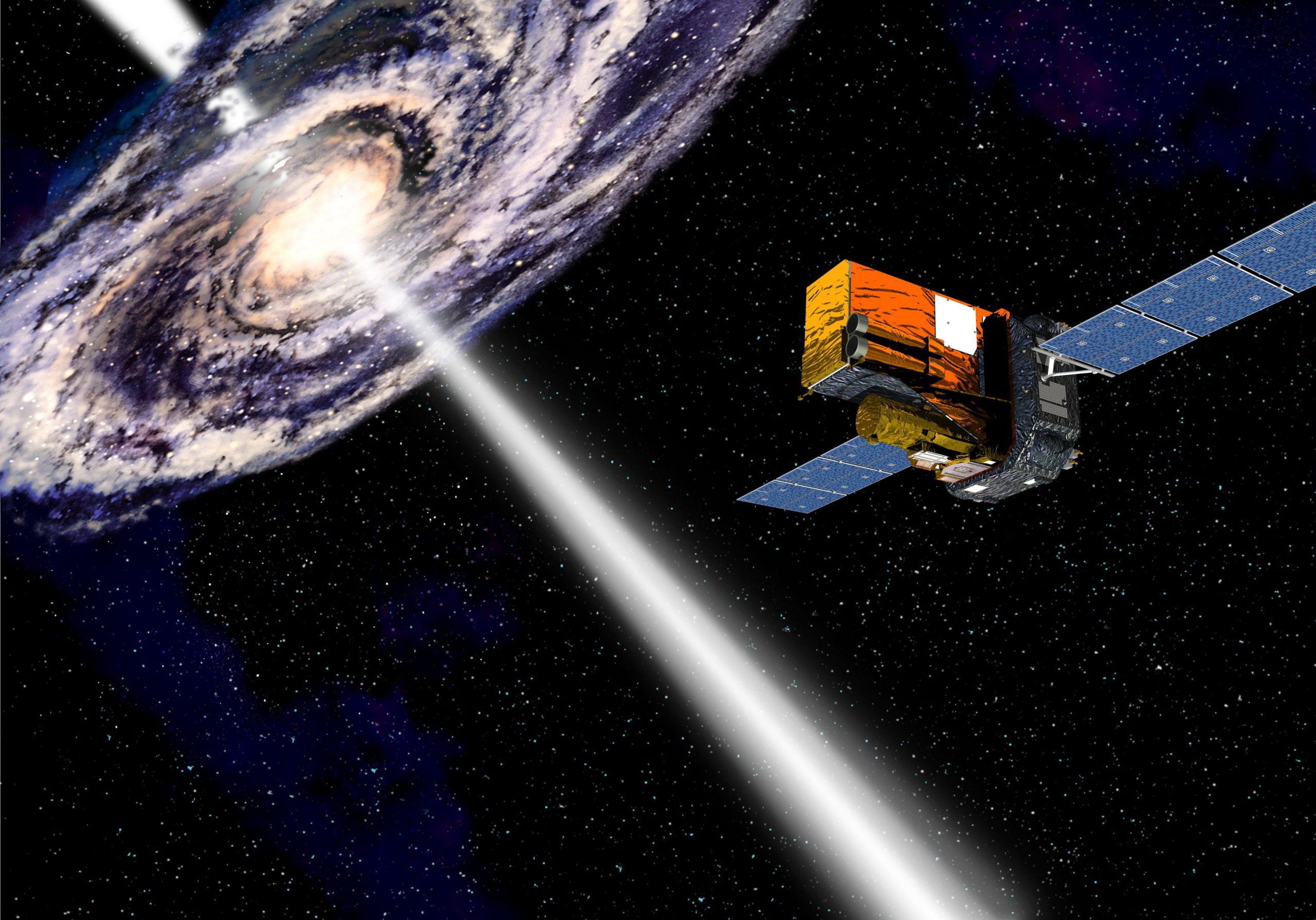
On December 27, 2004, several satellites, including the European Space Agency’s INTErnational Gamma-Ray Astrophysics Laboratory (INTEGRAL) space telescope, detected an extremely powerful burst of gamma-ray radiation from a magnetar in our Galaxy.
What Makes Magnetars So Extreme?
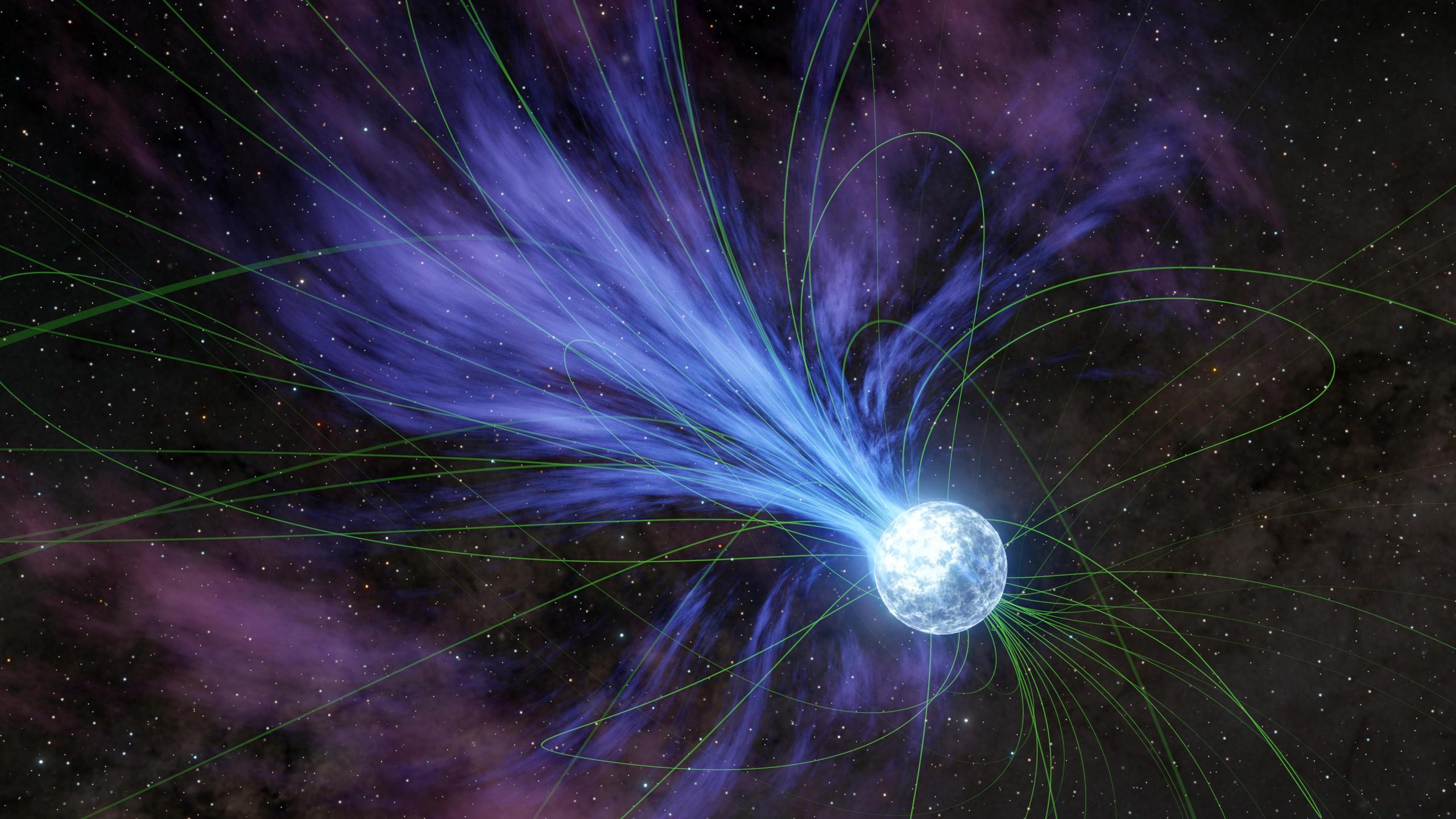
Magnetars are a class of neutron stars harboring the strongest magnetic fields in the Universe, over 10 trillion times stronger than the typical refrigerator magnet. Neutron stars are the compact bodies left over when massive stars collapse and explode in supernovae. The immense magnetic energy of magnetars powers extreme outbursts similar to but much more energetic than flares of particles that our own Sun produces.
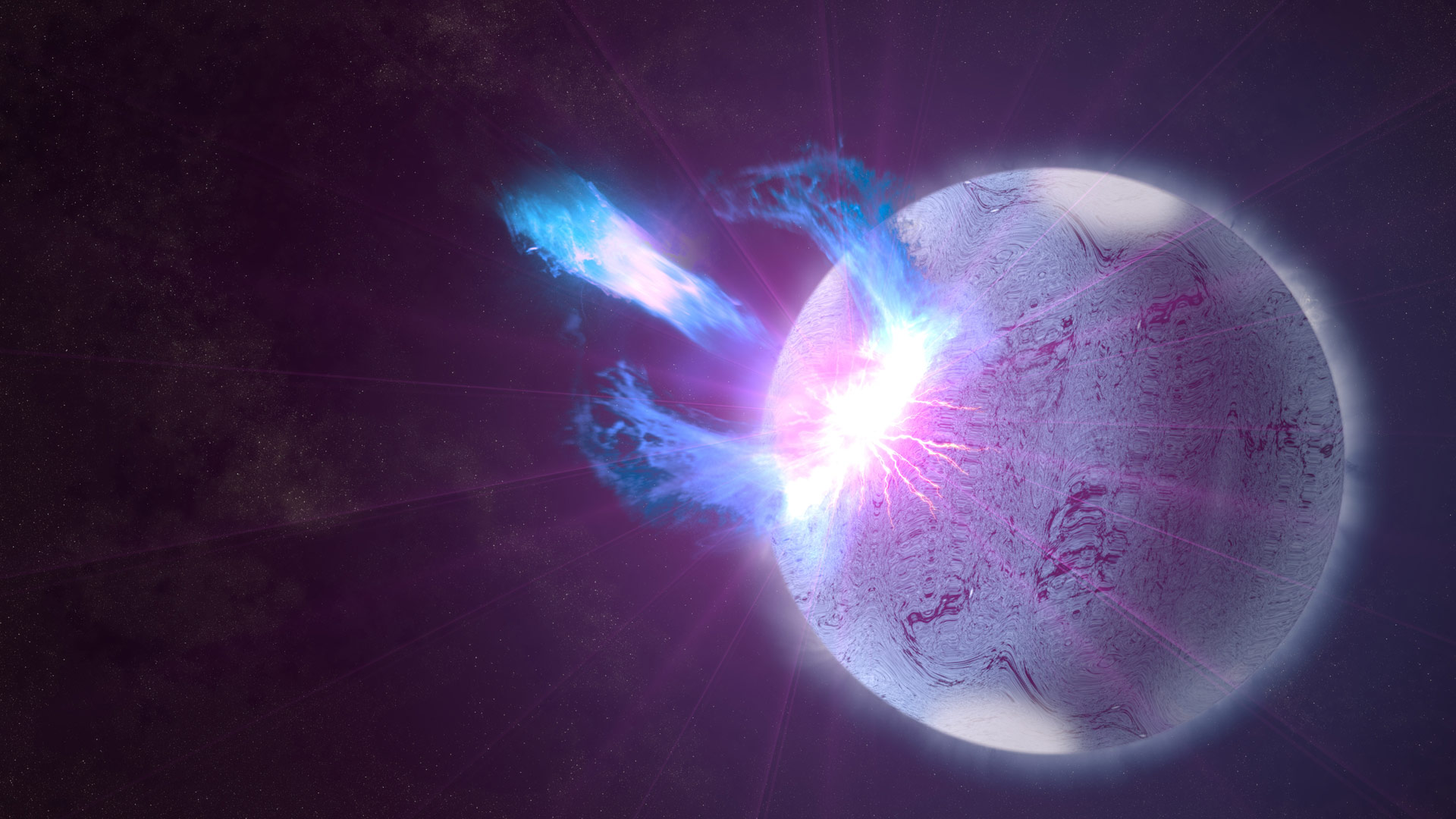
Although the magnetar, SGR 1806-20, lies roughly 30,000 light-years away, 2004’s “giant flare” was bright enough to affect the upper layers of the Earth’s atmosphere. After the initial gamma-ray burst, the INTEGRAL space telescope also detected a dimmer but longer gamma-ray signal from the source lasting for several hours. Although this “afterglow” was first reported by a team of researchers in 2005, no compelling physical explanation was offered by scientists at the time.
Heavy Metals Born in Stellar Fury
Now, Metzger, Patel, and their collaborators have shown that this previously unexplained signal from the famous 2004 magnetar giant flare can be attributed to gamma-ray emission from the radioactive decay of heavy elements—elements that were freshly synthesized by a series of nuclear reactions in the crust of the neutron star as it was expelled into space during the giant flare.
The researchers estimate that up to 10% or more of the precious metals on Earth can be produced by magnetars. Although many potential phenomena that create these elements have been proposed by scientists over the years, this represents only the second confirmed event in which the heaviest elements in our Universe can be synthesized; the first was a merger of neutron stars predicted by Metzger in 2010, and observationally confirmed in 2017.
The researchers began their discovery late last year when Patel was calculating what elements are created in magnetar flares. Just two weeks before the 20th anniversary of the 2004 giant flare, Patel made preliminary calculations of the gamma-ray radiation expected from these elements. “The peak brightness and time-scale of the predicted emission matched perfectly the unexplained observation from 2004. At this moment, we realized we might have just made a discovery,” said Patel.
Cosmic Alchemy: Our Jewelry’s Violent Origins
“This single giant flare was so prodigious in creating these heavy elements that the accumulation of similar events over our Galaxy’s history could contribute a significant fraction of all of these elements on Earth,” Metzger said. “It’s humbling to realize that the platinum in my wedding band may have been forged in such a cataclysmic event. This discovery opens a whole series of new questions related to the role that magnetars may play in seeding elements throughout the universe.”
Reference: “Direct Evidence for r-process Nucleosynthesis in Delayed MeV Emission from the SGR 1806–20 Magnetar Giant Flare” by Anirudh Patel, Brian D. Metzger, Jakub Cehula, Eric Burns, Jared A. Goldberg and Todd A. Thompson, 29 April 2025, The Astrophysical Journal Letters.
DOI: 10.3847/2041-8213/adc9b0
Never miss a breakthrough: Join the SciTechDaily newsletter.
Follow us on Google and Google News.