
Close Menu
    Facebook X (Twitter) Instagram
    SciTechDaily
    • Biology
    • Chemistry
    • Earth
    • Health
    • Physics
    • Science
    • Space
    • Technology
    Facebook X (Twitter) Pinterest YouTube RSS
    SciTechDaily
    Home»Space»Sudden Spin-Down Event Illuminates Magnetar Mystery
    Space

    Sudden Spin-Down Event Illuminates Magnetar Mystery

    By George Washington UniversityFebruary 13, 2023No Comments2 Mins Read
    Facebook Twitter Pinterest Telegram LinkedIn WhatsApp Email Reddit
    Share
    Facebook Twitter LinkedIn Pinterest Telegram Email Reddit
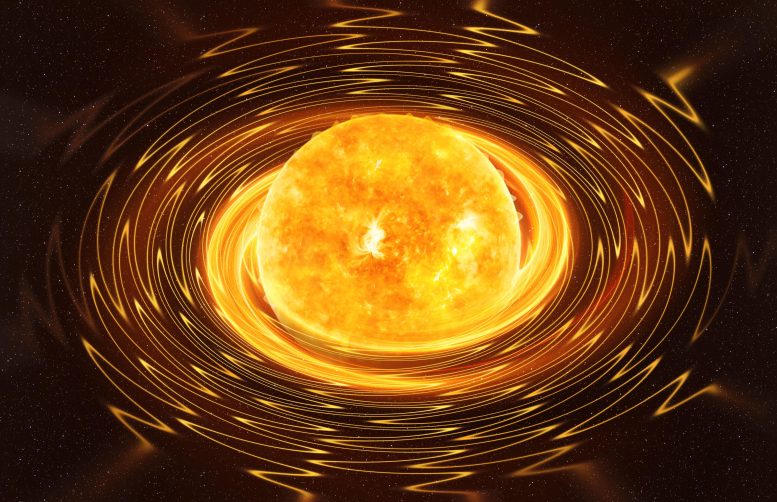
    Magnetar Star
    Magnetars are a type of neutron star that are characterized by their incredibly strong magnetic fields. These fields are estimated to be a thousand billion times stronger than the magnetic field of the Earth, making magnetars some of the most magnetic objects in the universe. They emit intense bursts of X-rays and gamma rays, which can last from a fraction of a second to several minutes, and are thought to be caused by the release of energy stored in their magnetic fields. In addition, magnetars also emit a continuous low-level emission of X-rays.

    Plasma shedding near a magnetar’s magnetic pole explains spin-down glitches and associated radio bursts.

    A recent publication in the journal Nature Astronomy is offering new insights into magnetars, whose characteristics are still not well understood. A magnetar is a type of neutron star with a magnetic field that is extremely strong and rotates once every two to ten seconds.

    Researchers observing the magnetar SGR 1935+2154 detected a sudden slowing of the star’s angular momentum, often referred to as a spin-down glitch, on October 5, 2020. In the following days, the magnetar emitted three Fast Radio Burst-like radio bursts followed by a month-long episode of pulsed radio emission, despite there being no signs of variation in the X-ray emission behavior in the star or evidence of a strong X-ray burst.

    Due to the rarity of spin-down glitches and radio signals from magnetars, the research team says the synchronicity of these events suggests an association, offering clues to their origin and triggering mechanisms.

    The researchers point to plasma shedding close to the magnetic pole, which generated a wind that impacted the star’s momentum and magnetic field and created the combination needed to trigger radio emission.

    Reference: “Magnetar spin-down glitch clearing the way for FRB-like bursts and a pulsed radio episode” by G. Younes, M. G. Baring, A. K. Harding, T. Enoto, Z. Wadiasingh, A. B. Pearlman, W. C. G. Ho, S. Guillot, Z. Arzoumanian, A. Borghese, K. Gendreau, E. Göğüş, T. Güver, A. J. van der Horst, C.-P. Hu, G. K. Jaisawal, C. Kouveliotou, L. Lin and W. A. Majid, 12 January 2023, Nature Astronomy.
    DOI: 10.1038/s41550-022-01865-y

    Never miss a breakthrough: Join the SciTechDaily newsletter.
    Follow us on Google and Google News.

    Astronomy Astrophysics George Washington University Magnetar Neutron Star Popular
    Share. Facebook Twitter Pinterest LinkedIn Email Reddit

    Related Articles

    The Magnetar That Forged a Planet’s Worth of Gold in Half a Second

    Runaway Star Might Explain Fast Radio Bursts

    New Type of Astronomical Object Discovered: Massive Magnetic Helium Stars

    Quantum Metamorphosis: Unveiling the Puzzling Phenomenon of Magnetar X-Rays

    “A True Cosmic Monster!” Violent High-Frequency Oscillations Captured in Gigantic Eruption of a Neutron Star

    Chandra Studies Extraordinary Magnetar: Fastest Spinning and Possibly the Youngest Magnetar Known

    Mysterious, Repeating Radio Burst Identified in Our Own Galaxy for the First Time

    Ultrabright Radio Flashes Detected Coming From Inside Our Own Galaxy

    NASA’s Swift Discovers Magnetar SGR J1745-29

    Leave A Reply Cancel Reply

    • Facebook
    • Twitter
    • Pinterest
    • YouTube

    Don't Miss a Discovery

    Subscribe for the Latest in Science & Tech!

    Trending News

    These Toads Are Surviving a Deadly Fungus – Scientists May Finally Know Why

    These Brain Cells May Explain Why We Eventually Have To Sleep

    Tomatoes Contain an Invisible Ingredient With Surprising Effects on Liver Health

    World’s First Heat-Powered Cooling System Turns Waste Heat Into Cold

    Antarctica Gained a Record 695 Billion Tons of Ice in Just Two Years

    Don’t Miss: A Brilliant Venus and Glowing Harvest Moon Light Up the Sky

    New Twist on the Einstein Problem Reveals Unexpected Physics

    JWST Captures Stunning Evidence of How Supermassive Black Holes Feed

    Follow SciTechDaily
    • Facebook
    • Twitter
    • YouTube
    • Pinterest
    • Newsletter
    • RSS
    SciTech News
    • Biology News
    • Chemistry News
    • Earth News
    • Health News
    • Physics News
    • Science News
    • Space News
    • Technology News
    Recent Posts
    • Scientists Discover a Hidden Defect That Could Explain Why IBD Keeps Coming Back
    • Millions Take Blood Pressure Drugs, but Many May Be Missing Their Heart-Protective Benefits
    • Could Alien Life Be Conscious in Ways We Can’t Imagine?
    • Scientists Develop a Fruit Wash That Removes Pesticide Residues and Keeps Produce Fresh Longer
    • Scientists May Have Finally Explained Why Astronauts Get Constipated in Space
    Copyright © 1998 - 2026 SciTechDaily. All Rights Reserved.
    • Science News
    • About
    • Contact
    • Editorial Board
    • Privacy Policy
    • Terms of Use

    Type above and press Enter to search. Press Esc to cancel.