
Tiny molecules that can think, remember, and learn may be the missing link between electronics and the brain.
For more than half a century, researchers have looked for ways to move past silicon by building electronics from molecules. The idea sounded simple and beautiful, but real devices turned out to be messy. Inside a working component, molecules do not act like neat, isolated pieces from a textbook. Instead, they form crowded, interactive networks where electrons move, ions shift position, interfaces change over time, and even tiny differences in structure can trigger strongly nonlinear behavior. The potential was exciting, but reliably predicting and controlling what a molecular device would do remained out of reach.
In parallel, neuromorphic computing has chased a related goal. Neuromorphic computing – hardware inspired by the brain – aims to find a material that can store information, perform computation, and adapt within the same physical substance, all in real time. But the leading approaches today, often built on oxide materials and filamentary switching, still act like carefully engineered systems that mimic learning rather than materials that naturally contain learning in their physical behavior.
A New IISc Study Brings Two Challenges Together
A new study from the Indian Institute of Science (IISc) suggests these two long-standing problems may be meeting at the same solution.
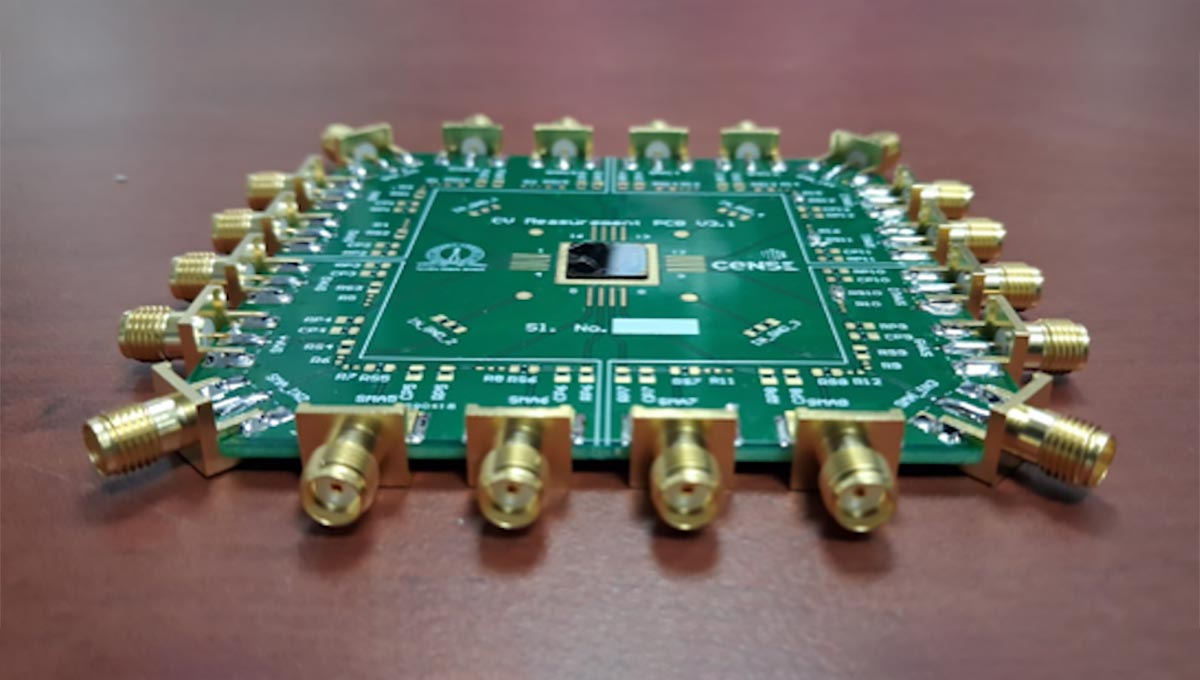
Working across chemistry, physics, and electrical engineering, a group led by Sreetosh Goswami, Assistant Professor at the Centre for Nano Science and Engineering (CeNSE) created tiny molecular devices that can be adjusted to take on very different roles. Depending on how the device is stimulated, it can function as a memory unit, a logic gate, a selector, an analog processor, or an electronic synapse. “It is rare to see adaptability at this level in electronic materials,” says Sreetosh Goswami. “Here, chemical design meets computation, not as an analogy, but as a working principle.”
Ruthenium Chemistry Drives Shape-Shifting Behavior
That flexibility comes from the chemistry used to build and tune the devices. The researchers made 17 carefully designed ruthenium complexes, then studied how small changes in molecular shape and the surrounding ionic environment influence how electrons behave. By adjusting the ligands and ions positioned around the ruthenium molecules, the team showed that one device can display many kinds of dynamic responses. It can even shift between digital and analog behavior, for instance, across a broad span of conductance values.
The molecular synthesis was carried out by Pradip Ghosh, Ramanujan Fellow and Santi Prasad Rath, former PhD student at CeNSE. Device fabrication was led by Pallavi Gaur, first author and PhD student at CeNSE. “What surprised me was how much versatility was hidden in the same system,” says Gaur. “With the right molecular chemistry and environment, a single device can store information, compute with it, or even learn and unlearn. That’s not something you expect from solid-state electronics.”
A Theory That Predicts Function From Molecular Structure
Explaining why the devices can behave this way required something molecular electronics has often lacked: a strong theoretical base. The team built a transport framework rooted in many-body physics and quantum chemistry that can predict device function from molecular structure. Using this approach, they traced how electrons travel through the molecular film, how individual molecules go through oxidation and reduction, and how counterions shift within the molecular matrix. Together, these processes shape the switching and relaxation behavior and determine how stable each molecular state is.
Toward Neuromorphic Hardware That Learns in the Material
The key takeaway is that the adaptability of these complexes makes it possible to combine memory and computation within the same material. That creates a route to neuromorphic hardware where learning can be encoded into the material itself. The team is already working on placing these materials onto silicon chips, with the goal of building future AI hardware that is both energy efficient and intrinsically intelligent.
“This work shows that chemistry can be an architect of computation, not just its supplier,” says Sreebrata Goswami, Visiting Scientist at CeNSE and co-author on the study who led the chemical design.
Reference: “Molecularly Engineered Memristors for Reconfigurable Neuromorphic Functionalities” by Pallavi Gaur, Bidyabhusan Kundu, Pradip Ghosh, Shayon Bhattacharya, Lohit T, Harivignesh S, Santi P. Rath, Damien Thompson, Sreebrata Goswami and Sreetosh Goswami, 9 December 2025, Advanced Materials.
DOI: 10.1002/adma.202509143
Never miss a breakthrough: Join the SciTechDaily newsletter.
Follow us on Google and Google News.
2 Comments
“The team is already working on placing these materials onto silicon chips, with the goal of building future AI hardware that is both energy efficient and intrinsically intelligent.”
Oh boy!
Very informative and interesting