
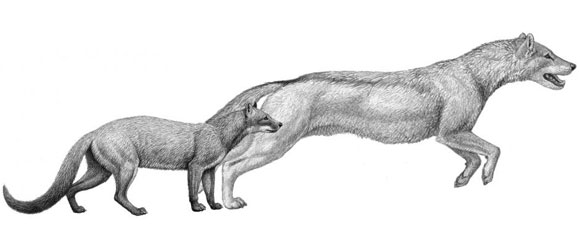
A new study from Brown University shows how dogs evolved in response to changes in climate over the last 40 million years, demonstrating that predators are sensitive to climate change because it alters the hunting opportunities in their habitat.
Brown University — Old dogs can teach humans new things about evolution. In Nature Communications a new study of North American dog fossils as old as 40 million years suggests that the evolutionary path of whole groups of predators can be a direct consequence of climate change.
“It’s reinforcing the idea that predators may be as directly sensitive to climate and habitat as herbivores,” said Christine Janis, professor of ecology and evolutionary biology at Brown University, who worked with lead author Borja Figueirido, a former Brown Fulbright postdoctoral researcher who is now a professor at the Universidad de Málaga in Spain. “Although this seems logical, it hadn’t been demonstrated before.”
The climate in North America’s heartland back around 40 million years ago was warm and wooded. Dogs are native to North America. The species of the time, fossils show, were small animals that would have looked more like mongooses than any dogs alive today and were well-adapted to that habitat. Their forelimbs were not specialized for running, retaining the flexibility to grapple with whatever meal unwittingly walked by.
But beginning just a few million years later, the global climate began cooling considerably and in North America the Rocky Mountains had reached a threshold of growth that made the continental interior much drier. The forests slowly gave way to open grasslands.
Pups of the plains
Did this transition affect the evolution of carnivores? To find out, Figueirido and the research team, including Jack Tseng of the American Museum of Natural History in New York, examined the elbows and teeth of 32 species of dogs spanning the period from ca. 40 million years ago to 2 million years ago. They saw clear patterns in those bones at the museum: At the same time that climate change was opening up the vegetation, dogs were evolving from ambushers to pursuit-pounce predators like modern coyotes or foxes — and ultimately to those dogged, follow-a-caribou-for-a-whole-day pursuers like wolves in the high latitudes.
“The elbow is a really good proxy for what carnivores are doing with their forelimbs, which tells their entire locomotion repertoire,” Janis said.
The telltale change in those elbows has to do with the structure of the base where the humerus articulates with the forearm, changing from one where the front paws could swivel (palms can be inward or down) for grabbing and wrestling prey to one with an always downward-facing structure specialized for endurance running. Modern cats still rely on ambush rather than the chase (cheetahs are the exception) and have the forelimbs to match, Janis said, but canines signed up for lengthier pursuits.
In addition, the dogs’ teeth trended toward greater durability, Figueirido’s team found, consistent perhaps with the need to chow down on prey that had been rolled around in the grit of the savannah, rather than a damp, leafy forest floor.
Not an ‘arms race’ of limbs
The study, with some of Janis’ prior research, suggests that predators do not merely evolve as an “arms race” response to their prey. They don’t develop forelimbs for speedy running just because the deer and the antelope run faster. While the herbivores of this time were evolving longer legs, the predator evolution evident in this study tracked in time directly with the climate-related changes to habitat rather than to the anatomy of their prey species.
After all, it wasn’t advantageous to operate as a pursuit-and-pounce predator until there was room to run.
“There’s no point in doing a dash and a pounce in a forest,” Janis quipped. “They’ll smack into a tree.”
If predators evolved with climate change over the last 40 million years, the authors argue, then they likely will have to continue in response to the human-created climate change underway now. The new results could help predict the effects we are setting in motion.
“Now we’re looking into the future at anthropogenic changes,” Janis said.
In addition to Figueirido and Janis, the paper’s other authors are A. Mártin-Serra of Málaga and Z.J. Tseng of the American Museum of National History.
Reference: “Habitat changes and changing predatory habits in North American fossil canids” by B. Figueirido, A. Martín-Serra, Z. J. Tseng and C. M. Janis, 18 August 2015, Nature Communications.
DOI: 10.1038/ncomms8976
Never miss a breakthrough: Join the SciTechDaily newsletter.
Follow us on Google and Google News.