

Brain networks mirror fractals when processing stories—disruption scrambles these patterns and impairs understanding.
Understanding how the human brain produces complex thought is daunting given its intricacy and scale. The brain contains approximately 100 billion neurons that coordinate activity through 100 trillion connections, and those connections are organized into networks that are often similar from one person to the next. A Dartmouth study has found a new way to look at brain networks using the mathematical notion of fractals, to convey communication patterns between different brain regions as people listened to a short story. The results are published in Nature Communications.
“To generate our thoughts, our brains create this amazing lightning storm of connection patterns,” said senior author Jeremy R. Manning, an assistant professor of psychological and brain sciences, and director of the Contextual Dynamics Lab at Dartmouth. “The patterns look beautiful, but they are also incredibly complicated. Our mathematical framework lets us quantify how those patterns relate at different scales, and how they change over time.”
Fractals: A New Mathematical Lens
In the field of geometry, fractals are shapes that appear similar at different scales. Within a fractal, shapes and patterns are repeated in an infinite cascade, such as spirals comprised of smaller spirals that are in turn comprised of still-smaller spirals, and so on. Dartmouth’s study shows that brain networks organize in a similar way: patterns of brain interactions are mirrored simultaneously at different scales. When people engage in complex thoughts, their networks seem to spontaneously organize into fractal-like patterns. When those thoughts are disrupted, the fractal patterns become scrambled and lose their integrity.
Fractal Patterns in Thought Processing
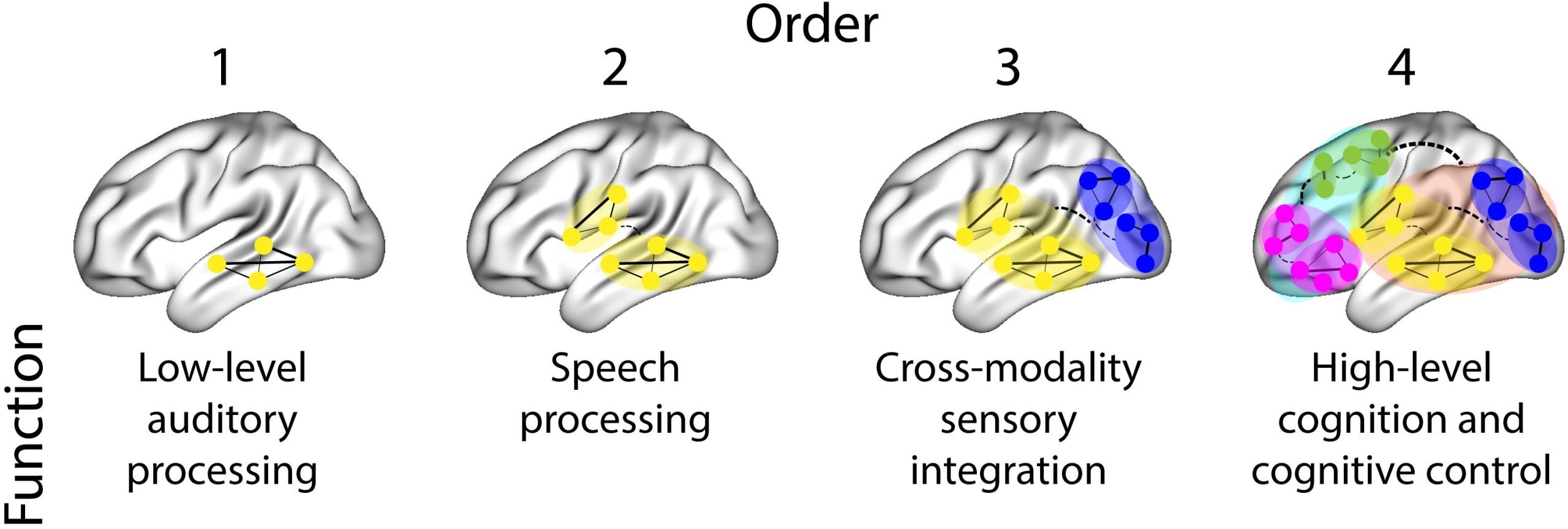
The researchers developed a mathematical framework that identifies similarities in network interactions at different scales or “orders.” When brain structures do not exhibit any consistent patterns of interaction, the team referred to this as a “zero-order” pattern. When individual pairs of brain structures interact, this is called a “first-order” pattern. “Second-order” patterns refer to similar patterns of interactions in different sets of brain structures, at different scales. When patterns of interaction become fractal— “first-order” or higher— the order denotes the number of times the patterns are repeated at different scales.
The study shows that when people listened to an audio recording of a 10-minute story, their brain networks spontaneously organized into fourth-order network patterns. However, this organization was disrupted when people listened to altered versions of the recording. For example, when the story’s paragraphs were randomly shuffled, preserving some but not all of the story’s meaning, people’s brain networks displayed only second-order patterns. When every word of the story was shuffled, this disrupted all but the lowest level (zero-order) patterns.
“The more finely the story was shuffled, the more the fractal structures of the network patterns were disrupted,” said first author Lucy Owen, a graduate student in psychological and brain sciences at Dartmouth. “Since the disruptions in those fractal patterns seemed directly linked with how well people could make sense of the story, this finding may provide clues about how our brain structures work together to understand what is happening in the narrative.”
The fractal network patterns were surprisingly similar across people: patterns from one group could be used to accurately estimate what part of the story another group was listening to.
Mapping Brain Regions to Fractal Orders
The team also studied which brain structures were interacting to produce these fractal patterns. The results show that the smallest scale (first-order) interactions occurred in brain regions that process raw sounds. Second-order interactions linked these raw sounds with speech processing regions, and third-order interactions linked sound and speech areas with a network of visual processing regions. The largest-scale (fourth-order) interactions linked these auditory and visual sensory networks with brain structures that support high-level thinking. According to the researchers, when these networks organize at multiple scales, this may show how the brain processes raw sensory information into complex thought—from raw sounds, to speech, to visualization, to full-on understanding.
The researchers’ computational framework can also be applied to areas beyond neuroscience and the team has already begun using an analogous approach to explore interactions in stock prices and animal migration patterns.
Reference: “High-level cognition during story listening is reflected in high-order dynamic correlations in neural activity patterns” by Lucy L. W. Owen, Thomas H. Chang and Jeremy R. Manning, 30 September 2021, Nature Communications.
DOI: 10.1038/s41467-021-25876-x
Never miss a breakthrough: Join the SciTechDaily newsletter.
Follow us on Google and Google News.