

Close Menu
    Facebook X (Twitter) Instagram
    SciTechDaily
    • Biology
    • Chemistry
    • Earth
    • Health
    • Physics
    • Science
    • Space
    • Technology
    Facebook X (Twitter) Pinterest YouTube RSS
    SciTechDaily
    Home»Health»Fractal Signatures of COVID-19 Transmission Could Reduce Socio-Economic Impact of Lockdowns
    Health

    Fractal Signatures of COVID-19 Transmission Could Reduce Socio-Economic Impact of Lockdowns

    By Agência FAPESPOctober 15, 2020No Comments4 Mins Read
    Facebook Twitter Pinterest Telegram LinkedIn WhatsApp Email Reddit
    Share
    Facebook Twitter LinkedIn Pinterest Telegram Email Reddit
    COVID-19 Masks Train Station
    Model developed by Brazilian researchers predicts spatial and temporal evolution of epidemic diseases and can help plan more effective social isolation programs with less socio-economic impact. Credit: zydeaosika

    Model developed by Brazilian researchers predicts spatial and temporal evolution of epidemic diseases and can help plan more effective social isolation programs with less socio-economic impact.

    The most widely used model to describe the epidemic evolution of a disease over time is called SIR, short for susceptible (S), infected (I), and removed (R). A susceptible person can be infected, and the infected person will eventually be removed owing to either immunization or death. The number of people in each class varies, whereas the total population, given by the sum of individuals in all three classes, is considered constant in the time scale of epidemic contamination.

    The function I(t) resulting from the model describes the increase in the number of infected people over time. The curve rises sharply during the phase in which the pathogen is spreading quickly, peaking at maximum contamination, and sloping down more gently as contagion slowly decreases until there are no longer any infectious people. The SIR model has been applied in several studies of the COVID-19 pandemic.
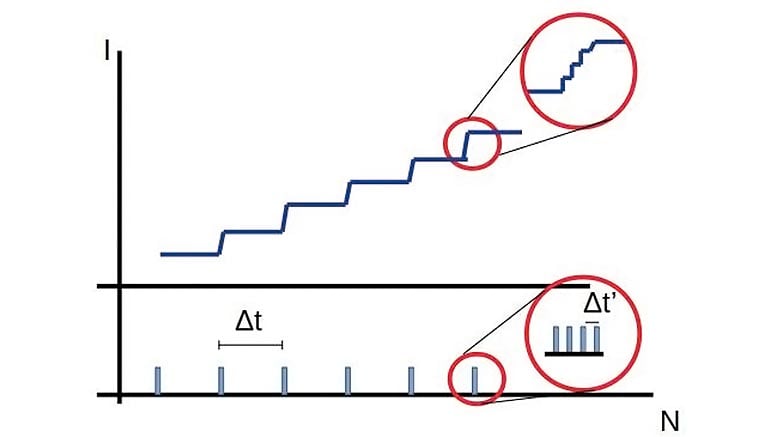
    Model Assumes Fractal Structure
    According to this assumption, agents of different scales carry the virus to other agents of the same scale in a similar fashion, as depicted in the figure. The model developed on the fractal assumption is used to explain details of the time series spread of the disease.” Credit: Airton Deppman

    “Although this model is a very useful tool to investigate the temporal evolution of the pandemic, it provides few insights into how contagion progresses spatially, which is key to the planning of social distancing programs that effectively protect people and at the same time reduce the socio-economic impact of the disease,” Airton Deppman, a professor in the University of São Paulo’s Physics Institute (IF-USP), told Agência FAPESP.

    Deppman is one of the authors of a paper published in the journal Chaos, Solitons & Fractals reporting some of the findings. 

    The study was supported by FAPESP via a Thematic Project for which Arnaldo Gammal is principal investigator and Deppman is one of several co-principal investigators.
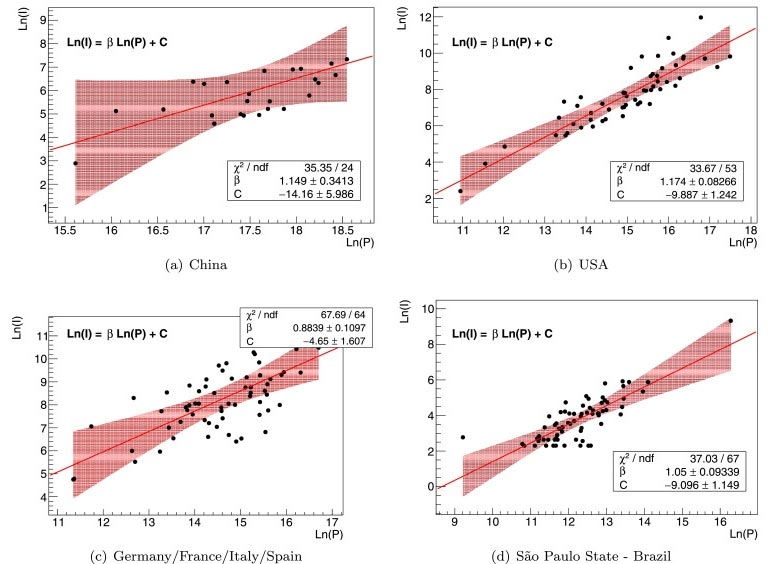
    COVID-19 Scaling Behavior
    Scaling behavior of the number of contamination cases as a function of region population in a) China, b) USA, c) France, Germany, Spain and Italy together and d) São Paulo State in Brazil, by city population. The confidence intervals are drawn at 95% confidence level. Credit: Chaos, Solitons & Fractals

    The results point to the fractal nature of transmission in the case of COVID-19, as is also the case for many other variables relating to social life. This means contagion occurs discontinuously but in accordance with the same pattern at different scales. An infected person initially transmits the virus to a relatively small group with which he or she is in direct contact. Then there is a gap in transmission, followed by another phase in which the initially infected group transmits the virus to a larger group, and so on.

    “When you construct a graph crossing the number of infected people with the population and quantify the variables on a logarithmic scale on the x and y axes, the result is a straight line. This is typical of a fractal phenomenon, in which the same pattern is repeated at various scales,” Deppman explained.

    The study investigated this spatial distribution using data for China, the United States, and the state of São Paulo and tested the results by comparing the data for São Paulo and Europe. “The model successfully described in great detail the temporal evolution of contagion,” Deppman said. “As a rule of thumb, the curve rises steeply at first, and this is followed by smaller peaks and troughs as the virus is transmitted from one area to the next.”

    The model can be used to find an optimal point at which to begin and end isolation, which should happen region by region and not generically for an entire state or country, he concluded.

    Reference: “Fractal signatures of the COVID-19 spread” by M. Abbasi, A. L. Bollini, J. L. B. Castillo, A. Deppman, J. P. Guidio, P. T. Matuoka, A. D. Meirelles, J. M. P. Policarpo, A. A. G. F. Ramos, S. Simionatto, A. R. P. Varona, E. Andrade-II, H. Panjeh and L. A. Trevisan, 11 July 2020, Chaos, Solitons & Fractals.
    DOI: 10.1016/j.chaos.2020.110119

    Never miss a breakthrough: Join the SciTechDaily newsletter.
    Follow us on Google and Google News.

    Agência FAPESP COVID-19 Infectious Diseases Mathematics
    Share. Facebook Twitter Pinterest LinkedIn Email Reddit

    Related Articles

    Melatonin Produced in the Lungs Prevents COVID-19 Infection

    Free Online App Calculates Risk of COVID-19 Transmission in Indoor Spaces

    Time to Rethink COVID Predictions? Pandemic Infection Rates Are Deterministic but Cannot Be Modeled

    Two Anti-inflammatory Medications Shown to Accelerate Recovery From COVID-19

    Contagion Transmission Model: Estimating Risk of Airborne COVID-19 With Mask Usage, Social Distancing

    Simple Algebra Enables Faster, Large-Volume COVID-19 Testing

    New Research Shows COVID-19 Herd Immunity Could Be Achieved With Fewer People Being Infected

    COVID-19 Drug Development Could Benefit From Approach Used Against Flu

    New Model Predicts the Peaks of the COVID-19 Pandemic Around the World

    Leave A Reply Cancel Reply

    • Facebook
    • Twitter
    • Pinterest
    • YouTube

    Don't Miss a Discovery

    Subscribe for the Latest in Science & Tech!

    Trending News

    Beyond Pain Relief: Scientists Discover a Protein That Could Stop Osteoarthritis in Its Tracks

    Scientists Discover Why Alcohol Prevents the Liver From Healing, Even After You Quit

    Scientists Stunned As Volcano Removes Methane From the Air

    Scientists Discover Signs Africa May Be Splitting Apart Beneath Zambia

    Common Blood Pressure Drug Supercharges Cancer Treatment in Surprising New Study

    540-Million-Year-Old Fossils Reveal a Huge Surprise About Early Life on Earth

    Scientists Reverse Stroke Damage Using Stem Cells in Breakthrough Study

    Eating One Egg a Day Could Cut Alzheimer’s Risk by 27%

    Follow SciTechDaily
    • Facebook
    • Twitter
    • YouTube
    • Pinterest
    • Newsletter
    • RSS
    SciTech News
    • Biology News
    • Chemistry News
    • Earth News
    • Health News
    • Physics News
    • Science News
    • Space News
    • Technology News
    Recent Posts
    • Scientists Uncover Promising New Strategy To Stop Parkinson’s in Its Tracks
    • New Study Reveals How Vitamin D Could Calm Gut Inflammation
    • Experts Reveal the Surprising Cancer Link Behind a Common Vitamin
    • NASA’s Roman Space Telescope Could Finally Find the Milky Way’s Missing Neutron Stars
    • Strange “Worm Towers” Found in the Wild for the First Time May Be Hitchhiking on Beetles
    Copyright © 1998 - 2026 SciTechDaily. All Rights Reserved.
    • Science News
    • About
    • Contact
    • Editorial Board
    • Privacy Policy
    • Terms of Use

    Type above and press Enter to search. Press Esc to cancel.