
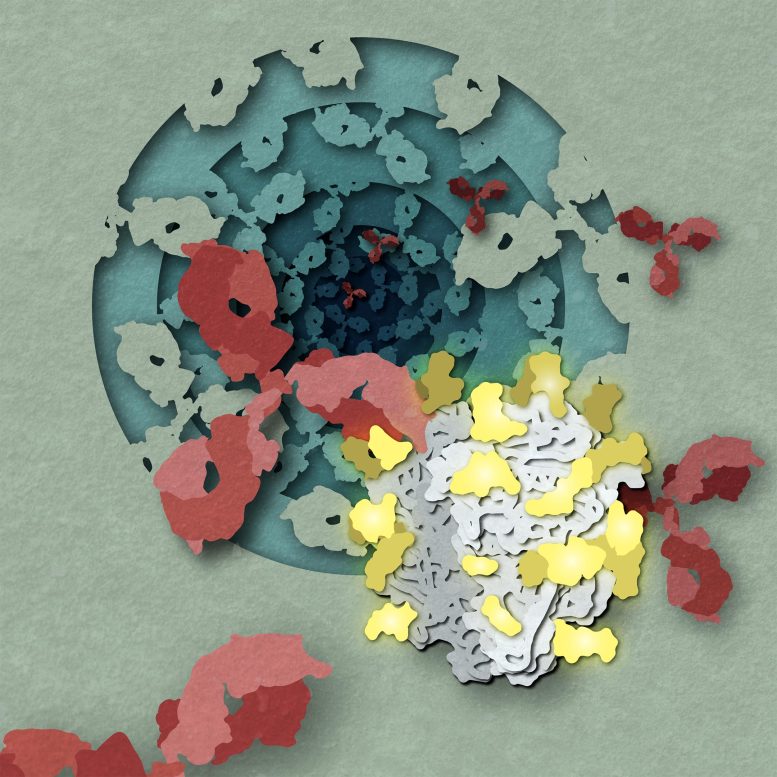
By comparing the structures of protein complexes from different lineages of the dangerous Lassa virus, a Scripps Research team identified new antibodies and vaccine targets.
Every year, hundreds of thousands of people in West Africa become infected with Lassa virus, which can cause Lassa fever and lead to severe illness, long-term side effects or death. There are currently no widely approved treatments or vaccines for the disease. Now, scientists at Scripps Research have determined the structure of the critical protein complex that lets Lassa virus infect human cells. The research, published online in the journal Cell Reports, also identified new antibodies that bind to these proteins and neutralize the virus, paving the way toward more effective vaccines and treatments for Lassa virus.
“This work is a big step forward in our ability to isolate new antibodies to relevant sites of vulnerability on the virus, and it provides a basis to conduct rational vaccine design to broadly protect people against many lineages of the Lassa virus,” says senior author Andrew Ward, PhD, professor of Integrative Structural and Computational Biology at Scripps Research. “These new reagents described in the paper are already being put to good use and yielding exciting new results.”
Like many viruses, Lassa virus exists in a variety of lineages, each with slight variations in its genes. This diversity has made it challenging to pinpoint antibodies that recognize all versions of Lassa virus. Scientists have also struggled to isolate Lassa glycoproteins—the spike-like proteins that surround the virus and are the target of most antibodies. In the infectious virus, these glycoproteins exist in complexes of three, called trimers. For decades, however, scientists were only able to isolate glycoproteins in the lab as single proteins and not in their trimer complexes.
In 2022, Ward and colleagues discovered how to use nanoparticles to hold the glycoproteins together into trimers. In the new work, they used that technique to isolate and structurally characterize trimers of the glycoproteins from four different Lassa virus lineages. Surprisingly, the glycoprotein structures from the distinct lineages were extremely similar.
“We were hoping to see more obvious differences that would explain why antibodies didn’t recognize all the lineages,” says Hailee Perrett, a Scripps Research graduate student and first author of the work. “Instead, we found a very high level of conservation across the peptide and sugar components of the protein.”
Identifying Potent Antibodies Against Lassa Virus
Using the same stable glycoproteins, Ward, Perrett and their colleagues next used blood samples from patients who had recovered from Lassa virus to isolate antibodies against the glycoprotein trimers. They found new antibodies and characterized previously discovered antibodies that recognize different lineages of the Lassa virus glycoprotein, which may be useful in developing a treatment or preventive vaccine against the virus.
The team is already planning future experiments to pinpoint more antibodies against the Lassa virus glycoproteins, as well as further analyzing the protein structures to identify places on the glycoproteins that are ideal for targeting with drugs.
“Our goals were to not only try and define some of the structural details of these different Lassa viruses, but to provide foundational protocols and resources for the field,” says Perrett. “We hope our approaches and initial findings help push the science in this field forward.”
Reference: “Structural conservation of Lassa virus glycoproteins and recognition by neutralizing antibodies” by Hailee R. Perrett, Philip J.M. Brouwer, Jonathan Hurtado, Maddy L. Newby, Lin Liu, Helena Müller-Kräuter, Sarah Müller Aguirre, Judith A. Burger, Joey H. Bouhuijs, Grace Gibson, Terrence Messmer, John S. Schieffelin, Aleksandar Antanasijevic, Geert-Jan Boons, Thomas Strecker, Max Crispin, Rogier W. Sanders, Bryan Briney and Andrew B. Ward, 18 May 2023, Cell Reports.
DOI: 10.1016/j.celrep.2023.112524
In addition to Ward and Perrett, authors of the study, “Structural conservation of Lassa virus glycoproteins and recognition by neutralizing antibodies,” include Philip J.M. Brouwer, Jonathan Hurtado, Grace Gibson, Terrence Messmer, Aleksandar Antanasijević and Bryan Briney of Scripps Research; Maddy L. Newby and Max Crispin of University of Southampton; Lin Liu and Geert-Jan Boons of University of Georgia; Helena Müller-Kräuter, Sarah Müller Aguirre and Thomas Strecker of Philipps-University Marburg; Judith A. Burger, Joey H. Bouhuijs and Rogier W. Sanders of Amsterdam University; and John S. Schieffelin of Tulane University.
This work was supported by a David C. Fairchild Endowed Fellowship, the Achievement Rewards for College Scientists Foundation, the National Institutes of Health (1F31Al172358, R01 AI165692, R01 AI171438), the Netherlands Organisation for Scientific Research, the amfAR Mathilde Krim Fellowship in Biomedical Research (#110182-69-RKVA), a Vici fellowship from the Netherlands Organisation for Scientific Research, the Fondation Dormeur in Vaduz, the Deutsche Forschungsgemeinschaft (197785619/SFB1021), the International AIDS Vaccine Initiative (INV008352/OPP1153692) and the Bill and Melinda Gates Foundation (OPP1170236).
Never miss a breakthrough: Join the SciTechDaily newsletter.
Follow us on Google and Google News.