
Close Menu
    Facebook X (Twitter) Instagram
    SciTechDaily
    • Biology
    • Chemistry
    • Earth
    • Health
    • Physics
    • Science
    • Space
    • Technology
    Facebook X (Twitter) Pinterest YouTube RSS
    SciTechDaily
    Home»Health»From the Abyss: New Virus Discovered in Earth’s Deepest Ocean Trench
    Health

    From the Abyss: New Virus Discovered in Earth’s Deepest Ocean Trench

    By American Society for MicrobiologySeptember 23, 2023No Comments3 Mins Read
    Facebook Twitter Pinterest Telegram LinkedIn WhatsApp Email Reddit
    Share
    Facebook Twitter LinkedIn Pinterest Telegram Email Reddit
    Deep Sea Virus Ocean
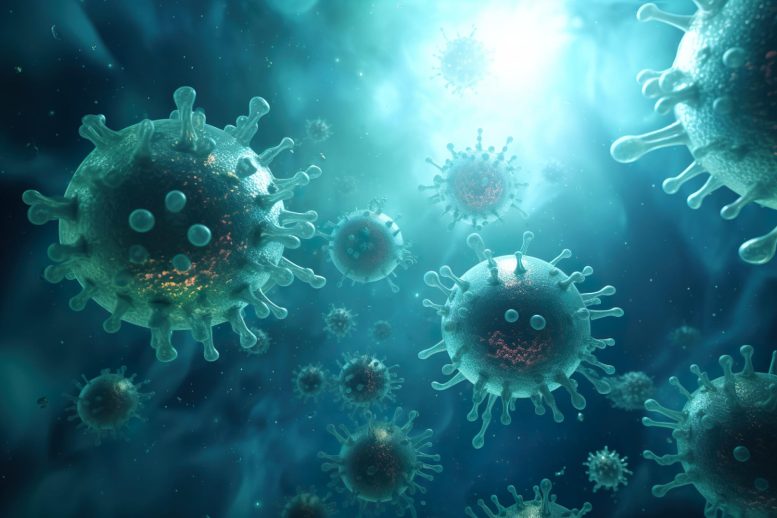
    Researchers discovered a new bacteriophage from the Mariana Trench, specifically from sediments at a depth of 8,900 meters. This discovery points to a previously unknown viral family in the deep ocean and offers insights into the genomic characteristics and evolution of deep-sea viruses.

    A newly discovered deep-sea virus, vB_HmeY_H4907, was found in the Mariana Trench, infecting Halomonas bacteria. 

    The Mariana Trench, the deepest place on Earth, descends almost 11,000 meters (36,000 feet) at its lowest point on the floor of the Pacific Ocean. Even in this profound and chilly abyss, life persists. “wherever there’s life, you can bet there are regulators at work,” said marine virologist Min Wang, Ph.D., at the Ocean University of China, in Qingdao. “Viruses, in this case.”

    In a study recently published in the journal Microbiology Spectrum, Wang and an international group of researchers report the discovery of a new virus isolated from sediment brought up from a depth of 8,900 meters (29,200 feet). The virus is a bacteriophage, or a virus that infects and replicates inside bacteria, and bacteriophages are believed to be the most abundant life forms on the planet. “To our best knowledge, this is the deepest known isolated phage in the global ocean,” said Wang.

    The newly found phage infects bacteria in the phylum Halomonas, which are often found in sediments from the deep seas and from hydrothermal vents, geyser-like openings on the seafloor that release streams of heated water. Wang said the group’s analysis of the viral genetic material points to the existence of a previously unknown viral family in the deep ocean, as well as new insights into the diversity, evolution, and genomic features of deep-sea phages and phage-host interactions.

    In previous work, the researchers have used metagenomic analysis to study viruses that infect bacteria in the order Oceanospirallales, which includes Halomonas. For the new study, Wang’s team looked for viruses in bacterial strains collected and isolated by a team led by marine virologist Yu-Zhong Zhang, Ph.D., also at the Ocean University of China, in Qingdao. Zhang’s research explores microbial life in extreme environments, including polar regions and the Mariana Trench.

    Exploring the Genomic Secrets of Deep-Sea Phages

    The genomic analysis of the new virus, identified as vB_HmeY_H4907, suggests that it is distributed widely in the ocean and has a similar structure to its host. Wang said the study points to new questions and research areas focused on the survival strategies of viruses in harsh, secluded environments—and how they co-evolve with their hosts. The new virus is lysogenic, which means it invades and replicates inside its host, but usually without killing the bacterial cell. As the cell divides, the viral genetic material is also copied and passed on.

    In future studies, Wang said, the group plans to investigate the molecular machinery that drives interactions between deep-sea viruses and their hosts. They’re also searching for other new viruses in extreme places, “which would contribute to broadening our comprehension of the virosphere,” Wang said. “Extreme environments offer optimal prospects for unearthing novel viruses.”

    Reference: “Identification and genomic analysis of temperate Halomonas bacteriophage vB_HmeY_H4907 from the surface sediment of the Mariana Trench at a depth of 8,900 m” by Yue Su, Wenjing Zhang, Yantao Liang, Hongmin Wang, Yundan Liu, Kaiyang Zheng, Ziqi Liu, Hao Yu, Linyi Ren, Hongbing Shao, Yeong Yik Sung, Wen Jye Mok, Li Lian Wong, Yu-Zhong Zhang, Andrew McMinn and Min Wang, 20 September 2023, Microbiology Spectrum.
    DOI: 10.1128/spectrum.01912-23

    Never miss a breakthrough: Join the SciTechDaily newsletter.
    Follow us on Google and Google News.

    American Society for Microbiology Bacteriophage Deep Sea Microbiology Sediment Virus
    Share. Facebook Twitter Pinterest LinkedIn Email Reddit

    Related Articles

    Genetic Testing of Wastewater Can Detect New COVID Variants Before They Are Detected by Local Clinical Sequencing

    New Proof That Measles-Mumps-Rubella (MMR) Vaccine May Protect Against COVID-19

    New Research Shows a Simple Method to Reduce COVID-19 Exposure Risk From Halloween Candy

    MMR Vaccine Could Protect Against the Worst COVID-19 Symptoms – “A Low-Risk-High-Reward Preventive Measure”

    Two Drugs – Already FDA-Approved for Other Illnesses – Show Promise Against COVID-19

    Promising MERS Vaccine Candidate Might Be Able to Block Coronavirus Infections

    Tracking Dangerous Bat Coronaviruses With Next-Generation DNA Sequencing

    Copper Hospital Beds Are Real Killers, but That’s a Good Thing

    Deepest Scientific Marine Samples Ever Collected Show Hints of Life

    Leave A Reply Cancel Reply

    • Facebook
    • Twitter
    • Pinterest
    • YouTube

    Don't Miss a Discovery

    Subscribe for the Latest in Science & Tech!

    Trending News

    Scientists May Have Found the Key to Jupiter and Saturn’s Moon Mystery

    Scientists Uncover Brain Changes That Link Pain to Depression

    Saunas May Do More Than Raise Body Temperature – They Activate Your Immune System

    Exercise in a Pill? Metformin Shows Surprising Effects in Cancer Patients

    Hidden Oceans of Magma Could Be Protecting Alien Life

    New Study Challenges Alzheimer’s Theories: It’s Not Just About Plaques

    Artificial Sweeteners May Harm Future Generations, Study Suggests

    Splashdown! NASA Artemis II Returns From Record-Breaking Moon Mission

    Follow SciTechDaily
    • Facebook
    • Twitter
    • YouTube
    • Pinterest
    • Newsletter
    • RSS
    SciTech News
    • Biology News
    • Chemistry News
    • Earth News
    • Health News
    • Physics News
    • Science News
    • Space News
    • Technology News
    Recent Posts
    • Physicists Discover a Strange New Kind of One-Dimensional Particle
    • Scientists Discover Unexpected Climate Benefit Hidden in Forest Soils
    • The Grand Canyon’s “Swiss Cheese” Rocks Hold a Critical Secret
    • Scientists Discover 430,000-Year-Old Wooden Tools, Rewriting Human History
    • Scientists Make Breakthrough on 40-Year-Old 2D Physics Puzzle
    Copyright © 1998 - 2026 SciTechDaily. All Rights Reserved.
    • Science News
    • About
    • Contact
    • Editorial Board
    • Privacy Policy
    • Terms of Use

    Type above and press Enter to search. Press Esc to cancel.