
Close Menu
    Facebook X (Twitter) Instagram
    SciTechDaily
    • Biology
    • Chemistry
    • Earth
    • Health
    • Physics
    • Science
    • Space
    • Technology
    Facebook X (Twitter) Pinterest YouTube RSS
    SciTechDaily
    Home»Physics»From the Shadows: A New Method for X-Ray Color Imaging
    Physics

    From the Shadows: A New Method for X-Ray Color Imaging

    By University of GöttingenFebruary 12, 2023No Comments3 Mins Read
    Facebook Twitter Pinterest Telegram LinkedIn WhatsApp Email Reddit
    Share
    Facebook Twitter LinkedIn Pinterest Telegram Email Reddit
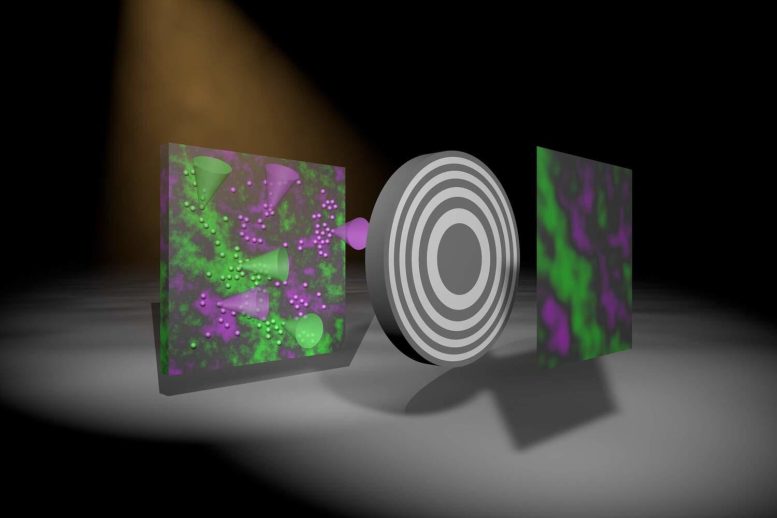
    Artistic Representation Showing How an Image Is Created Using the Newly Developed X Ray Imaging Method
    Artistic representation showing how an image is created using the newly developed method. Two colors – green and magenta – are emitted by fluorescing atoms in the sample (left) due to X-Ray excitation. The grey round object represents an optic casting a shadow on the detector. The algorithm then produces an actual image with two colors – the intensity of which represents the density of the fluorescing atoms within the sample. Credit: Markus Osterhoff

    Researchers at Göttingen University Have Devised a New Technique for X-Ray Color Imaging

    Researchers at the University of Göttingen have created a new approach to generate colored X-ray images. Previously, the only way to determine the chemical composition and arrangement of components in a sample using X-ray fluorescence analysis was to focus X-rays on the entire sample and scan it, which was both time-consuming and costly. The new method allows for the creation of an image of a large area with just one exposure, eliminating the need for focusing and scanning. The findings were published in the journal Optica.

    In contrast to visible light, there are no comparably powerful lenses for “invisible” radiation, such as X-ray, neutron, or gamma radiation. However, these types of radiation are essential, for example, in nuclear medicine and radiology, as well as in industrial testing and material analysis.

    Uses for X-ray fluorescence include analyzing the composition of chemicals in paintings and cultural artifacts to determine authenticity, origin, or production technique, or the analysis of soil samples or plants in environmental protection. The quality and purity of semiconductor components and computer chips can also be checked using X-ray fluorescence analysis.

    For their new method, the scientists used an X-ray color camera developed by PNSensor in Munich and a novel imaging system that essentially consists of a specially structured, gold-coated plate between the object and the detector, which means the sample casts a shadow.

    The intensity pattern measured in the detector provides information about the distribution of the fluorescing atoms in the sample, which can then be decoded using a computer algorithm. This new approach means that the plate can be very close to the object or detector, unlike when using an X-ray lens, which makes this a practical method.

    Decoding X-Ray Patterns with Advanced Algorithms

    “We have developed an algorithm that allows us to quickly and robustly create a sharp image, simultaneously for each X-ray color,” explains first author Dr. Jakob Soltau, a postdoctoral researcher at the Institute for X-ray Physics at the University of Göttingen.

    Co-author Paul Meyer, a doctoral student at the same institute, adds: “The optics simply cannot be compared to normal lenses; they were manufactured according to our precise specifications by a new company in Switzerland.”

    This start-up company, XRNanotech, specializes in nanostructures and was founded by Dr. Florian Döhring who completed his Ph.D. at Göttingen University. Research group leader Professor Tim Salditt concludes: “Next, we want to extend this approach to three-dimensional imaging of biological samples, as well as exploring phenomena in imaging such as inelastic scattering of X-rays, neutrons, or gamma radiation in nuclear medicine.”

    Reference: “Full-field x-ray fluorescence imaging using a Fresnel zone plate coded aperture” by Jakob Soltau, Paul Meyer, Robert Hartmann, Lothar Strüder, Heike Soltau and Tim Salditt, 20 January 2023, Optica.
    DOI: 10.1364/OPTICA.477809

    Never miss a breakthrough: Join the SciTechDaily newsletter.
    Follow us on Google and Google News.

    Imaging University of Göttingen X-ray
    Share. Facebook Twitter Pinterest LinkedIn Email Reddit

    Related Articles

    Laser Precision Unveils Semiconductor Secrets of Single Atoms

    Revealing the Mysterious World of Molecules – Scientists Confirm Decades-Old Theory

    For the First Time Ever, Images of Brain Inflammation Have Been Successfully Captured

    A Surprising Structural Change in Metal Oxide at Low Temperature May Resolve a 60-Year-Old Mystery

    New Quantum Stopwatch With Ultrafast “Time Lens” Can Improve Imaging Technologies

    Build a High-Resolution Microscope From LEGO and Affordable Phone Parts

    Incredible Microscope Sees Atoms at Record Resolution

    Laser Transformation of Crystal Structures in Super Slow Motion

    ‘Whispering Gallery’ Effect Allows Light to Be Stored and Controls Electron Beams

    Leave A Reply Cancel Reply

    • Facebook
    • Twitter
    • Pinterest
    • YouTube

    Don't Miss a Discovery

    Subscribe for the Latest in Science & Tech!

    Trending News

    Mezcal “Worm” in a Bottle Mystery: DNA Testing Reveals a Surprise

    New Research Reveals That Your Morning Coffee Activates an Ancient Longevity Switch

    This Is What Makes You Irresistible to Mosquitoes

    Shockingly Powerful Giant Octopuses Ruled the Seas 100 Million Years Ago

    Scientists Stunned by New Organic Molecules Found on Mars

    Rewriting Dinosaur Evolution: Scientists Unearth Remarkable 150-Million-Year-Old Stegosaur Skull

    Omega-3 Supplements Linked to Cognitive Decline in Surprising New Study

    First-of-Its-Kind Discovery: Homer’s Iliad Found Embedded in a 1,600-Year-Old Egyptian Mummy

    Follow SciTechDaily
    • Facebook
    • Twitter
    • YouTube
    • Pinterest
    • Newsletter
    • RSS
    SciTech News
    • Biology News
    • Chemistry News
    • Earth News
    • Health News
    • Physics News
    • Science News
    • Space News
    • Technology News
    Recent Posts
    • Male Birth Control Breakthrough: Scientists Find Way To Turn Sperm Production Off and Back On
    • A Common Vitamin Could Hold the Key to Treating Fatty Liver Disease
    • New Research Shows Vitamin B12 May Hold the Key to Healthy Aging
    • Scientists Map Thousands of Brain Connections With RNA Barcodes
    • This Gene Tweak Turns Strawberries Into Healthier, Tastier Superfruit
    Copyright © 1998 - 2026 SciTechDaily. All Rights Reserved.
    • Science News
    • About
    • Contact
    • Editorial Board
    • Privacy Policy
    • Terms of Use

    Type above and press Enter to search. Press Esc to cancel.