
Close Menu
    Facebook X (Twitter) Instagram
    SciTechDaily
    • Biology
    • Chemistry
    • Earth
    • Health
    • Physics
    • Science
    • Space
    • Technology
    Facebook X (Twitter) Pinterest YouTube RSS
    SciTechDaily
    Home»Space»Galactic Ballet Captured by State-of-the-Art Dark Energy Camera
    Space

    Galactic Ballet Captured by State-of-the-Art Dark Energy Camera

    By Association of Universities for Research in Astronomy (AURA)May 8, 20225 Comments4 Mins Read
    Facebook Twitter Pinterest Telegram LinkedIn WhatsApp Email Reddit
    Share
    Facebook Twitter LinkedIn Pinterest Telegram Email Reddit
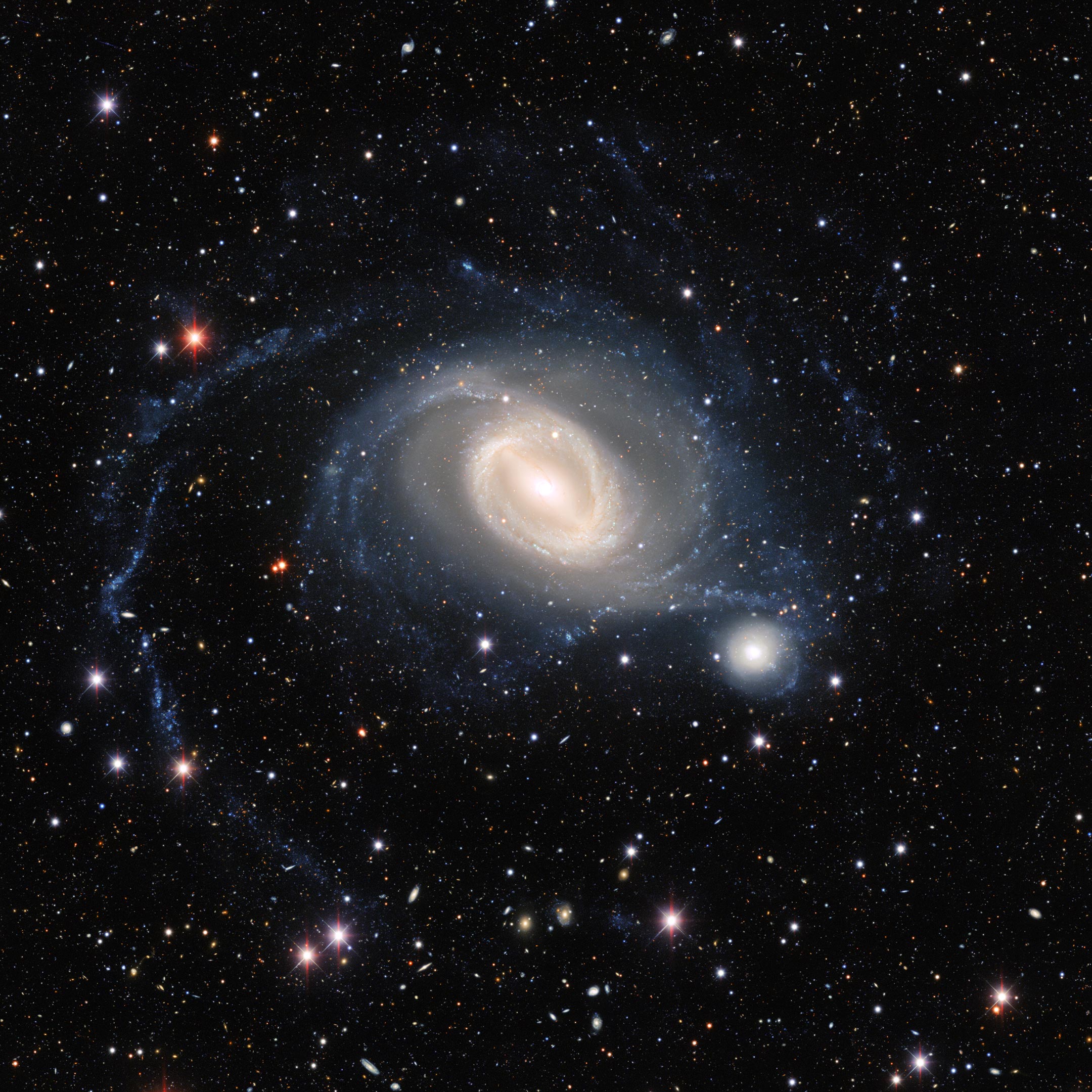
    Galaxy NGC 1512
    The interacting galaxy pair NGC 1512 and NGC 1510 take center stage in this image from the Dark Energy Camera, a state-of-the-art wide-field imager on the Víctor M. Blanco 4-meter Telescope at Cerro Tololo Inter-American Observatory, a Program of NSF’s NOIRLab. NGC 1512 has been in the process of merging with its smaller galactic neighbor for 400 million years, and this drawn-out interaction has ignited waves of star formation and warped both galaxies. Credit: Dark Energy Survey/DOE/FNAL/DECam/CTIO/NOIRLab/NSF/AURA, Image processing: T.A. Rector (University of Alaska Anchorage/NSF’s NOIRLab), J. Miller (Gemini Observatory/NSF’s NOIRLab), M. Zamani & D. de Martin (NSF’s NOIRLab)

    DOE-funded Dark Energy Camera at NSF’s NOIRLab in Chile captures a pair of galaxies performing a gravitational duet.

    The interacting galaxy pair NGC 1512 and NGC 1510 take center stage in this image from the US Department of Energy-fabricated Dark Energy Camera, a state-of-the-art wide-field 570-megapixel imager on the Víctor M. Blanco 4-meter Telescope at Cerro Tololo Inter-American Observatory, a Program of NSF’s NOIRLab. NGC 1512 has been in the process of merging with its smaller galactic neighbor for 400 million years, and this drawn-out interaction has ignited waves of star formation.

    The barred spiral galaxy NGC 1512 (left) and its diminutive neighbor NGC 1510 were captured in this observation (image at the top of the article) from the Víctor M. Blanco 4-meter (13-foot) Telescope. As well as revealing the intricate internal structure of NGC 1512, this image shows the wispy outer tendrils of the galaxy stretching out and appearing to envelop its tiny companion. The starry stream of light that connects the two galaxies is evidence of the gravitational interaction between them — a stately and graceful liaison that has been going on for 400 million years. NGC 1512 and NGC 1510’s gravitational interaction has affected the rate of star formation in both galaxies as well as distorting their shapes. Eventually, NGC 1512 and NGC 1510 will merge into one larger galaxy — a drawn-out example of galactic evolution.
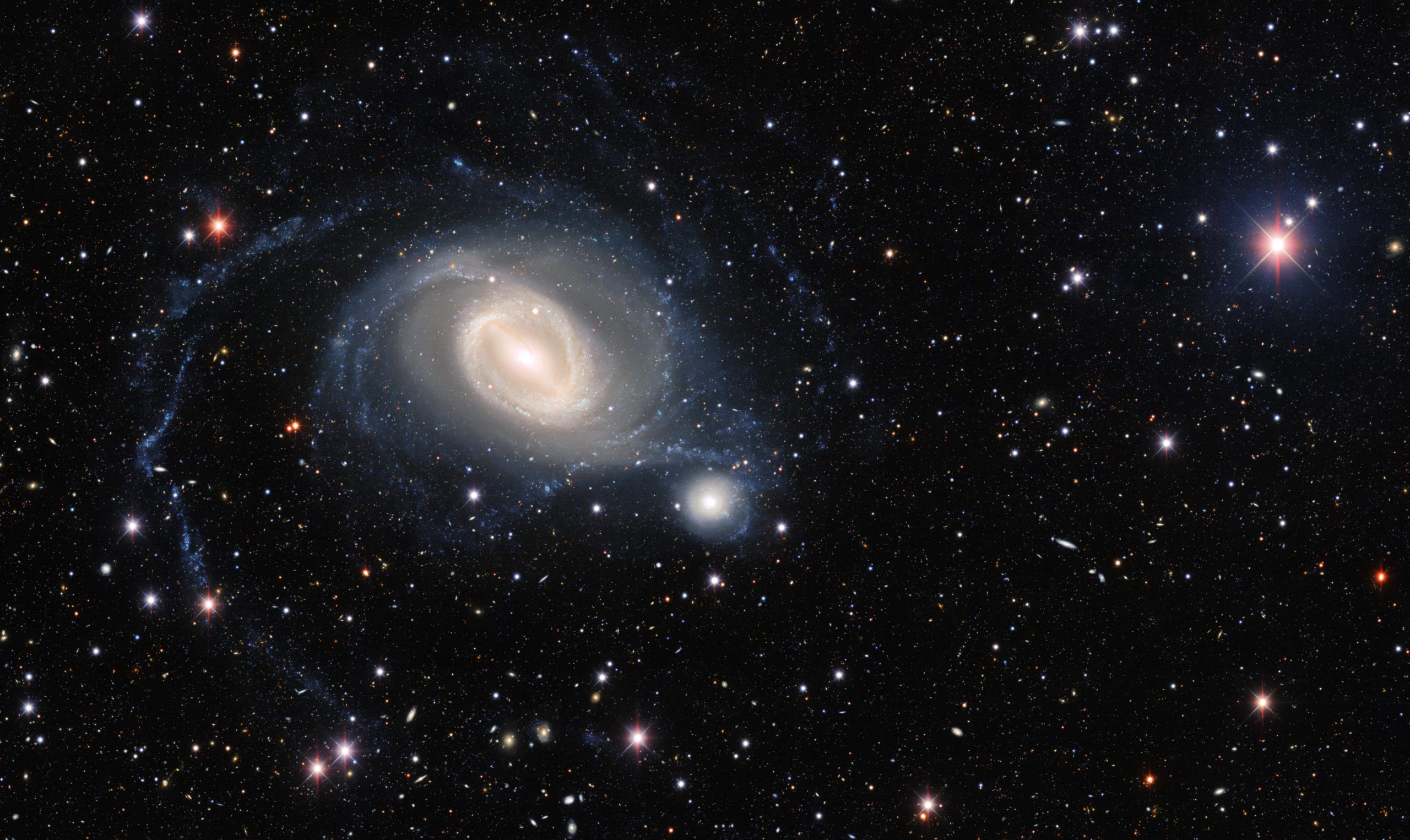
    Galaxy NGC 1512 Wide
    A wider crop of the NGC 1512 image. Credit: Dark Energy Survey/DOE/FNAL/DECam/CTIO/NOIRLab/NSF/AURA, Image processing: T.A. Rector (University of Alaska Anchorage/NSF’s NOIRLab), J. Miller (Gemini Observatory/NSF’s NOIRLab), M. Zamani & D. de Martin (NSF’s NOIRLab)

    These interacting galaxies lie in the direction of the constellation of Horologium in the southern celestial hemisphere and are around 60 million light-years from Earth. The wide field of view of this observation shows not only the intertwined galaxies, but also their star-studded surroundings. The frame is populated with bright foreground stars within the Milky Way and is set against a backdrop of even more distant galaxies.

    The image was taken with one of the highest-performance wide-field imaging instruments in the world, the Dark Energy Camera (DECam). This instrument is perched atop the Víctor M. Blanco 4-meter Telescope and its vantage point allows it to collect starlight reflected by the telescope’s 4-meter-wide (13-foot-wide) mirror, a massive, aluminum-coated, and precisely shaped piece of glass roughly the weight of a semi truck. After passing through the optical innards of DECam — including a corrective lens nearly a meter (3.3 feet) across — starlight is captured by a grid of 62 charge-coupled devices (CCDs). These CCDs are similar to the sensors found in ordinary digital cameras but are far more sensitive, and allow the instrument to create detailed images of faint astronomical objects such as NGC 1512 and NGC 1510.
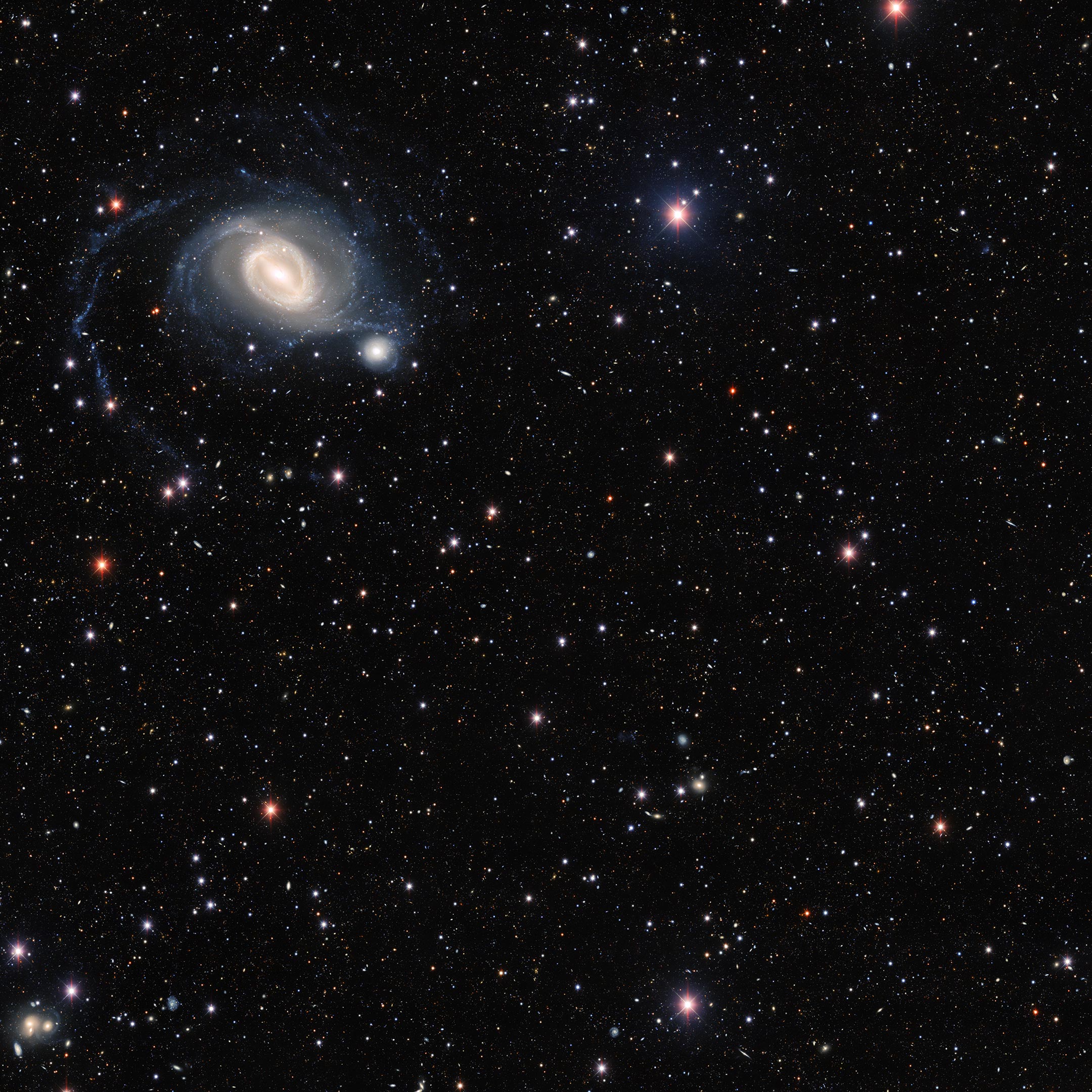
    Galaxy NGC 1512 Wider
    An even wider crop of the NGC 1512 image. Credit: Dark Energy Survey/DOE/FNAL/DECam/CTIO/NOIRLab/NSF/AURA, Image processing: T.A. Rector (University of Alaska Anchorage/NSF’s NOIRLab), J. Miller (Gemini Observatory/NSF’s NOIRLab), M. Zamani & D. de Martin (NSF’s NOIRLab)

    Large astronomical instruments such as DECam are custom-built masterpieces of optical engineering, requiring enormous effort from astronomers, engineers, and technicians before the first images can be captured. Funded by the US Department of Energy (DOE) with contributions from international partners, DECam was built and tested at DOE’s Fermilab, where scientists and engineers built a “telescope simulator” — a replica of the upper segments of the Víctor M. Blanco 4-meter Telescope — that allowed them to thoroughly test DECam before shipping it to Cerro Tololo in Chile.


    DECam was created to conduct the Dark Energy Survey (DES), a six-year observing campaign (from 2013 to 2019) involving over 400 scientists from 25 institutions in seven countries. This international collaborative effort set out to map hundreds of millions of galaxies, detect thousands of supernovae, and discover delicate patterns of cosmic structure — all to provide much-needed details of the mysterious dark energy that is accelerating the expansion of the Universe. Today DECam is still used for programs by scientists from around the world continuing its legacy of cutting-edge science.

    Never miss a breakthrough: Join the SciTechDaily newsletter.
    Follow us on Google and Google News.

    Astronomy Astrophysics AURA Popular
    Share. Facebook Twitter Pinterest LinkedIn Email Reddit

    Related Articles

    The Universe Is Expanding Too Fast and Scientists Can’t Explain Why

    A Sun-Like Star Went Dark for 9 Months – Astronomers Just Found Out Why

    Blast From the Past: Breakthrough in Centuries-Old Effort to Unravel Astronomical Mystery

    Brown Dwarf Discovered by Radio Telescope Observations for the First Time

    A White Dwarf’s Surprise Planetary Companion: First-of-Its-Kind Exoplanet Detected Around Dead Star

    Nearly 100 Cool New Worlds Found in Our Cosmic Backyard With Key Help From Citizen Scientists

    Clever Trick Allows Precision Measurement of Exoplanet – Surprisingly High Density Challenges Planet Formation Theories

    Astronomical Mystery Deepens After Fast Radio Burst Detected From Unknown Source

    Dynamical Footprints in the Andromeda Galaxy Uncovered by Galactic Archaeologists

    5 Comments

    1. Mike on May 8, 2022 3:02 pm

      Dark matter has never been discovered or seen. How can a camera image it?

      Reply
      • Babu G. Ranganathan on May 9, 2022 6:39 am

        The camera was designed to capture dark energy in addition to capturing other regular structures in space. This article is not claiming that the camera captured dark energy.

        Reply
    2. Roger Smith on May 8, 2022 9:19 pm

      Nice image and great science story. Some Astrobin images are quite good too. Not complaining this image, but interesting to compare some amateurs’ images with multi-million dollar equipment.

      Reply
    3. xABBAAA on May 10, 2022 6:27 am

      … a simple argument for a dark matter is>
      let take some air into your mouth, and try to blow the air into your hand… you feel something but you don’t see anything…

      Reply
      • xABBAAA on May 10, 2022 6:28 am

        … So, does this mean there is a dark mater or that there is clear idea what it is, … don’t think so…

        Reply
    Leave A Reply Cancel Reply

    • Facebook
    • Twitter
    • Pinterest
    • YouTube

    Don't Miss a Discovery

    Subscribe for the Latest in Science & Tech!

    Trending News

    Why Popular Diabetes Drugs Like Ozempic Don’t Work for Everyone: The “Genetic Glitch”

    Scientists Stunned After Finding Plant Thought Extinct for 60 Years

    Scientists Discover Tiny New Spider That Hunts Prey 6x Its Size

    Natural Component From Licorice Shows Promise for Treating Inflammatory Bowel Disease

    Scientists Warn: Popular Sweetener Linked to Dangerous Metabolic Effects

    Monster Storms on Jupiter Unleash Lightning Beyond Anything on Earth

    Scientists Create “Liquid Gears” That Spin Without Touching

    The Simple Habit That Could Help Prevent Cancer

    Follow SciTechDaily
    • Facebook
    • Twitter
    • YouTube
    • Pinterest
    • Newsletter
    • RSS
    SciTech News
    • Biology News
    • Chemistry News
    • Earth News
    • Health News
    • Physics News
    • Science News
    • Space News
    • Technology News
    Recent Posts
    • 5 Simple Ways To Remember More and Forget Less
    • This Common Habit Could Signal Serious Health Problems in Later Life
    • Common Food Preservative Linked to Rising Suicide Deaths Among Young People
    • Seeing the Invisible: Scientists Develop New Way To Track Particles in 3D
    • The Atomic Gap That Could Cost the Semiconductor Industry Billions
    Copyright © 1998 - 2026 SciTechDaily. All Rights Reserved.
    • Science News
    • About
    • Contact
    • Editorial Board
    • Privacy Policy
    • Terms of Use

    Type above and press Enter to search. Press Esc to cancel.